Kingfisher

The kingfisher in Yorkshire.
Kingfishers are charismatic, colourful, and instantly recognisable. They are not usually very tolerant of the presence of humans, so they aren't always easy to observe.
Some of the information here comes from David Chandler's RSPB Spotlight on Kingfishers - highly recommended, if you want more depth on the topic.
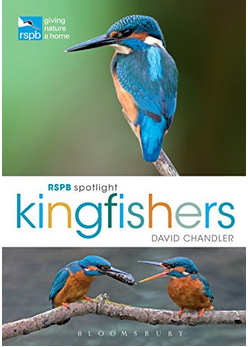
Kingfisher: classification
In Yorkshire, and in Britain and most of Europe, there's only one species of kingfisher, the Common Kingfisher, or Alcedo atthis.
Kingfisher: distribution

Kingfishers are resident in Britain and Ireland all year round, as well as in Spain, France, Germany, Italy, Greece, and the Balkans. Some move further east in Europe in summer, but abandon that territory in winter. There are perhaps 10,000 Common Kingfishers in Britain, 200,000-300,000 in Europe, and 600,000 in the world.
They favour small and medium-sized rivers, with slow-flowing sections, some trees, and banks to make their nests in. They sometimes live by lakes, and in winter, on estuaries and at the coast.
Kingfisher: description & behaviour

Kingfisher, High Batts
Kingfishers are small: only 16-17cm from bill-tip to tail-tip. An adult weighs 34-46g.
They have an orange breast, a white throat and white patch on the neck, and a blue head, back, tail, and wings. The blue on the back and tail is an electric blue, a colour produced by the tips of the feathers there. The structure of the feathers causes blue wavelengths of light to scatter, something called the Tyndall effect.
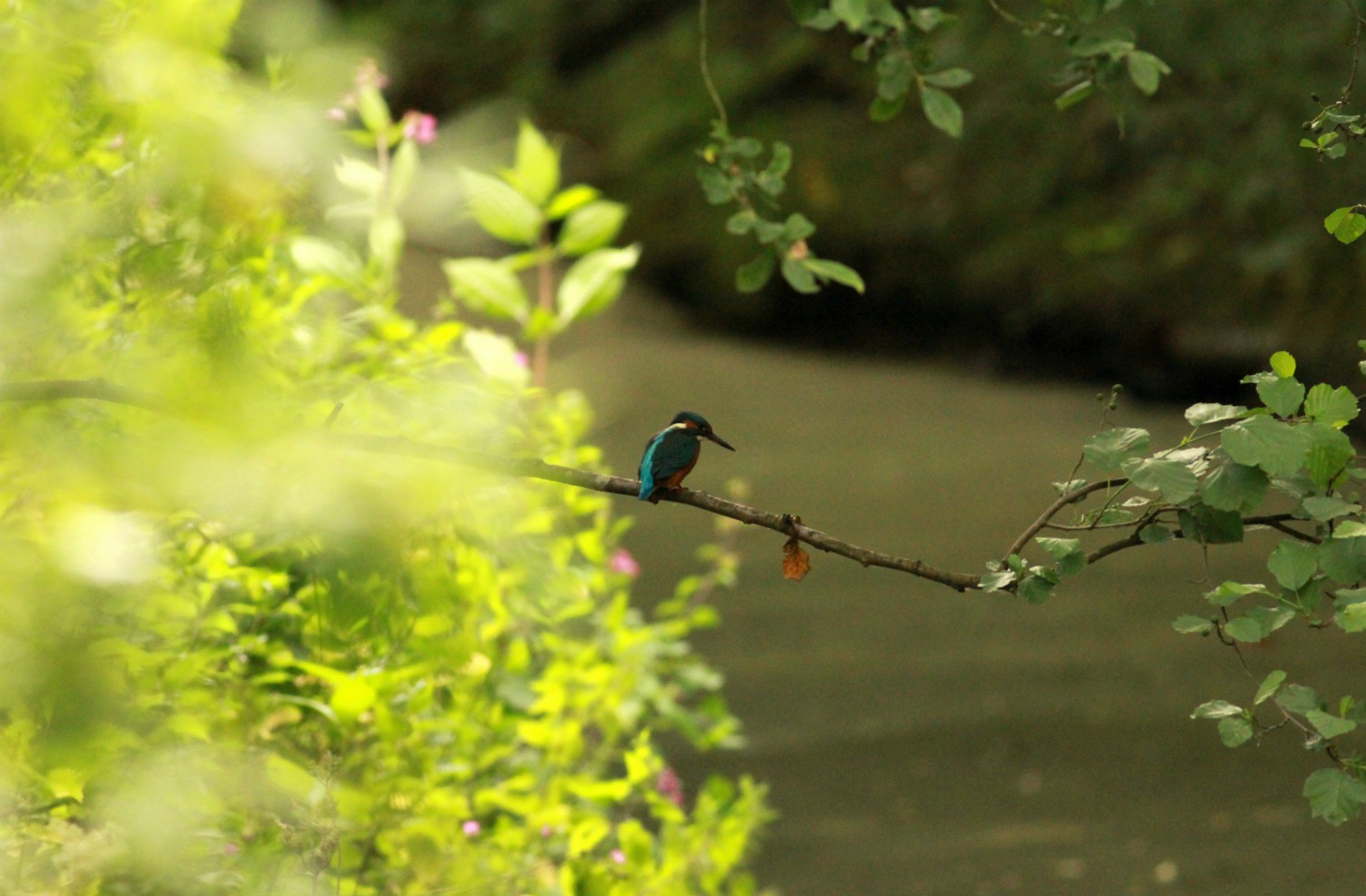
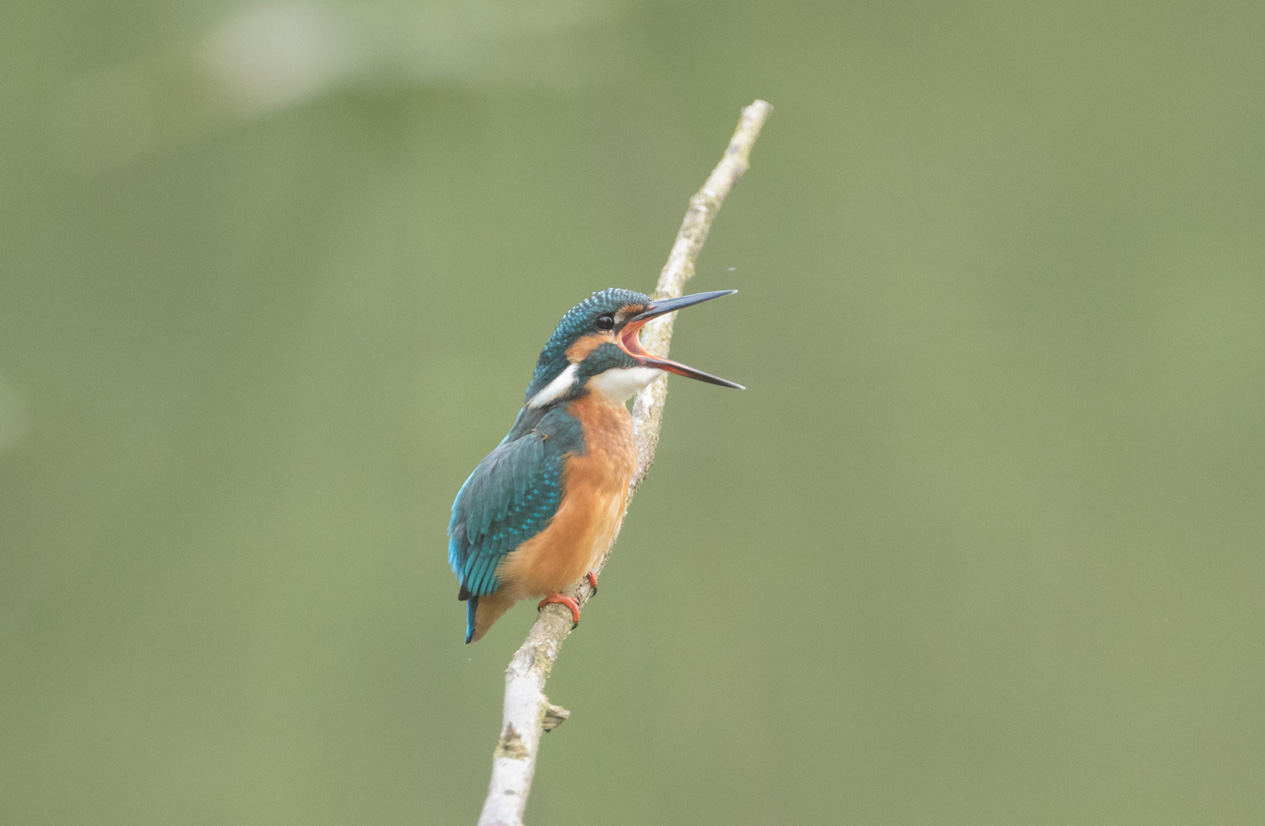
Females and males can be told apart by their bills. Females have a reddish lower mandible (see, for example, the Saltaire kingfisher in the photo below); males have an all-black bill.

A kingfisher has short legs, and an adult's feet and legs are orange.
Kingfishers stand very still on sturdy perches 1-3m above the water, and scan for fish. (They can hover over the water if there is no suitable perch). They prefer slower-flowing water of a fairly shallow depth. They dive into the water to catch fish (up to about 10cm long) in their bills. Favoured prey includes Minnows, Sticklebacks, and Bullheads.
A kingfisher hits its prey several times against something solid to kill it. It manoeuvres the fish so it can be swallowed head first. It will cough up pellets of the undigested parts of the fish, such as the bones.
Males present gifts of fish to females during courtship, in February or March.
Kingfishers like sandy banks, ideally vertical, for their nests. They excavate a tunnel about a metre long, leading to a nest chamber. The female lays six to seven eggs, and there are generally two broods per year, but there can be three. The first brood of eggs is laid in April, the second in July, and sometimes a third in September or October.
Some predators may raid kingfisher nests, including rats and mink.
The parents take turns incubating. The hatched chicks are fed fish by the adults, and fledge after 23-27 days. They may be fed for a short time (about 4 days) after leaving the nest, but then they move away.

Juveniles have black feet and legs for the first 10 weeks or so. The colour of the feathers is more muted than that of adults (see photo above), and they have a white tip to their otherwise black bill.
Both female and male juveniles develop pinkish blobs on the lower mandible. In the female, the lower mandible gets pinker over the winter, but in the male, the pink colour disappears. (This may cast doubt on my diagnosis of the Saltaire kingfisher as a female).
Around 20% of fledglings survive the first year. Typical life expectancy is 2 years, but one Belgian kingfisher lived to 21.
Where to see a kingfisher in Yorkshire

This is by no means an exhaustive list, but I've seen kingfishers at these place in Yorkshire:
- Howsham Mill
- Roberts Park, Saltaire
- the Nidd Gorge west of Knaresborough
- RSPB Fairburn Ings
- High Batts private nature reserve
David Chandler says that good times to see kingfishers include:
- early morning
- February and March during courtship, when they are more conspicuous
- autumn, when youngsters are being driven off
The kingfisher is protected under Schedule 1 of the Wildlife and Countryside Act. This means that it is an offence to disturb them when they are at or near their nest, or to disturb dependent young.
All images ©HedgehogCycling