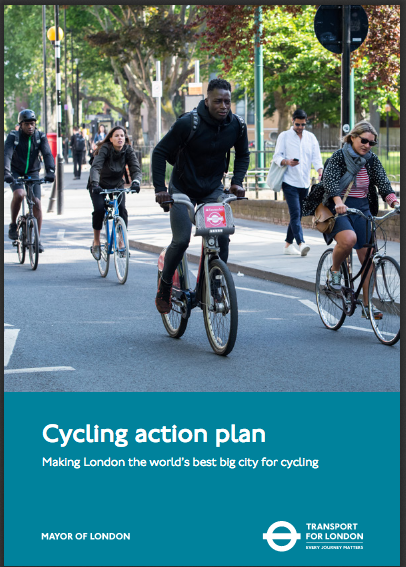
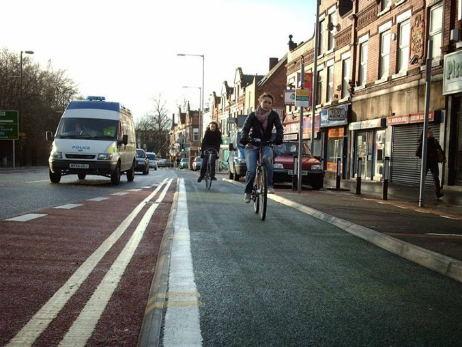
TfL and Mayor of London Sadiq Khan today published a Cycling
Action Plan, subtitled 'Making London the world's best big
city for cycling'.
Is it a plan that will result in real improvements in conditions
for cycling in London, or just more warm words from the Mayor
without action to back them up?
Gilligan says Mayor's claim to have built 140km of cycle routes
are false
Gilligan says that the Mayor is trying to claim credit for an
'entire fake cycle network'. The former Commissioner has been out
to ride the routes Khan says he has built, and found that they are
existing cycle routes with no new work done on them. 'In a few
places, I found, new Quietway signs have indeed been painted on
the road...The last thing many of these routes are is quiet.'
26km of the claimed routes are decades-old cycle paths, with new
Quietway signs on them. A further 30km comes from re-branding
unsegregated routes on busy streets. On much of the rest of the
'new' routes claimed by the Mayor, Gilligan found no trace of any
work at all.
'The mileage of meaningful new route proposed and built by the
Mayor remains at nil...'
London Cycling Action Plan: Will Norman's foreword
London's Walking and Cycling Commissioner Will Norman wrote a
foreword to the Plan. It says:
For too long we've heard that people cycle more in
countries such as Denmark and the Netherlands because it's part of
their culture, or because it's flat, or because the cities there are
compact. But none of those are the reason why cycling is more
popular in these places. In truth, these cities see more cycling
because their streets prioritise people, not cars.
Norman's foreword accepts that London's streets are too hostile for
most people to consider cycling. He promises 'a pipeline of new
cycle routes stretching into the future', and new quality criteria.
London Cycling Action Plan: the plan
London
Cycling Action Plan
The document says in Chapter 1 that without a big increase in
cycling, it won't be possible to address London's congestion and air
quality issues. It notes that by 2041, there will be an estimated 6
million more journeys made every day.
Chapter 2 is about the authors' 'vision' for cycling in London. It
is that everyone who wants to cycle for their journeys in London
will be able to do so confidently and comfortably.
In Chapter 3, TfL and the Mayor tell us what they have learned
about cycling from 'customer research'. It includes the fact that
'where we have invested in new and upgraded infrastructure, cycling
growth has been extremely strong.' An example is the protected cycle
lane on Blackfriars Road, which resulted in a 127% increase in
cycling. Cycling is concentrated in central and inner London, and
white men are most likely to cycle.
Fear of collisions is the biggest factor putting people off
cycling.
Chapter 4 sets an ambition to double the number of cycle trips made
in London in 2017, by 2024, and to expand the cycle network.
Chapter 5 concerns 'streets that enable cycling', and refers to
updated design guidance and new quality standards for cycling
infrastructure. It says that 450km of new routes are planned by
2024, tripling 'the reach of the network'.
The network is to be re-branded, with a single identity instead of
Cycle Superhighways and Quietways. The details will be revealed
early in 2019.
The 'pipeline' of 25 cycle schemes is being worked on with the
London Boroughs. Five consultations are to take place in 2019,
including Camden and Tottenham Hale, and Hackney and the Isle of
Dogs.
London Cycling Design Standards (LCDS) were published in 2015, and
will be updated in 2019. The new LDCS will include quality criteria.
Those criteria concern the speed and total volume of motor traffic
cyclists can be expected to mix with on a cycle route, width of
cycle lanes, minimising disruption to cycle routes from parking and
loading (kerbside activity), minimising interaction with HGVs, and
reducing risk of left hooks.
The plan's authors hope to stimulate the private sector to launch
digital cycle maps and other wayfinding tools. TfL's Cycling
Infrastructure Database will be made available to everyone free of
charge, so it can be integrated in journey planning services.
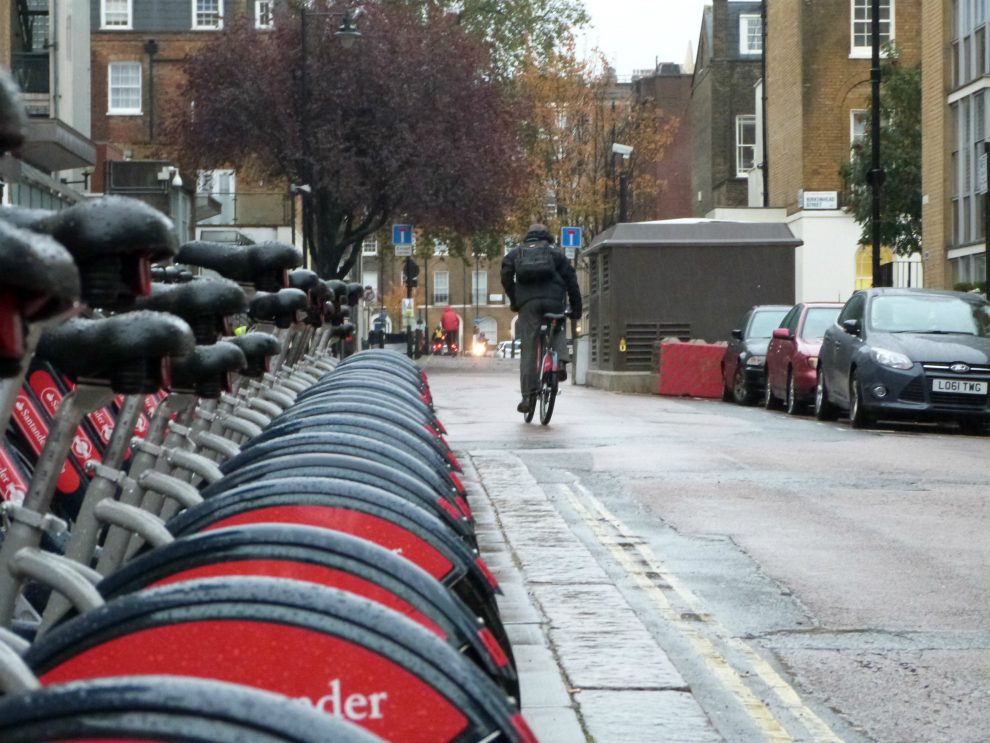
The next generation of Santander bikes, currently being rolled out,
are British made.
Sadiq Khan was elected Mayor of London in May 2016, having made
promised to be pro-cycling, and to triple protected infrastructure.
It's now two and a half years later, and his term has been
characterised by loss of momentum on cycling. He has appeared to be
so desperate not to upset anyone, that he has ended up doing little
or nothing.
The positive talk in this plan is welcome - better a Mayor who says
he wants to do something for cycling than one who says he doesn't.
But as Andrew Gilligan has commented in the past, what matters is
deeds not words.
There's not much sign of deeds in this plan. It recognises the
obstacles to cycling, and how to remove them, but if it isn't backed
up with action, it's just waffle that doesn't get us anywhere.
It has come to the point where we don't need any more glossy
documents with nice pictures of people on bikes. Mayor Khan, please
just get on with it.
An alliance of health professionals has launched a report,
calling for a new Clean Air Act to reduce air pollution and the
damage it causes to our health.
A Transport Strategy for the City of London aims to reduce
traffic, prioritise walking, make cycling pleasant, improve air
quality, reduce noise, and apply a Square Mile-wide 15mph speed
limit.