European attitudes to cycling and urban mobility
7th March 2014
A survey has been carried out for the European Commission Directorate-General from Mobility and Transport. It measures the attitudes of Europeans to urban mobility, including cycling. The survey was carried out in May and June 2013, and was published around December 2013.
The introduction to the report notes that congestion in urban areas costs nearly €100bn, or 1% or the EU's GDP. Air and noise pollution is also a problem, and it is the EU's goal to phase out conventionally-fuelled cars in urban areas by 2050.
European attitudes to cycling & urban mobility: transport habits
In Europe as a whole, the percentage of people who, at least once a day:
- walk, is 68%
- use a car is 50%
- use public transport is 16%
- cycle is 12%, and
- ride a motorbike is 3%
The UK is exactly at the European average in terms of people who use a car every day, at 50%. However, the percentage of people cycling every day is well below average in the UK, at just 4%. Only Cyprus and Malta have a lower percentage cycling every day (at 2% and 1% respectively). The Netherlands has the highest percentage cycling every day (43%), and Denmark is second (30%). This graph shows the percentages:
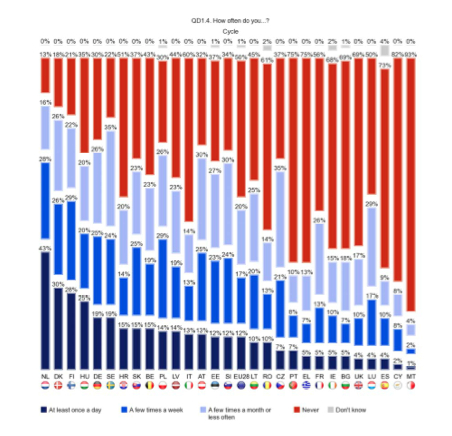
Perhaps the most shocking statistic shown by the graph is that 69% of people in the UK never cycle.
European attitudes to cycling and urban mobility: analysis of cycling figures
Those least likely to say they never cycle are managers and students. The most likely to say they never cycle are the retired, homemakers, and the unemployed.
People who never have difficulty paying bills are twice as likely to cycle a few times a week as those who have difficulty paying bills most of the time.
European attitudes to cycling and urban mobility: importance of transport problems within cities
81% of Europeans believe air pollution is an important problem. The figures for congestion, travel costs, accidents, and noise pollution are all between 70% and 80%. The UK is about in the middle, compared with other European countries.
Specifically in relation to road congestion, 85% of respondents in the UK rated it as important, behind only Malta and Greece. The report suggests a correlation between views on congestion and cycling rates. It states (p29), 'Respondents' views on road congestion might be related to the proportion of respondents who regularly cycle in different member states. It is possible that this relationship exists because Europeans feel safer cycling in areas where road congestion is not severe.'
European attitudes to cycling and urban mobility: measures to improve travel in cities
Europeans were asked for their views on how to improve travel in cities. The most popular options were lower prices for public transport (59%) and better public transport (56%). Improved cycling facilities came third (33%). Other options included car sharing (25%) and road charges (9%).
Looking at individual countries, the report suggests that respondents favour improving the mode of transport that they currently use. Views in the UK are line with those in Europe overall. 68% and 66% of respondents agreed with lower prices and better public transport. 32% are in favour of better cycle facilities. 10% in the UK are in favour of road tolls.
European attitudes to cycling and urban mobility: expectations for the future
Asked if the urban traffic situation will improve in the future, 24% of Europeans believe it will, 35% think it will stay the same, and 37% say it will get worse. Respondents in the UK are more pessimistic than the average European, and the most pessismistic of any European country: 61% believe the situation will get worse.