HedgehogCycling.co.uk
Yorkshire cycling website
London Mayor's cycling report
25th March 2016
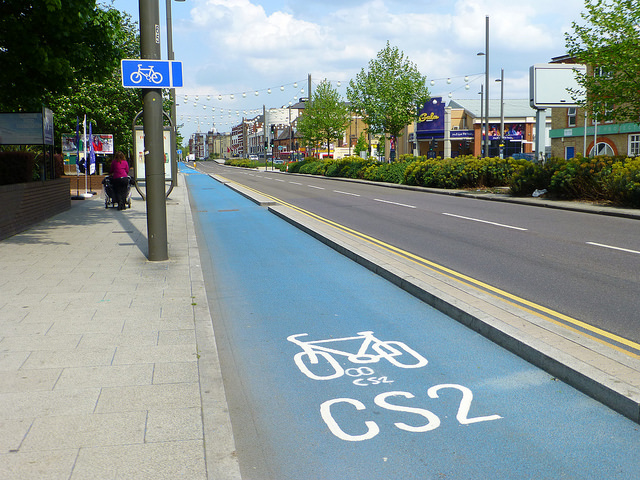
CycleSuperhighway2-Stratford-London,
by Simon
Smiler,
Flickr, CC0
1.0 Public Domain Dedication
Boris Johnson, Andrew Gilligan, and the GLA have produced a report on cycling in London, titled 'Human Streets: the Mayor's Vision for Cycling Three Years On.' It charts progress in the three years since Johnson announced his vision for cycling in London, and sets out suggested priorities for the future.
Boris Johnson's foreword
In his foreword, Mr Johnson writes that it is three years since he unveiled his vision for cycling. 'My biggest regret as Mayor is that I did not do it sooner.' He regrets starting with painted cycle lanes, and wishes he had gone for segregated lanes from the beginning.
The outgoing Mayor says there has been a lot of opposition to the Cycle Superhighways, and refers to Nigel Lawson's hyperbolic and irrational comments in a House of Lords debate. (Lawson said that the cycleways were 'doing more damage to London than almost anything since the Blitz.') But, according to Mr Johnson, the Superhighways and mini-Hollands are succeeding in increasing the numbers of people who cycle, and reshaping 'car-dominated town centres into places that work for the majority who do not drive.'
Johnson says that cycling benefits everyone, even non-cyclists. '...if more people cycle, everyone else benefits too, even if they have no intention of getting into the saddle. Everyone who gets on a bike is freeing up space for someone else on the bus, or the train, or indeed in a car. Everyone who cycles is improving not just their own health but other people's health, because bikes do not cause pollution.'
In his remarks, he points out that the main cause of congestion is not building cycle lanes, but the fact that London's population is increasing by 10,000 people a month. It's therefore important to make better use of the roads. One way of doing this is to increase cycling, because bikes take up much less space than cars. He says that in public consultations and opinion polls, a clear majority support the cycling programme. This is not surprising, as 71% of Londoners never drive in London at all, and they would like the centre of the city to be better for people like them, and less dominated by motor vehicles. Finally, he says that the next Mayor will have to reduce central London traffic, probably by changes to the congestion charge.
Andrew Gilligan's foreword
In his foreword, Andrew Gilligan begins by writing about Orford Road, Walthamstow Village, one of the first places to benefit from funds from the Mayor's cycling vision. He describes how on 14th September 2015, '...the council gave that street back to the majority of the people who use it and turned it into somewhere they can sit down and have a drink, somewhere they can walk or cycle without being run down by a car.'
Mr Gilligan says that cycling schemes are popular. 'Everyone supports cycling - until it involves doing anything meaningful. Meaningful cycling schemes almost always have clear majority support, but seldom unanimous support. They will usually inconvenience or upset somebody. So for years in this country, we did half-hearted cycling schemes that upset nobody but also, bluntly, helped nobody and changed nothing.' The approach now in London is to do serious, meaningful schemes, but it requires political courage.
According to Gilligan, the Superhighways and junction improvements have gone 'outstandingly well,' but some of the borough-led schemes (essentially, the Quietways) have seen slower progress.
Andrew Gilligan talks about opposition to the cycle schemes. 'Much of the opposition to cycle schemes is based on a belief that motor traffic is like rainwater and the roads are the drains for it. If you narrow the pipe, these people say, it will flood. If you block one route, they say, the same amount of traffic will simply flow down the next easiest route. But that seldom or never actually happens in practice. Because traffic isn't a force of nature. It's a product of human choices. Our surveys tell us that huge numbers of Londoners will choose to cycle if they feel safe doing so. If we open up that choice, even more people will take it.'
A Cycling City
The first section of the report itself is called 'A Cycling City'. It gives some statistics about cycling. On TfL-controlled main roads, it rose 63% in the first six years of Boris Johnson's Mayoral term (to 2014). In 2000, in the morning rush hour, there were 11 cars for every bike. In 2014, the ratio was 2 cars for every bike. If the trend continues, there'll be more people cycling into central London than driving in three years' time.
The report also says that cycling in London has become more diverse, with more black and minority ethnic bike riders - although women are still under-represented. Cycling has become much safer, according to the casualty data. These trends will accelerate now that the first main infrastructure projects have opened.
This section of the report deals with the popularity of cycling schemes, and opposition from a vocal minority. The E-W and N-S Superhighways received 84% support in the consultation. The mini-Holland scheme in Palmer's Green, Enfield, secured 60% support in the consultation. Only 3% of Londoners drive a car or van in central London every day, and only 7% once a week or more.
A record of Achievement
This section sets out what has been achieved so far.
The budget for cycling in 2015/16 is £145 million, or £18 per head (about the same as in Germany, and not far short of the Netherlands).
Cycle Superhighways have been built and upgraded, including the E-W Superhighway (Europe's longest substantially segregated urban cycle route), and the N-S Superhighway. Dangerous junctions are being fixed.
£90 million has been awarded for mini-Hollands in Waltham Forest, Enfield, and Kingston. There has also been some progress on safer lorries, with the Safer Lorry Scheme, and on the London Quietway network. The cycle hire scheme has been expanded to new areas of London, there's a bigger sponsorship deal (with Santander), and usage is up. The report also makes mention of Operation Safeway, and cycle training schemes.
Priorities for the Future
There are many suggestions for the future. Cycling currently accounts for 4% of TfL's capital spending, and the next Mayor should maintain or increase it.
The Quietways programme has been difficult and slow, and the report suggests more TfL control and involvement in these schemes, still in partnership with the boroughs. It also says that only schemes of an acceptable quality should be funded, rather than wasting money on poor routes.
There should be more Superhighways, but they do not necessarily need to be segregated in the same way as those currently being built, with stone and granite. Stepped tracks could be used (the cycle route at an intermediate level between the road the pavement), as could armadillos, planters, or parked cars.
The report mentions an electric bike hire scheme being developed in Crouch Hill and Muswell Hill.
Lizzie Armitstead to ride Tour de Yorkshire 2016
23rd March 2016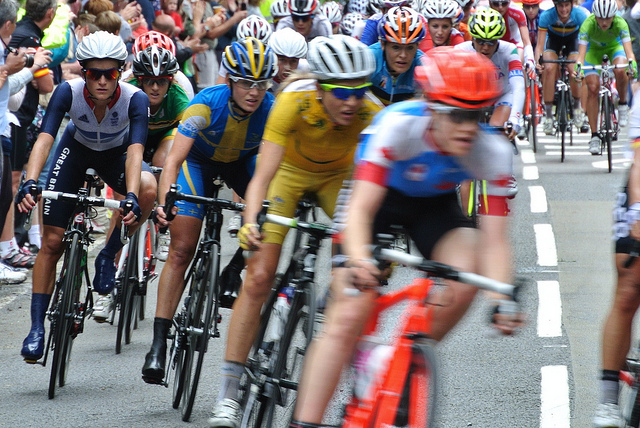
Lizzie Armitstead will ride the women's Tour de Yorkshire 2016,
which is the same route as the men's stage 2. It's to be the most
lucrative race on the women's caldendar. Read more about Armitstead to ride the Tour de Yorkshire 2016...
Geraint Thomas wins Paris Nice
14th March 2016

Geraint Thomas held off an attack by Alberto Contador on the final stage of Paris Nice, to take overall victory. Read more about Geraint Thomas wins Paris Nice...


© 2016 ValThorensGuide
Template
design by Andreas
Viklund