Hedgehog Cycling tested out this route on 13th November 2013,
starting west of the Leeds Road, and using South Drive, St James
Drive, the path across the Stray, then Oatlands Drive, Hookstone
Drive, and Hookstone Chase. The comments below are only on the route
from Oatlands Drive on.
I made a trip to Homebase on Plumpton Park. The roads on this
route are often congested, so I decided not to add to the traffic,
and try riding there. It was a 53 minute round trip, including about
15 minutes spent in Homebase - probably not that much different to
the time you'd take if driving.
(Note: more recently, the Yorkshire Showground
Greenway has opened, and that's the route I would choose to go from
Leeds Road to Plumpton Park).

There are cycle lanes on this route, but are they any good? The
short answer is no, but a longer answer follows.
Oatlands Drive & Hookstone Drive
The cycle lanes on Oatlands Drive and Hookstone Drive are advisory
cycle lanes (bounded by a dotted white line) rather than mandatory
cycle lanes (which would be bounded by a solid white line). Advisory
cycle lanes mean that other traffic should not enter unless it is
safe to so.
I have mixed feelings about the value of these lanes. On the
one hand, they mean that the existence of cyclists is recognised. On
the other hand, there is a risk that drivers think that as long as
they're not actually in the cycle lane, they can pass a cyclists as
close as they like, rather than following the general rule in the
Highway Code (rules 163 & 211-215). This happened to me on
Oatlands Drive on my ride.
The recent succession of tragic deaths in London, where four
cyclists have been killed in 8 days (see this
report
in the Guardian on 14th November 2013; this became five
cyclists
in 9 days), shows the limitations of cycle lanes created only
by paint on the road. As part of the response, the London mayor says
he will increase the number of protected cycle lanes - cycle lanes
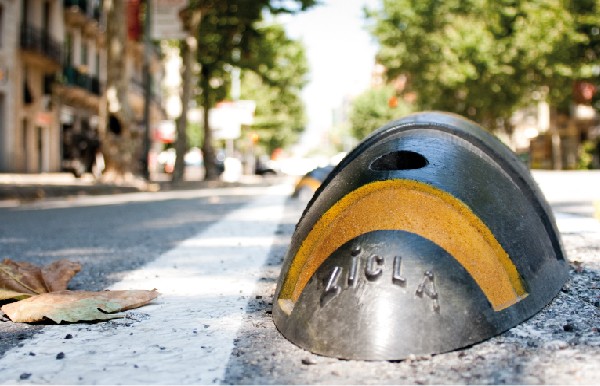
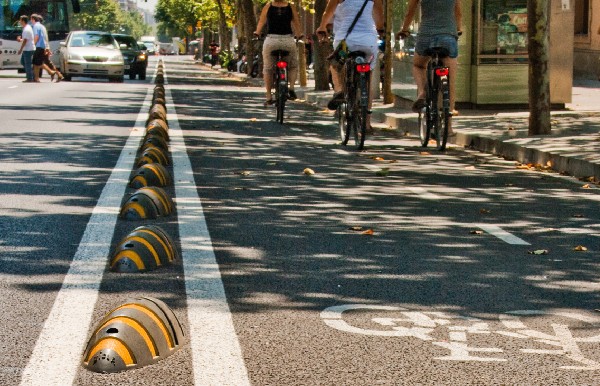
separated from traffic by strips of pavement, or other barriers. (An example is the 'armadillo' manufactured
by Zicla).
This
is
what is really needed to make the cycle lanes on Oatlands Drive and
Hookstone Drive safe.
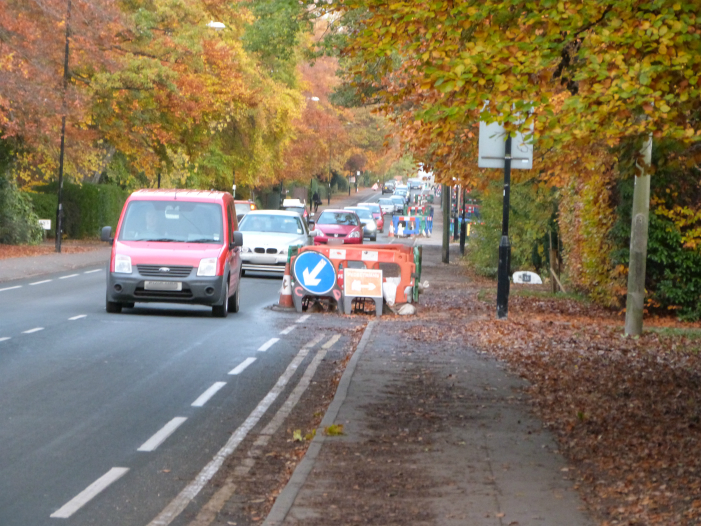
The cycle lane on Hookstone Drive had decaying leaves and gravel in
it, when I rode it. The government's Cycle
Infrastructure Design document recognises this as a problem,
and says (p51), 'Regular sweeping is required to keep cycle tracks,
lanes and bypasses clear of accumulated debris...' I suggest this is
not happening (enough) on Hookstone Drive.
Also on p51 of Cycle Infrastructure Design, is a paragraph on road
works: 'Works affecting cycle routes should be co-ordinated to
minimise inconvenience to the same degree as those in the
carriageway.' On 13th November 2013, there were several sets of
works blocking the cycle lane along Hookstone Drive, which have been
there for some time. (It may be that cyclists were considered
in planning the works, and it was decided that there was no
alternative to the current arrangements. Nevertheless, because of
these works, at the moment there is little or no benefit from the
cycle lane). These are some of the obstacles:

Whilst I don't use this route regularly, I'm told that the cycle
lanes are frequently blocked by traffic stuck in congestion at a
standstill in the cycle lane, during the rush hour periods.
There's also an issue with pedestrian refuges along Hookstone
Drive. The carriageway narrows where there are pedestrian refuges,
so this is where a 'squeeze' comes, ie where cyclists need
protection most. What happens to the cycle lane? It just stops, then
starts again after the refuge, each time. There has to be a better
solution.
Cycle Infrastructure Design states (p30): '[R]efuges and islands in
particular can create hazardous pinch points for cyclists. If they
are introduced and it is not possible to provide a cycle bypass, the
width available should either be sufficient to allow vehicles to
overtake cyclists safely, or narrow enough to discourage overtaking
altogether.' I wouldn't necessarily agree with the second part of
this, because of the risk that some drivers will try to overtake
anyway, even if the road is made too narrow for comfortable
overtaking. Perhaps the council could consider cycle bypasses of the
refuges? In my opinion, the current situation, where the cycle lane
just stops, is the worst option.
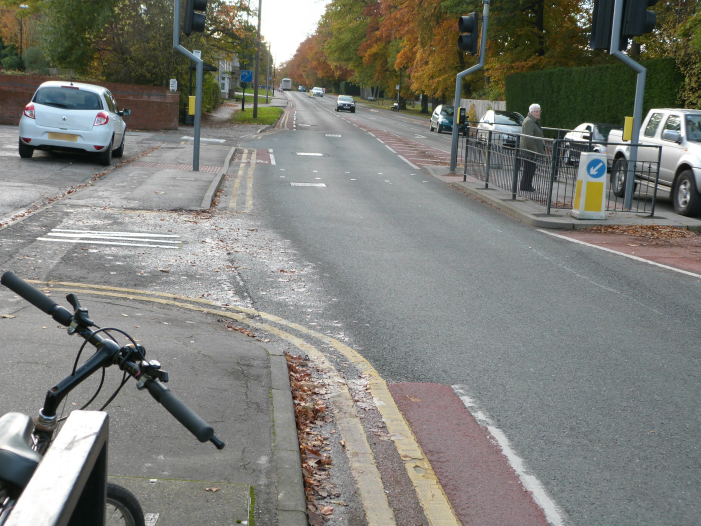

As an example of the problem this can create for cyclists, on my
ride along Hookstone Drive, a big construction truck came past too
fast and too close, racing to get ahead before the next pedestrian
refuge.
Hookstone Chase
After the junction with the Wetherby Road, heading down towards
Plumpton Park, there is a very short section of cycle lane, which
stops just before the squeeze of the next pedestrian refuge (see
photo above right). This bit wins my vote for Worst Cycle
Infrastructure Design in Harrogate. My experience is that cars are
just building up speed after the junction, and are ready to overtake
at precisely the point that the carriageway begins to narrow. They
either squeeze past, or brake and wait. Either way, it's
uncomfortable for the cyclist.

After that point, it's downhill to Plumpton Park, so my experience
is that I can keep up with the traffic, and it feels relatively
safe.
There is cycle parking at Plumpton Park - HedgehogCycling's was the
only bike there on 13th November 2013!
The return trip up Hookstone Chase is awkward. It's fairly steeply
uphill, so cyclists go slowly. The road is narrow, and vehicles have
to slow down and wait to overtake when there's oncoming traffic, or
pass too close. This section would benefit from a separate cycle
lane - separated from the road (see the comments under Oatlands
Drive/Hookstone Drive above), but part of the traffic (ie not giving
way at every side road, otherwise it won't be used).
Oatlands Drive/Hookstone Drive/
Hookstone Chase: suggestions for improvements
To summarise, my suggestions for these routes are:
1) Separate the cycle lanes on Oatlands Drive and Hookstone Drive
from the traffic. Do not make them give way at each side road or
driveway.
2) Sweep these cycle lanes to remove leaves and gravel.
3)Try not to block the cycle lanes with roadworks, or keep the
obstructions to a minimum.
4) Avoid blocking the cycle lanes with stationary traffic during
peak times, by making them separate (see 1) above).
5) Change the current design, where the cycle lanes just stop where
they are most needed, at pinch points. Consider pedestrian refuge
bypasses for cyclists.
6) Change the road design at the top of Hookstone Chase, going
towards Plumpton Park, perhaps with a proper cycle lane (separate if
possible) to the pedestrian refuge, and a cyclist bypass for the
refuge.
7) Build a proper, separate cycle lane, going uphill on Hookstone
Chase towards the Wetherby Road. Do not make it give way to side
roads and driveways.
These are the problems I've identified, based on my own experience
of cycling these routes, and my suggested solutions. I'm not a
professional road and cycle lane designer. These are my suggestions,
but I'm very much open to other ideas. If the councils decide to
improve the cycle infrastructure here, I would suggest consulting
with British Cycling, who know the best practice, and engage with
the national government on cycling infrastructure design issues.
Do you have any more comments or suggestions?