Cycling in Yorkshire

Cycling in Yorkshire
10th August 2021

The IPCC published the first of a series of documents yesterday, as part of the Sixth Assessment Report on Climate Change. Yesterday's report was by Working Group I, and concerns the physical science basis of climate change. Key findings are presented in the Summary for Policymakers.
The Introduction explains the nature of the document.
'This Summary for Policymakers provides a high-level summary of the understanding of the current state of the climate, including how it is changing and the role of human influence, the state of knowledge about possible climate futures, climate information relevant to regions and sectors, and limiting human-induced climate change.'
Introduction, Summary for Policymakers
These are some of the points made about the current state of the climate:
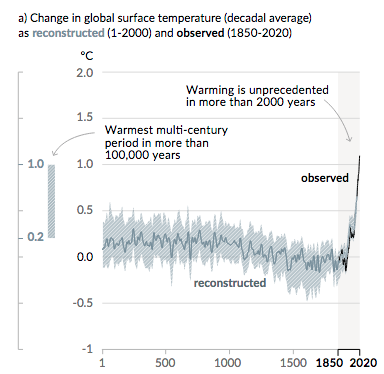
This graph shows the way temperatures have shot up recently, driven by human activities.
These are some further points about the current state of the climate:
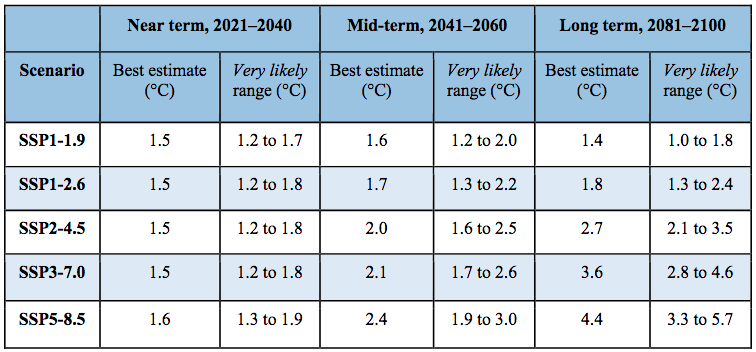
The report uses five illustrative scenarios to show climate futures in the near-, mid- and long-term. Temperatures will continue to increase in all scenarios until at least 2050, but the outcomes are very different in the mid- and long-term depending on future CO2 emissions.
This table below shows the differences in the five scenarios, from SSP1-1.9 (very low future emissions) to SSP5-8.5 (very high future emissions).
More global warming leads to more extreme weather, including floods and droughts.
Natural land ocean carbon sinks will become less effective the more CO2 is emitted, and a higher proportion of CO2 will remain in the atmosphere.
Many changes are irreversible for centuries to millennia. Past greenhouse gas emissions mean oceans will continue to warm, acidify, and lose oxygen. Mountain and polar glaciers are committed to continue melting for decades or centuries. The Greenland Ice Sheet is at risk of total loss.
Sea level will continue to rise over the C21st.
At 1.5C of warming, we can expect more floods and droughts. At 2C, it would be worse.
Cities intensify warming locally, and will suffer from more severe heatwaves. Cities can also generate heavier rainfall. Coastal cities may be caught by a combination of extreme rainfall and storm surges amplified by sea level rise.
Low-likelihood outcomes that cannot be ruled out include:
The Atlantic Meridional Overturning Circulation (which includes the Gulf Stream) is very likely to weaken over the C21st. There is medium confidence there won't be an abrupt collapse before 2100, but if there were, it would cause a lot of disruption to regional weather patterns.
The solution to all this is to reduce cumulative CO2 emissions. Rapid reductions in methane (CH4) would also limit warming and improve air quality.
The authors of the report have calculated remaining CO2 budgets - how much more can be emitted to result in various temperature increases.

Anthropogenic CO2 removal could remove CO2 from the atmosphere. In theory this could reverse temperature increases, but other changes such as sea level rises would take centuries to millennia to undo.
Achieving global net zero CO2 emissions is a requirement for stabilising temperature increase.
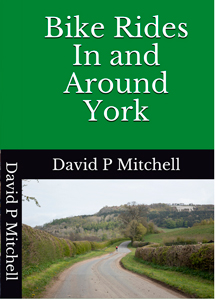
Bike Rides In and Around York features a historical city tour, plus family rides, road rides, and mountain bike rides.
"This book is simply a treasure trove not only of great rides but also as a travel guide to the area."
Read more about Bike Rides In and Around York.

Bike Rides in Harrogate and Nidderdale is a book of family, mountain and road bike rides.
"This guide is a wonderful companion whether you ride alone, with family or friends. Don't set out without it."
Read more about Bike Rides in Harrogate and Nidderdale.