
IPCC AR6

Many of us were concentrating on other things when the Intergovernmental Panel on Climate Change (IPCC) published its Sixth Assessment Report (AR6). I thought it would be appropriate to do a short summary of the findings.
I haven’t been through the reports in forensic detail – much of the information here comes from Wikipedia.
AR6 is made up of reports by three Working Groups:
- WG1 – the Physical Science Basis (August 2021)
- WG2 – Impacts, Adaptation & Vulnerability (February 2022)
- WG3 – Mitigation of Climate Change (April 2022)
As well as all the background material in each report, there is a Summary for Policymakers, which is negotiated and agreed by governments.
WG1 – the Physical Science Basis
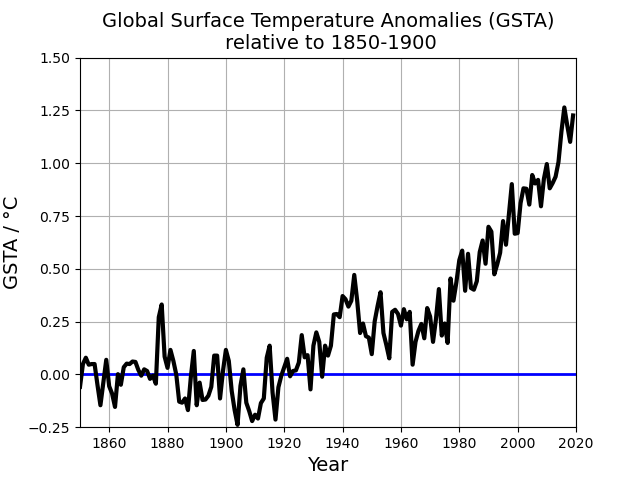

The report sets out the consensus about the foundations of climate science in 13 chapters. There is more detail about the regional effects of climate change than in previous Assessment Reports.
It is still possible to keep global warming below 1.5C, but this would require:
- cutting emissions by 50% by 2030, and
- cutting emissions by 100% by 2050
The global carbon budget to achieve this is around 500 billion more tonnes of greenhouse gas (50% chance of staying within 1.5C), or 400 billion tonnes (67% chance), or 300 billion tonnes (83% chance).
It is more likely that temperatures will rise by 3C by 2100. Sea level rise is likely to be between 50cm and 1m by 2100, but 2-5m due to melting ice sheets cannot be ruled out.
Extreme weather events increase in frequency and severity with more warming.
The UN Secretary-General Antonio Guterres called the report a code red for humanity.
WG2 – Impacts, Adaptation & Vulnerability
Some of the main conclusions of the report on impacts, adaptation and vulnerability are:
- at least 3.3 billion people (40% of the world’s population) are highly vulnerable to climate change
- on the current emissions path, Africa will lose 30% of its maize cultivation territory and 50% of land cultivate for beans
- 1 billion people face flooding due to sea level rise
- a mass extinction of species is already under way
- droughts, floods and heatwaves are becoming more frequent
- climate change increases the risk of the emergence of infectious diseases like Covid-19
- some human systems, and natural systems like corals, wetlands, rainforests, and ecosystems in polar and mountain regions, will reach “hard adaptation limits” as warming increases
There is still time to limit warming to 1.5C by drastic cuts to greenhouse gas emissions, but action must be taken immediately.
WG3 – Mitigation of Climate Change
This report found that greenhouse gas emissions are still increasing.
‘Net anthropogenic GHG emissions have increased since 2010 across all major sectors globally. An increasing share of emissions can be attributed to urban areas. Emissions reductions in CO2 from fossil fuels and industrial processes, due to improvements in energy intensity of GDP and carbon intensity of energy, have been less than increases from rising global activity levels in industry, energy supply, transport, agriculture and buildings.’
wg3 report on mitigation of climate change
Some of the main findings include:
- participation in international agreements leads to adoption of climate policies; international cooperation needs to be much stronger than now
- CO2 removal is necessary, for example by reforestation and restoration of peatland
- cities have big potential for reducing emissions. Mitigation measures in cities include mixed use of space, walking, cycling, public transport, and vehicle-sharing; urban forests and lakes can also reduce emissions directly and indirectly (for example by cooling and reducing the need for energy
- emissions from buildings can be reduced by SER – Sufficiency, Efficiency and Renewables. Sufficiency measures include natural ventilation, green roofs and white walls
UN Secretary-General responded to the report.
‘Climate activists are sometimes depicted as dangerous radicals. But the truly dangerous radicals are the countries that are increasing the production of fossil fuels.’
un secretary-general guterres
Recent Extreme Weather Events
Evidence of the damaging effects of global heating continues to pile up.
India and Pakistan
India and Pakistan have suffered from a heatwave that started in March 2022 and went on for months. Dehli recorded a record temperature of 49.2C in mid-May.
The heat has resulted in failed harvests, forest fires, and deaths.
Antarctic and Arctic
In March 2022 there were simultaneous heatwaves in the Antarctic and Arctic.
Temperatures were 40C warmer than normal in the Antarctic and 30C warmer than normal in the Arctic. Researcher Stefano di Battista described the temperature surge as ‘impossible’ and ‘unthinkable’.
America
In America in May 2022, a heat dome caused record temperatures in Mississippi and Texas. Dallas had its hottest May in history. The heat affected more than 120 million Americans.
France, Spain and Portugal
France, Spain and Portugal have suffered very high temperatures in May and June 2022. Spain had its hottest May in at least 100 years.
France reached hot temperatures of 38 to 40C in June – much earlier in the year than normal. This followed its hottest May on record.
European Heatwave June 2022
There was a heatwave across much of Europe in June 2022, with temperatures up to 20C hotter than would normally be expected.
The mercury reached 32.5C at Banak in Norway – the hottest temperature ever recorded inside the Arctic Circle in Europe.