
Motonormativity


British people accept risks and harms from motor vehicles that they would not accept in other areas of life. That’s the conclusion of a study by Ian Walker, Alan Tapp and Adrian Davis, reported in the Guardian.
The researchers call this state of mind ‘motonormativity’, and they believe it is endemic in government and the medical profession, as well as in the general population.
The study is titled ‘Motonormativity: How social norms hide a major public health hazard’. It describes:
‘…shared, largely unconscious assumptions about how travel is, and must continue to be, primarily a car-based activity. We label this phenomenon motonormativity.’
the study’s description of motonormativity
Survey Statements
2,000 people were asked their views on risks. They were randomly assigned to one of two sets of statements – one about driving-related risks, and the other about non-driving risks.
75% of respondents to the survey agreed with this statement:
‘People shouldn’t smoke in highly populated areas where other people have to breathe in the cigarette fumes.’
non-driving related risk
On the other hand, only 17% of respondents agreed with this statement:
‘People shouldn’t drive in highly populated areas where other people have to breathe in the car fumes.’
driving related risk
These were some of the other statements.
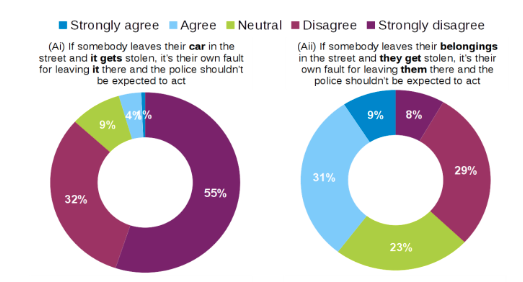
The police should take action if:
- belongings are left in the street and are stolen (37% agreed)
- a car is left in the street and is stolen (87% agreed)
Risk is a natural part of:
- working (31% agreed)
- driving (61% agreed)
Professor Walker’s Comments
Ian Walker, Professor of Environmental Pyschology at Swansea University commented:
‘It is nonsensical to say that making people breathe toxic air is a problem when it comes from a cigarette, but making people breathe toxic air is fine when it comes from a car. The underlying principle is the same, but people in our study were not using the same standards when they judged the two things.’
‘It has long been suspected that people can slip unconsciously into using different standards when they think about driving, leading them to commit a fallacy known as ‘special pleading’. Our study was intended to reveal this phenomenon and show just how substantial these effects can be.’
professor ian walker
The Study
The Abstract at the start of the study explains the results and their implications in a little more detail.
‘Decisions about motor transport by individuals and policy-makers show unconscious biases due to cultural assumptions about the role of private cars – a phenomenon we term motonormativity.’
‘To explore this claim, a national sample of 2,157 UK adults rated, at random, a set of statements about driving…or a parallel set of statements with key words changed to shift the context…Such context changes could radically alter responses…’
‘We discuss how these biases systematically distort medical and policy decisions and give recommendations for how public policy and health professionals might begin to recognise and address these unconscious biases in their work.’
abstract from the study
The authors of the study describe environmental degradation, and three parallel health epidemics, due to easy hypermobility afforded by private cars. The health epidemics are:
- collisions
- diseases of physical inactivity
- air pollution
They say that ‘in the specific context of individual motor transport, we have a cultural inability to think objectively and dispassionately’ because of motonormativity. People suspend ethical and moral judgements that they would apply in other contexts.
One result is the widespread acceptance of law-breaking by drivers.
Another affects town planning. Developments are predicated on the assumption that access will be by car, and the minority who choose not to use cars are forced to accept the harms arising from other people’s motoring whether they like it or not.’
The motonormative mindset is also prevalent in medical settings, so GPs ask patients about diet, smoking and drinking, but never about how they travel – despite the fact that this is a better predictor of early mortality.
Discussion
In the discussion section of the study, the authors consider the results.
One suggested explanation of the findings is pluralistic ignorance. This would mean that respondents recognise the harms from driving, but feel they are unusual in doing so, so do not express their true feelings.
The study says that since people responded privately, pluralistic ignorance probably does not apply.
It is more likely that people have schemas – organised packets of subject-specific knowledge that shape the way we perceive the world. They come from a wider framework of cultural and social influences, from:
- individual experiences
- the influence of family and friends
- the influence of other drivers
- road design and (lack of) enforcement of laws
- media stories and the portrayal of driving in entertainment
On road design, the authors say:
‘Transport systems make car use easy, even for short journeys, by absorbing externalities, subsidising parking, providing priority over other modes, providing ineffective public transport alternatives.’
the study’s explanation of the contribution of road design
The discussion notes that were cars invented today, no device killing 35 people in the UK each week would be permitted in our streets, however convenient.
The study’s call to action is for decision-makers to become aware of their own individual and institutional unconscious biases and how these have health and quality of life implications for others. We need to address the Institutional Car-ism underpinning our own thinking.
Progress will be made when pedestrian crossings are redesigned so that walkers no longer need to stop and ask permission to cross a road on which inactive and polluting motorists are automatically given priority.
Government and medical professionals should:
- audit all decisions from the viewpoint of a person who does not drive and
- incorporate the harms from motoring – particularly physical inactivity and pollution – into day-to-day practice