
Cycle Campaign Launches 42 Ways to Transform York
York Cycle Campaign (YCC) has launched a document called 42 Ways to Transform York, promising fresh thinking about the kind of city York should be.
It is divided into:
- Foreword
- Introduction
- i Cycling is Good for York
- ii Wanted: a Coherent Cycle Network
- iii Make York Accessible for Everyone
- iv Create a People-Friendly Transport Strategy
- Appendices
It’s worth reading 42 Ways to Transform York cover to cover; here, I’ll summarise and pick out a few highlights.
Foreword – People Thrive in Cycling Cities
The Foreword is by YCC Chair Robyn Jankel.
She says that 42 Ways to Transform York is about making cycling in York safe, convenient, and accessible for everyone.
Introduction – What Kind of a City Do We Want to Live In?
The Introduction says that outside the city centre:
‘there’s total chaos. Vehicles dominate everywhere, creating ugly, overcrowded, noisy, stressful and polluted spaces. With the entire network mired in traffic, sometimes the only comfortable place to be is inside a vehicle.’
Introduction to 42 ways to transform york
It describes children stuck indoors and chauffered everywhere, because traffic undermines so much of what is good in York.
i Cycling is Good for York
This section identifies that a focus on vehicles and traffic flow has meant that most trips are made by a single person in a car. The suggestion is that York should become a city of people not vehicles (1).
The solution is to make cycling easy (2). With a network of good-quality, protected cycle tracks, more people will cycle – and become happier and healthier in the process.
Boosting cycling would help city centre businesses to thrive (3).
It would also boost the wider economy (4). The costs associated with driving include road-building, pollution and ill-health through sedentary lifestyles, and amount to 95p per mile. By contrast, cycling benefits the economy by 52 per mile.
Cycling is good for the environment too, emitting no greenhouse gases nor particulate pollution (5).
Cycling contributes to the idea of 15-minute neighbourhoods (6), because you can walk about a mile in 15 minutes, but cycle 2 to 3 miles. Heavy traffic dissuades people from walking and cycling. Proper cycle routes and cycle parking would allow people to ‘daisy-chain’ trips.
ii Wanted: a Coherent Cycle Network
Here, it’s a question of ‘build it and they will come’ (7). People want to cycle, but are put off because they don’t feel safe.
YCC say that cycling should be permitted on the central ‘footstreets’ where it is currently banned (8). There should be direct north-south and east-west routes, rather than access everywhere (9).
Also, there must be safe cycle routes from the suburbs to the city centre (10), and more cycle parking in the city centre (11).
Villages outside York (such as Haxby) should be linked up too so it’s easy to cycle in (12).

Active travel to schools should be enabled with protected routes, not just encouraged, and there should be covered cycle parking at schools (13). More School Streets, which exclude vehicles at pick-up and drop-off times, are also needed.
Park & Ride works well, but it should be extended to Park & Pedal (14).
Instead of allowing delivery by motor vehicles in the pedestrianised city centre, there should be consolidation hubs and e-cargo bike deliveries (15).
Motor vehicles should be removed from the Inner Ring Road, replaced by people-friendly transport (16). This visual shows Station Road now, and how it could be.

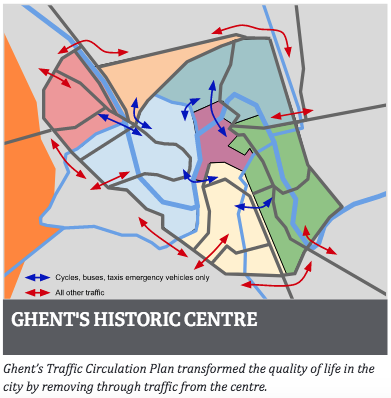
York should learn from Ghent (17), which divided the city into sectors and limited the ability to drive between them. Drivers have to go out to a Ring Road to change sectors, while people on foot, on bikes, and using public transport can travel more directly.
iii Make York Accessible for Everyone
York is a Human Rights City, but its cycle routes are not accessible to all. They should be (18).
The city should provide for people without access to a car, which is a third of society. The simplest way to do this is to provide a high-quality cycle network (19). This is also important to low-income families, since cycling is cheaper than driving, and on a bike you can go further than on foot (20).
Cycle routes should be built with disabled people in mind. When we build for the least able, we build for everyone (21).
A cycle route should be safe enough for an unaccompanied 12-year-old (22). It should also accommodate different kinds of cycle, including handcycles, trikes and cargo bikes (23).
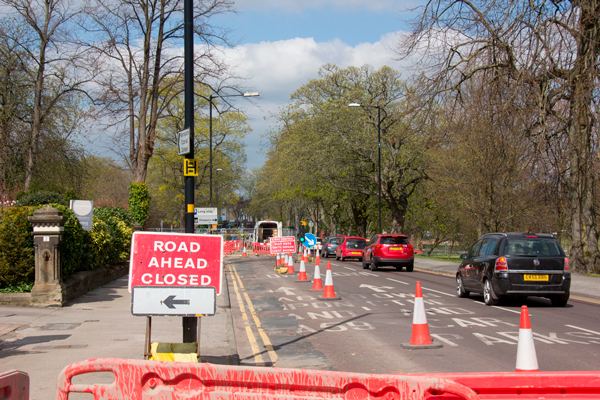
During road works, the council should avoid blocking cycle tracks with signage; and any diversions should be as safe as the original route, even if this means inconveniencing motorists (24).
Consultations on transport issues should be a process where challenging ideas are worked through and negotiated. Better quality public debate will lead to better outcomes (25).
Green spaces like the planned community woodland at Knapton are often car-dependent. Instead of building a car park at Knapton, parking should be for disabled people only, and the woodland should be reached primarily by cycle routes, with excellent bus provision too (26).
iv Create a People-Friendly Transport Strategy
York’s transport strategy is ‘predict and provide’ – constantly increasing motor vehicle capacity.
The city’s 2011 Local Transport Plan talks about reducing car use, but policy – led by senior council officers – has been the opposite. Councillors, not officials, need to come up with a transport strategy and require officers to implement it (27).
Consultations are a series of fights over small, local projects. Instead there should be a consultation on overall transport strategy, then leave the technical details to transport professionals (28).
The transport strategy should apply the transport hierarchy (29).

York’s money should be spent on the priorities at the top of the hierarchy, not on cars (30). Currently, York is planning to spend £65 million on dualling part of the Outer Ring Road.
Making driving less attractive and thus reducing unnecessary car trips should be a primary strategic aim (31). The Local Transport Plan should set ambitious targets for the alternatives to the private car, and detail exactly how and when they will be achieved.
Congestion can be a useful deterrent to driving, and it’s impossible to build a way out of it. Instead, York should plan for modal shift (32).
York’s cycling potential is 30-50% of trips, and that would free up road space for those who really need to drive (33).
68% of York’s commuters travel by car. A workplace parking levy, as in Nottingham, could change this (34). The council charges larger employers a fee per parking space per year, and this is often passed on to employees using them. The money raised is used to improve sustainable transport options.
Road space will have to be reallocated from storage of private cars to protected cycle tracks (35).
Home Zones – areas where priority is given to people not cars – should be reintroduced (36), and residents who don’t have a car should be rewarded (37).
There should be bike hubs at the station and at Park & Rides, with a diverse range of bikes to include e-cargo bikes (38).
At new developments within a mile of the city centre, there should be disabled parking only. Developers should be required to provide high-quality cycle routes and parking (39). York’s Respark scheme can be used to stop displaced car parking (40).
A Bicycle Mayor is a voluntary, independent role, with the Mayor acting as a bridge between local cyclists and policy-makers. A Bicycle Mayor should be appointed in York (41).
York should be looking to replicate the success of the Millennium Bridge, which is a meeting point and social hub (42).