Cycle Infrastructure on the A59 Poppleton to York - Part 3
3rd November 2021
Cycling in Yorkshire

3rd November 2021
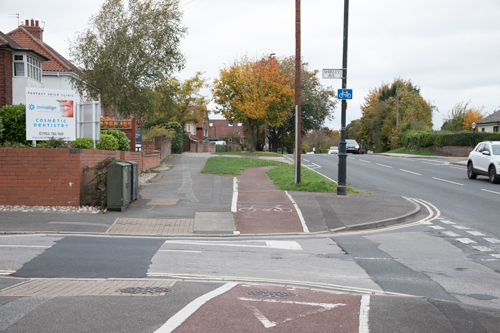
This review of the cycle infrastructure along the A59 between York City Centre and Poppleton is Part 3. In Part 1 and Part 2, I looked at the route in the opposite direction, from Poppleton to the city centre.

I'm not going to go into as much detail as I did in Parts 1 and 2. I hope that the City of York will review their work here and come up with solutions themselves.
Generally, the two most important principles to apply are:
'On roads with high volumes of motor traffic or high speeds, cycle routes indicated only with road markings or cycle symbols should not be used as people will perceive them to be unacceptable for safe cycling.'
Summary Principle 3, LTN 1/20
Traffic volumes are high on the A59, and dedicated, protected space for cycling is required.

Cycle lanes are unacceptable on busy roads, Chapter 6 of LTN 1/20 confirms.

The majority of the route from the city centre to Poppleton uses on-road painted advisory cycle lanes, which are clearly unacceptable. Further, most of them are below the Absolute Minimum width of 1.5m.


The York-Poppleton route along the A59 does exactly what Summary Principle 21 says it shouldn't - it jumps from road to pavement and back again.
General improvements will involve rectifying the problems I've outlined above.
That means replacing advisory cycle lanes with kerb-protected cycle tracks - removing on-street car parking where necessary. It also requires careful thought to make sure the cycle provision is consistent: that it flows as a route, and that it doesn't abandon people on two wheels anywhere.
Where there are large grass verges, a route a few metres away from the traffic may be more pleasant one right next to vehicles - but it still has to be properly linked to the rest, without the need to keep stopping and giving way.
As well as the general improvements, I noticed a few specific instances where the current provision is especially poor and needs particular attention.

At this junction, cyclists going straight on have to move into the right hand lane. Most people won't be prepared to mix with traffic in this way, and it will put them off using the route.
The junction needs to be completely re-worked, to provide safe, segregated facilities for cycling.
The other issue here is that there's a painted lane which appears to be intended for cycling straight on on the A59. If you follow it, it takes you onto an island with overgrown bushes (pictured above), where you find that you can't go straight on after all. There's no dropped kerb to do so.

The refuge island turns out to be intended only for people who want to cross the road here.
Cycle infrastructure has to be legible. Arriving at cycling speed, it should be obvious what you're supposed to do and where you're meant to go.
If the council's cycle route keeps sending users down blind alleys, and leaving them in the lurch, they will very soon lose confidence in it and ignore it.

Immediately after the junction with Ouseburn Avenue, the cycle route diverts off the road onto the pavement by some shops.
If you follow the route, you're let down.
First, when I rode it someone had parked their car in it. Drivers will park in cycle tracks if they can, so this problem must be designed out - either by making it physically impossible, or with a plan for enforcement.
Second, when you get to the next side road (Shirley Avenue), you're expected to give way, then a few metres later you're dumped back onto the road anyway.
Overall, this section of cycle track is not doing anything useful for anyone. Nobody will ride it more than once.
There's a huge amount of work to do to bring York's cycle facilities up to a minimum acceptable standard.
They have been built with the idea in mind that roads are for cars, and cycling is marginal and unimportant; on the principle that cycling infrastructure must never impinge on priority for drivers, and that it can be bodged with a can or two of paint.
In common with other local authorities, the City of York seems have no idea about what actually works for existing cyclists and will attract more people to get about by bike - or it doesn't care.
The impression you get is that the people who built this stuff have perhaps heard of bicycles, but never ridden one, and certainly have no intention of getting about the city on two wheels for their everyday journeys.
That must now change.
I have made a few suggestions for cycling infrastructure on the A59 between Poppleton and York in Part 1, Part 2, and here in Part 3.
With the climate going haywire, with cities across the UK congested and full of pollution, and chronic problems of inactivity among citizens, the best time to start putting this route to rights was yesterday. Failing that, how about starting today?

SL Eurobike Road Bike.
£387.00 on Amazon as at 3rd November 2021.
Bike Rides In and Around York starts a city tour of York, then there are wonderful family, road, and mountain bike rides.
It's intended to inspire you discover York and the surrounding countryside on two wheels.
Each ride comes with a map and GPS files that you can upload to a device.
'This book is simply a treasure trove not only of great rides but also as a travel guide to the area.' Reader review, July 2021.
Find out more about Bike Rides In and Around York, and buy a copy.

Bike Rides in Harrogate and Nidderdale is a book of family, mountain and road bike rides.
"This guide is a wonderful companion whether you ride alone, with family or friends. Don't set out without it."
Read more about Bike Rides in Harrogate and Nidderdale .