
York Civic Trust Transport Strategy

York Civic Trust (YCT) has published a Transport Strategy for York,
The Civic Trust explains that it was originally intended as a contribution to updating the City of York’s Local Transport Plan. Since the LTP has now been delayed, YCT has gone ahead and published its own strategy.
The strategy is the result of work by a Citizens Transport Forum. There’s an Executive Summary and the full report.
Current Trends
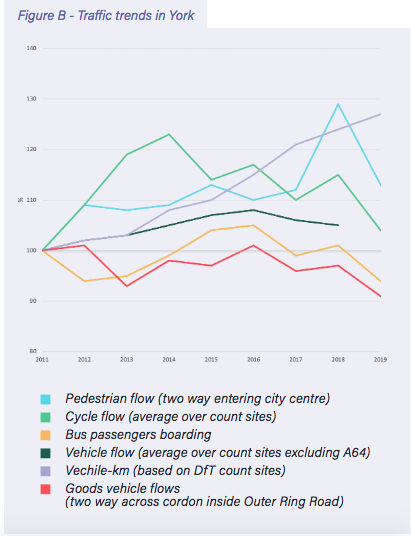
Since 2011, vehicle kilometres have increased by a quarter. Cycling and bus use have been falling.
Goods vehicle flows inside the Outer Ring Road are falling. This suggests that it is not necessary to increase capacity on the Outer Ring Road to reduce freight traffic in the city, because freight traffic in the city is reducing anyway.
Objectives
The objectives of the YCT transport strategy are to:
- reduce transport emissions by 70% to achieve the council’s goal of being carbon neutral by 2030
- reduce traffic congestion
- improve air quality
Targets
No more than half of the City of York’s carbon target can be achieved through switching to electric vehicles, so the rest will have to come from changing the way we travel.
YCT suggest reducing car travel by 20%.
Strategy
YCT have a six-point strategy.
- Reduce the need to travel, with working from home and 20-minute neighbourhoods.
- Improve and promote active travel.
- Improve and promote public transport.
- Change the way the road network is managed to encourage use of more suitable routes, to support sustainable travel, and to improve liveability and the public realm.
- Change freight operation, including using smaller electric vehicles and e-cargo bikes.
- Modify car use, with less private ownership and more car clubs.
YCT point out that changes need to start immediately, and they ask what could be achieved by the end of 2023. With full public engagement, they suggest:
- workplace and school travel plans
- freight delivery plans
- prioritising active travel and public transport improvements, and traffic management
- more spent on footway and cycle route maintenance
- a simpler fare structure for buses
- experimental car-free days in the city centre
- more bus prioriy
They also suggest that two radial roads should be redesigned with continuous segregated cycle lanes and bus priorities. This should be expanded to all radial roads within few years.
Dualling of the Outer Ring Road
Very surprisingly, the Executive Summary says:
‘By 2027 the north-eastern outer ring road will have been dualled. We should ensure that longer distance traffic uses it in preference to inner city roads.’
It seems astonishing that YCT should make uncritical mention of this project to dual the Outer Ring Road and increase capacity for private cars. It is very well-established that increasing capacity induces more traffic. Inducing more traffic runs counter to everything else in the strategy.
Other Measures
Other measures suggested by the strategy include:
- 20mph speed limits on all residential roads, with through traffic discouraged
- segregated cycle and bus routes between all villages and the city centre
Transport Policy is Controversial
The Executive Summary identifies that transport policy is controversial. ‘We therefore need to build consensus,’ it says.
Seville’s experience was that it is impossible to build consensus. You do need to involve people and consult, but then you have to make a deal with most of the people.
Overall Impression
The YCT Transport Strategy for York is a valuable way of starting a conversation. I agree with most of it.
Its uncritical mention of the road expansion scheme north of York is quite shocking, because it runs counter to everything else in the report.
The idea of creating segregated cycle routes and bus provision on radial routes and to all villages is great and should be pursued, but it’s important to be honest about the hard choices involved.
It’s likely to be necessary to make some roads one way for motor vehicles in order to create the space for segregated cycle tracks, and often there may be a choice between segregated cycle provision and bus lanes.