
Post-Pandemic Dip in Cycling

Cycling rates in England dipped after the pandemic, according to statistics released by the DfT on 31st August 2022.
They relate to the year to November 2021, and are based on the National Travel Survey and the Active Lives Survey. It’s important to note that more recent statistics (for March to July 2022) show cycling in England up by 47% on weekdays.
According to the figures to November 2021, cycling trips, stages and miles decreased back to pre-pandemic levels or lower. For example, an average of 15 cycle trips per person per year is back to the level previously seen in 2016.
The DfT notes that the average number of trips per person remained broadly stable in the range of 14 to 18 from 2002 to 2019. 2020 was different, with an average 20 trips.
Average distance cycled per person declined from 88 miles in 2020 to 55 miles in 2021. 55 miles still represents a small increase on 2019, when the equivalent figure was 54 miles.
On average people make around 2% of their trips by bike, representing 1% of total distance. 3% of children cycle to school.
55% of cycling stages were done for leisure or shopping.
Demographic Differences
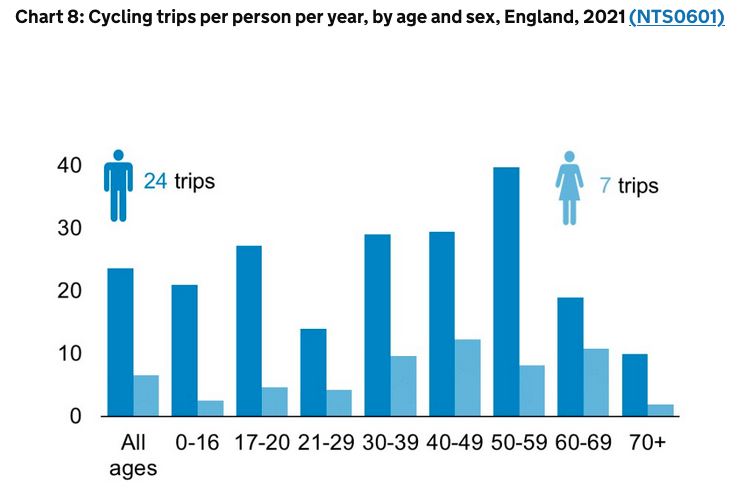
Men make far more cycling trips than women – on average 24 vs 7. Men aged 50 to 59 make the most cycling trips.
KSIs
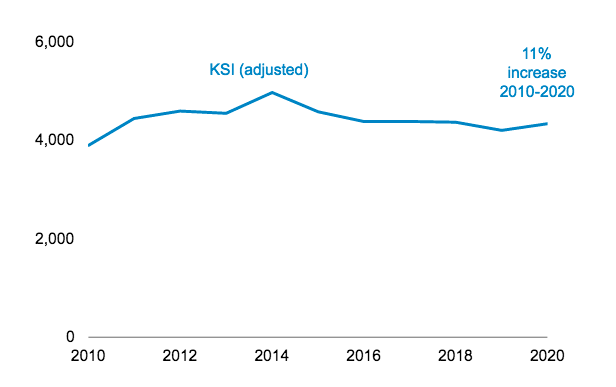
The number of pedal cyclists killed or seriously injured in the year to November 2021 was 4,462. As the graph shows, the number of KSIs is not coming down substantially.
York

The Active Lives Survey provides information on local cycling rates, and the DfT has made the data sets available. In the table above, which I’ve taken from cw0302, the fifth column represents 2021, the sixth 2020, and so on.
The data for York suggest that the proportion of people cycling at least once a week was:
- 16% in 2021
- 21.2% in 2020
- 22.1% in 2019
- 21% in 2018
- 25% in 2017
In 2016, it was 27.2%.
Harrogate

The data for Harrogate show the proportion of people cycling at least once a week was:
- 13.4% in 2021
- 12.7% in 2020
- 10.7% in 2019
- 12.9% in 2018
- 10% in 2017
In 2016, it was 13.4%.
It looks to me like the possible effect of employed people working from home instead of cycle commuting in York. In Harrogate where fewer people cycle commute rates have increased so overall a good thing.
Yes those could well be factors, but it’s hard to know for sure.
There’s definitely plenty of leisure cycling in Harrogate. My subjective impression is that there is a fair bit of cycle commuting too, but a lot of children either walk or are driven to school. We lack cycle facilities safe enough for parents to trust.