
Far-Fetched Claim that Dualling York Outer Ring Road Will Reduce Emissions from Driving
Consultants Pell Frischmann claim that dualling the northern part of York Outer Ring Road (YORR) will not increase emissions from driving – even though they admit that emissions from construction will dwarf any change in ‘operational emissions’.
The far-fetched claim about emissions from driving comes in documents in support of a planning application which has been submitted for the road capacity expansion project.
York Press says that if planning permission is granted, road-building will start in mid-2023 and continue for 2 years to 2025. The cost is £65 million.
There are 185 documents in support of the planning application, and some of them make reality-defying claims about the traffic and climate impact of the proposed road capacity expansion scheme.
Far-Fetched Claim 1: Dualling YORR Will Not Increase Traffic
Chapter 17 of the Environmental Statement claims (para 17.1.6):
‘The Proposed Scheme itself is not anticipated to generate significant levels of new traffic on the highway network but it does potentially encourage traffic to be re-assigned throughout the City of York’s highway network.’
The claim is based on various traffic models, which simply don’t reflect reality.
The Campaign to Protect Rural England found that bypass schemes generate huge amounts of traffic:
- +7% over the short term, 3-7 years, and
- +47% over the long term, 8-20 years
Sightline Institute has a good summary of the effects of adding extra lanes to highways:
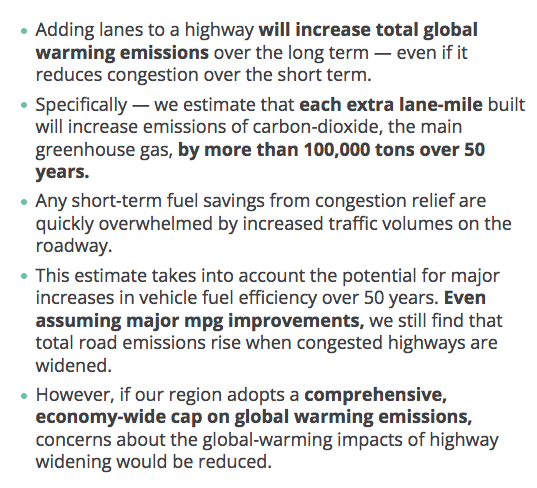
City Observatory says that research shows that reducing congestion does not reduce emissions:
‘Adding more capacity might reduce idling a bit, but it will actually induce more driving, which will lead to higher, not lower carbon emissions’.
city observatory
A Norwegian study also concludes that in most cases the construction of better roads leads to increased greenhouse gas emissions. This is because of construction emissions, more capacity leading to more driving, and faster speeds on the expanded roads.
Far-Fetched Claim 2: Dualling YORR Will Not Increase Greenhouse Gas Emissions from Driving
Chapter 12 of the Environmental Statement concerns greenhouse gases (GHG).
The document admits that construction of the dual carriageway ‘…would have an adverse effect on climate…’ (para 12.10.1). The main source of GHG during the construction phase is the embedded carbon in the construction materials.
The total GHG emissions in construction are estimated at 51,573 tCO2e (para 12.10.5).
This is said to be 0.0026% of the UK’s total carbon budget for 2023-27 – but frankly that is a ludicrous comparison to make. It would be more sensible to give a figure for the extra emissions as a percentage of York’s total transport emissions.

Operational emissions are mainly those arising from driving on the road.
According to Pell Frischmann’s assertions, there is a tiny decrease in operational emissions in the Do Something (DS) scenario where the scheme is implemented vs the Do Minimum (DM) scenario where it is not.

The claimed tiny reduction in operational emissions is due to “the improvement of traffic flows” (para 12.11.5), and the fact that their models don’t show any generated traffic.
Those assumptions are not supported by evidence from around the world. Widening highways just spurs more people to drive, according to research quoted in the New York Times, and Colorado is now pushing transport planners to redirect funding towards buses and bike lanes.
Kevin DeGood of the Center for American Progress is quoted in the NYT article as follows:
‘Everyone gets that oil pipelines are carbon infrastructure. But new highways are carbon infrastructure too. Both lock in place 40 to 50 years of emissions.’
kevin degood
Even on Pell Frischmann’s Figures, the Project Increases GHG Emissions
It is important to note that even in the unlikely event that Pell Frischmann’s figures for operational emissions are accurate, the extra GHG emissions from construction dwarf any savings:
- GHG from construction +51,573 tonnes
- GHG from operation -935 in 2040
- net increase in GHG by 2040 = 50,638
York’s Draft Climate Strategy
The City of York Council (CYC) declared a climate emergency in 2019, and it has produced a draft climate strategy. The transport goals include:
- reducing vehicle miles travelled by 25% between 2011 and 2030
- increasing active travel by 33% over the same period
If CYC were sincere about meeting these targets, it would not be contemplating spending £65 million on a huge increase in road capacity.
Dualling the YORR is certain to increase vehicle miles travelled – the exact opposite of the climate goal to reduce them by 25%.
Routemap to Carbon Negative
The Routemap to Carbon Negative for the York & N Yorkshire region is even more ambitious than York’s Climate Change Strategy. It envisages:
- a 48% decrease in vehicle miles travelled from 2020 to 2030 and
- a 900% increase in cycling
York’s road capacity expansion plan has no contribution to make to the Routemap goals; it is perverse.
Judicial Review
Transport Action Network has recently launched a judicial review of a similar scheme, to expand road capacity between Milton Keynes and Cambridge, on the basis that it is incompatible with sectoral, regional and local carbon budgets.
Assessing emissions only against national carbon budgets – as Pell Frischmann have done for YORR – is wrong, according to TAN’s claim.
TAN say it is madness to be investing in roads that increase traffic in a climate emergency.