
North Yorkshire’s Climate Change Strategy
North Yorkshire County Council (NYCC) has published its draft Climate Change Strategy. It will be considered at a meeting of NYCC’s Executive on Tuesday 17th January 2023, and will then go out to public consultation.
NYCC becomes North Yorkshire Council (NYC) on 1st April 2023.
TL;DR
NYCC has produced a draft Climate Change Strategy that is a homeopathic version of York & N Yorkshire’s Routemap to Carbon Negative, on transport at least.
The Routemap sets out clear, measurable goals including:
- reducing vehicle miles travelled by 48% by 2030 and
- increasing cycling by 900% by 2030
There is no reference at all to reducing vehicle miles in NYCC’s Strategy, and the other measurable goals in the Routemap have been removed from the Strategy.
Unless measurable goals are put back in, it will be hard to hold NYCC to account for their performance. No doubt that is precisely the cynical objective of the Executive.
On the other hand, at the meeting on 17th January the Executive will endorse the Routemap to Carbon Negative, so they ought to be responsible for achieving its goals – at least on matters that they control, like transport.
The best hope of holding them accountable will be to measure their performance against the Routemap, not their own Strategy.
The Strategy is padded out with a lot of background information, and contains quite a few excuses and some buck-passing. From a transport point of view, it is a huge disappointment.
Meeting on 17th January
This is the reports pack for the meeting, which includes an agenda and the draft Climate Change Strategy. The Strategy is item 5 on the agenda.
At the meeting the Executive will:
- endorse York & N Yorkshire’s Routemap to Carbon Negative ‘whilst recognising that many of the ambitions and actions in the Routemap are the responsibility of others and outside the control and influence of the Council’
- agree to undertake a public consulation on the draft Climate Change Strategy
- agree a Climate Change Strategy 2023-2030 after the consultation
NYCC is the highways authority, and has control of the county’s local road network (but not strategic through roads like the A1). The council cannot shirk responsibility for decarbonising transport.
Agenda Item 5 and the Accompanying Report
A report on the draft Strategy states:
‘It is proposed that North Yorkshire Council adopts a climate change strategy, taking account of the Council’s broader responsibilities and the Council’s difficult financial circumstances, setting out how the Council will become net zero as an organisation and contribute towards the delivery of York & N Yorkshire’s Routemap to Carbon Negative.’
para 2.4 of Nycc’s report about the draft climate change strategy
The report says that once the Strategy has been adopted, NYC will develop an Action Plan setting out how it will deliver the Strategy.
Draft Climate Change Strategy

The Introduction acknowledges that NYC declared a climate emergency in July 2022.
Greenhouse Gas Emissions in North Yorkshire in 2020

Transport represented 28% of N Yorkshire’s greenhouse gas emissions in 2020.
Refreshing the Strategy and Action Plan
The draft Strategy seems to say (p12) that it will be refreshed every 2 years, and that the Action Plan for delivery will be refreshed every year.
The first Action Plan will be agreed by September 2023. Initially it will bring together the action plans of the abolished local authorities (e.g. Harrogate Borough Council) plus the Implementation Plans being developed by the LEP for the Routemap.
NYC’s Transport and Economy Scrutiny Committee will review progress twice a year and do an annual report.
An external reference group of private and voluntary sector organisations could be set up, to review progress.
Soft Measures
An awful lot of the Strategy is either background or other general waffle that doesn’t commit NYC to doing anything meaningful.
A good example is this little feature box about communication and engagement.
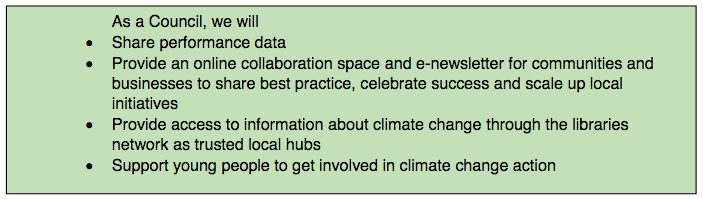
Sharing performance data is useful. Putting information about climate change in libraries is fine, but won’t contribute to meaningful change on the scale required.
Travel and Transport Objectives
The key section from a transport point of view is (7) Objectives, which starts on p18.
The draft Strategy promises that the next Local Transport Plan, due in 2024, will ‘set out how we can make quantifiable carbon reductions.’
These are the transport goals of the Routemap to Carbon Negative.
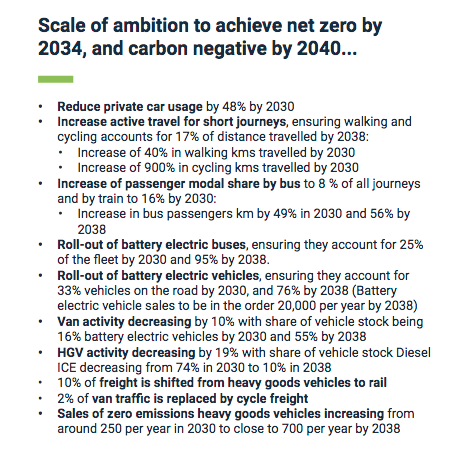
By 2030 amongst other things there must be:
- a 48% reduction in vehicle miles travelled and
- a 900% increase in cycling
This is how NYCC’s Strategy summarises the Routemap goals.

Part of the Transport Strategy Has Gone Missing
There is a huge problem here. The reduction of 48% in private car use stipulated by the Routemap has gone missing.
That is not an oversight. It is the deliberate and cynical removal of a key transport goal which is vital to decarbonising transport, but which NYCC doesn’t have the backbone to implement.
Unfortunately, deleting probably the most important aspect of the Routemap’s transport plan renders NYCC’s transport Strategy close to worthless.
Specific Measurable Goals Also Missing
For the other goals, the specifics have been removed. So instead of increasing walking by 40% and cycling by 900%, we’re left with a vague ambition to ‘increase active travel’. How can NYC be held to account on that?
There is a small graphic in a different part of the Strategy (p12) that shows some of the Routemap’s measurable goals.
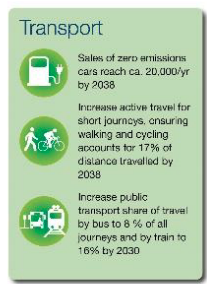
Again, it omits the key goal of reducing vehicle miles travelled by 48%. It also lumps walking and cycling in together so that the cycling-specific goal of a 900% increase is invisible.
The Strategy for Reducing Transport Emissions
The Strategy sets out some ways of reducing transport emissions by reducing ‘travel in fossil fuel vehicles’. This obscures the point that electric vehicles are not a magic solution, and reducing vehicle miles travelled in all types of vehicle is necessary.
The ways of reducing transport emissions suggested by the Strategy are:
- Improve access to digital services and services close to where people live
- Increase walking and cycling opportunities for shorter trips (no measurable targets)
- Support people to choose public transport, car share and car clubs (no measurable targets)
- Increase access to alternative fuels for vehicles (electricity and green hydrogen)
- Ensure low carbon travel choices are supported by a Development Plan (in place by 2028!) and the Local Transport Plan. 15-minute neighbourhoods
Again, there are no specific, measurable goals so there’s nothing to measure NYCC/NYC’s performance against.
NYCC are trying to wriggle out of being held to account. They plumb the depths with their cynicism.
A consultation should start in February 2023.