
Underwhelming HTIP2 Report
North Yorkshire Council (NYC) have published a brief update on the Harrogate Transport Improvement Programme (HTIP).
It’s a short report about a much longer report by consultants which the council is refusing to publish – the consultants’ second report about HTIP, and so it is called HTIP2.
NYC have spent nearly half a million pounds on the two HTIP reports over six years. There are appears to be no drive from the council to actually do anything about the consultants’ proposals, except perhaps so far as they involve prioritising motor vehicles.
Background

In 2019, NYCC (as they were then) carried out a Congestion Survey.
It showed that there was no support for a Ring Road (the so-called Relief Road), but 77% of 15,500 respondents wanted better walking and cycling facilities.
In the six years since then, NYC has done almost nothing to improve walking and cycling facilities.
Instead, its focus remains on increasing capacity for motor vehicles.
HTIP1 looked at three roads – the A61, A661 and A59 (para 3.8 of the current NYC report). HTIP2 focuses exclusively on the A61 Leeds Road, except for the Park & Ride element.
Warm Words
The report about HTIP2 opens with some warm words about sustainable travel. According to NYC (para 2.1), HTIP2 is:
‘a study looking into ways to reduce congestion and encourage use of sustainable travel modes on the A61 Leeds Road corridor in Harrogate’.
The consultants have looked at the corridor in order to see how to achieve transformational change with:
‘a multimodal package of linked measures…which can offer people travelling a genuine choice of how to travel other than by car’ [para 2.3]
West Harrogate Urban Expansion vs HTIP
Paragraph 3.12 uses the West Harrogate Urban Expansion as an excuse for long delays to HTIP.
Fundamentally, the West Harrogate Transport Strategy and HTIP have contradictory aims.
NYC’s development control officers have developed a strategy for West Harrogate that is all about increasing capacity for motor vehicles, whereas HTIP is, or was, about sustainable transport.

It’s not surprising the council has struggled to reconcile the two.
Do Minimum, Do Something, Do Maximum
The consultants have come up with three packages, Do Minimum, Do Something and Do Maximum. Each is given a high-level costing.
Do Minimum (£1.8 Million)
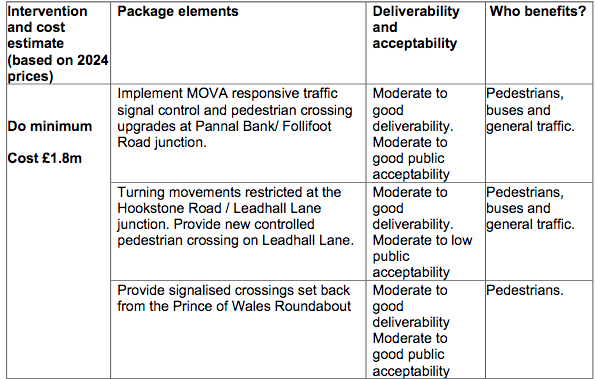
The Do Minimum package is mainly about increasing capacity for motor vehicles on Leeds Road.
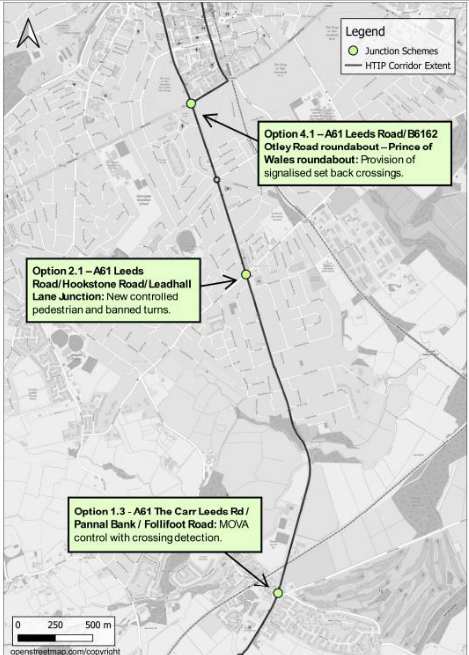
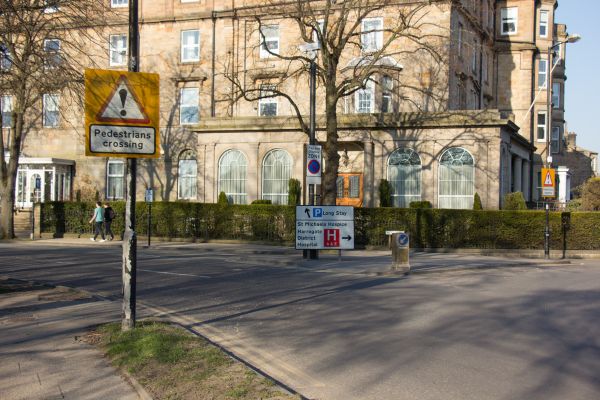
There is one small improvement for pedestrians in the package – crossings at the Prince of Wales roundabout. They are much-needed, because currently pedestrians are expected to cross multiple lanes of traffic with no priority.
Do Something (£8.9 Million)
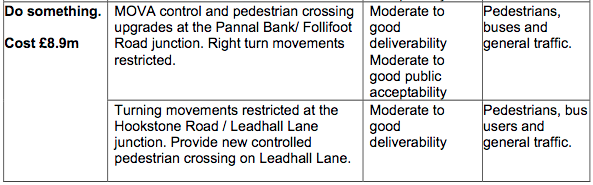
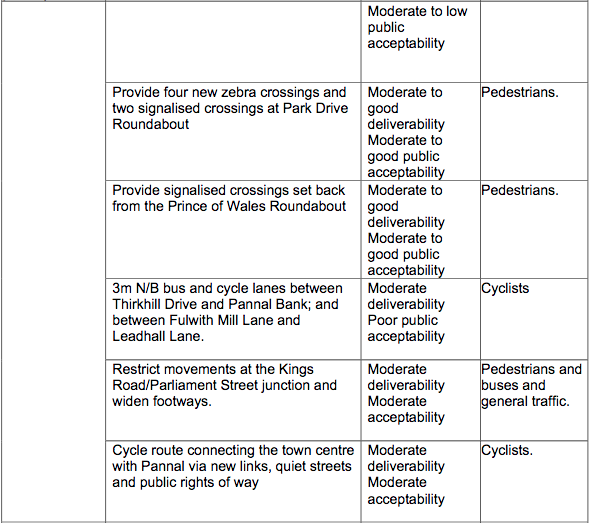
The Do Something package adds more proposals to Do Minimum.
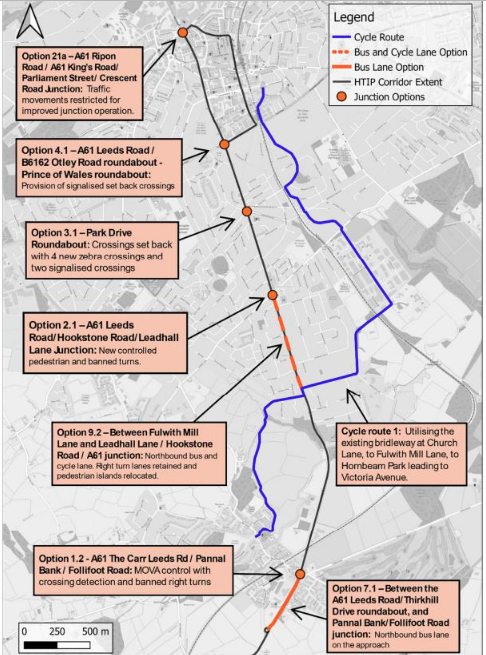
The additional proposals include zebra crossings at St George’s roundabout (called the Park Drive roundabout in the report).
Cycle facilities to get people across St George’s roundabout, between Park Drive and South Drive, are also needed, but not mentioned.
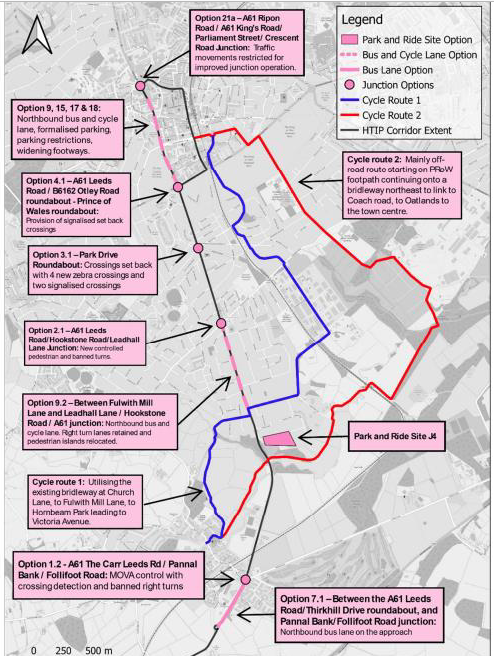
Another new proposal is for a fragment of bus lane in Pannal. It would be a small improvement for bus passengers but because it would be short, it would not be transformational. It could be used for cycling, but of course it would be one direction only.
A cycle route is shown on the map in blue.
The problems with this suggestion are:
- it is not at all direct
- the section to the west of the A61 would be a new path across fields, meeting a rural bridleway at the steep, narrow crossing of Stone Rings Beck. Would NYC really build a path suitable for utility cycling?
- there would probably be objections to a sealed surface and lighting; without those elements, it would not work at all for cycling
- improvements would be needed to the existing route east of the A61; if the plan is simply to signpost people to the existing route, why would that result in any increase in modal share?
- a better onward route to town would be through the Mallinson estate (modal filter) and via the Cricket Ground and Beech Grove (modal filter)
If the objective is increasing modal share for cycling, dedicated cycle facilities on the A61 would be most likely to achieve this as it is direct and street-lit.
To an extent the proposals marginalise cycling.
While a cycle route from Pannal would be nice, high-quality town centre routes have more potential to attract large numbers of cyclists and should be more of priority.
Do Maximum (£38.6 Million)
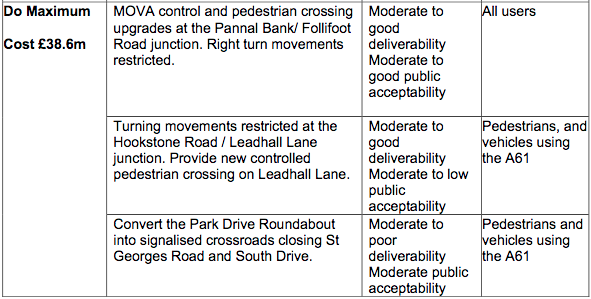
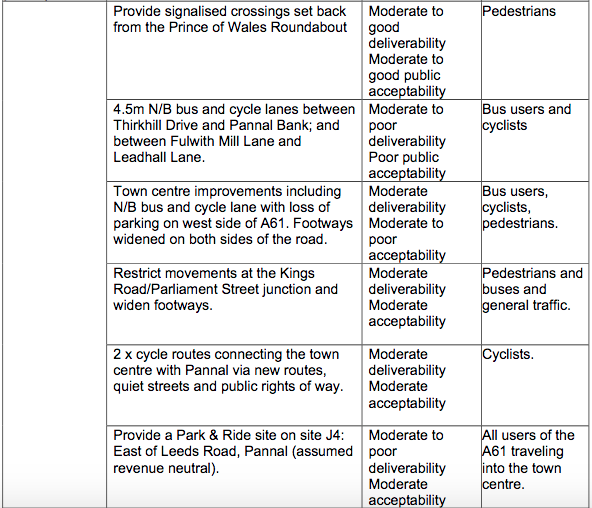
The Do Maximum package has more proposals.
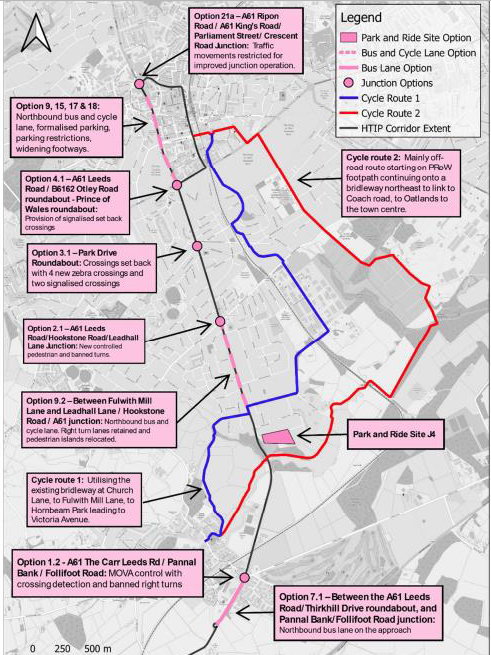
They include closing two of the roads at the St George’s roundabout.
The bus lane would be wider than in the Do Something proposals, and there would be an extra sector of it, between Fulwith Mill Lane and Leadhall Lane.
I don’t understand why there would be no bus lane up Almsford Bank, since the A61 is very wide there.

There would be a section of bus lane on West Park and Parliament Street, from the Prince of Wales roundabout to the Royal Hall.
The sections of bus lane would be useful for cycling, but only in one direction.
There’s a proposal for another cycle route, shown in red on the map above.
Again, it is indirect, it would probably be unlit, and there may well be objections to a sealed surface. It would be unlikely to increase cycling’s modal share, but could be useful if NCN Route 67 is realigned to pass through the Prospect Tunnel.
Do Maximum includes a Park & Ride site near Fulwith Road. The red cycle route could be useful in conjunction with P&R.
Park & Ride
Successful Park & Ride requires bus priority, so there is a time advantage over private cars (para 8.1).
The consultants shortlisted eleven sites.
More than one P&R site is needed. This is because if town centre parking is to be disincentivised, it’s only fair to enable people coming from different directions to use P&R.
Market Research
The report says that:
‘market research was undertaken by a specialist consultancy to understand the propensity for people living within Harrogate and further afield to change their travel habits and use sustainable modes of travel’.
Interesting points noted by the market researchers include:
- there was a high level of support for Park & Ride provided it is high frequency, fast and cheap
- more than half of respondents supported improvements to cycling facilities
- two thirds of respondents would support reduced town centre parking and higher parking charges, to incentivise use of sustainable modes
For change to happen, sustainable options need to be convenient, integrated and easy to use.
Final Thoughts
In the 2019 Congestion Survey, local people asked the council for better walking and cycling facilities.
Since then, NYC have spent six years and nearly half a million pounds doing nothing much.
Now that the consultants have come up with their second report, the process of diluting and marginalising active travel, and turning HTIP into a high traffic scheme, has begun.
As far as cycling is concerned, there is really nothing in this report that is likely to result in a significant increase in modal share.
Next Steps
NYC now say that it is up to York & North Yorkshire Combined Authority to add HTIP to their pipeline of major schemes, and fund them through the Local Transport Grant.
The report’s recommendation is to pass the study to YNYCA.