
UK Transport Emissions to Overshoot Carbon Budget
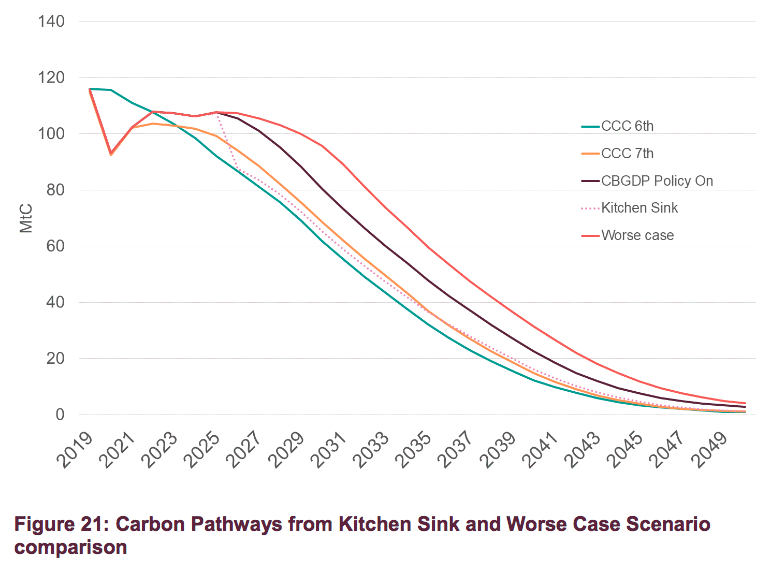
UK transport emissions are set to overshoot the Climate Change Committee’s (CCC’s) 6th and 7th Carbon Budgets.
That’s the conclusion of a new report, Overshoot, by Greg Marsden of the University of Leeds.
Carbon Reduction
The government’s Carbon Budget & Growth Delivery Plan (CBGDP) is around 15% less ambitious than the CCC’s 7th Carbon Budget (which itself is less ambitious than the 6th Carbon Budget).
The CBGDP plans for another 10 million vehicles by 2050, a trajectory far higher than the current trend. The DfT is therefore over-estimating growth in vehicle ownership.
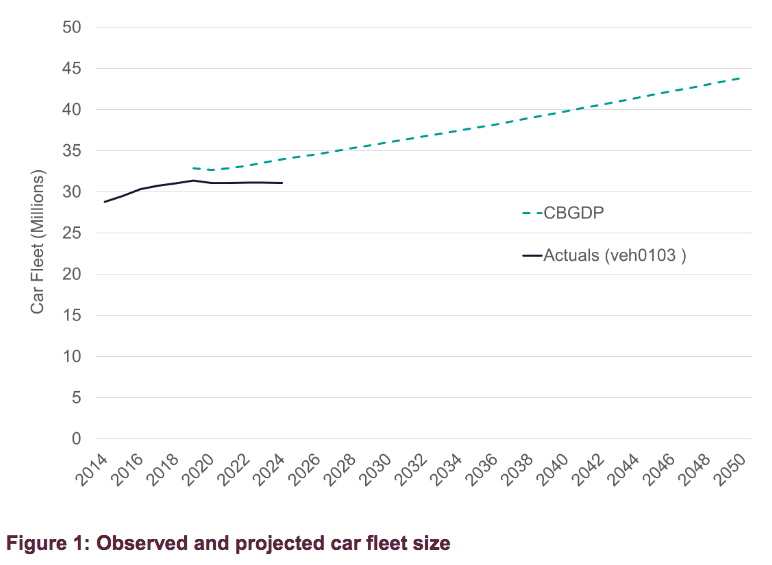
Because the government is over-estimating vehicle sales, it is over-estimating electric vehicle adoption.
Also, although Battery Electric Vehicles (BEVs) will make up most new vehicles, they are more carbon-intensive to manufacture than Internal Combustion Engine (ICE) cars.
Manufacturing emissions may be accounted for under a different heading to transport emissions, but they are still a consequence of transport policy.
Road Traffic Levels
Although the government thinks there will be far more vehicles, they expect them to be driven 14% less by 2050.
Previous research has shown that for transport emissions to come within the Carbon Budgets, there must be an absolute reduction in vehicle miles travelled of at least 20%.
However, government policy in the CBGDP for the period 2025-2040 is for traffic levels only 1% lower than business as usual (represented by the National Road Traffic Forecast).
This means 16% more traffic in 2040 than in 2025.
It also means that the DfT is planning for annual growth in car traffic which is more than double the actual rate from 2000 to 2024.
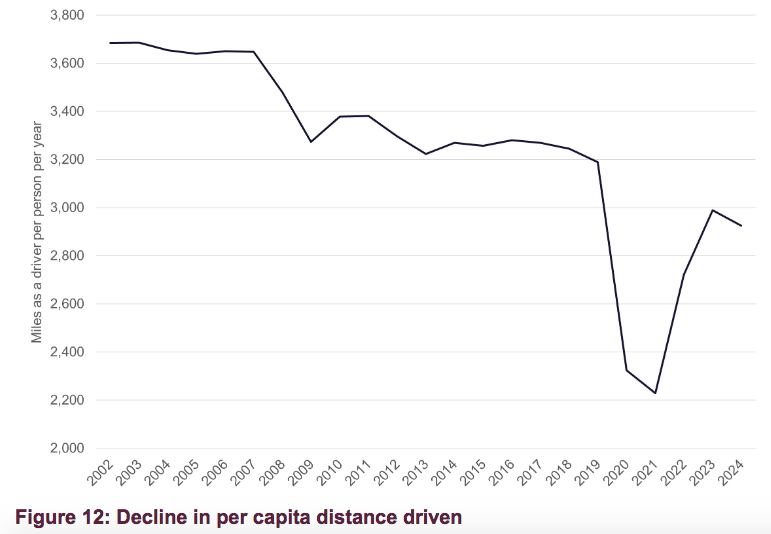
Although the population is increasing, distance driven per person is going down.
The report’s conclusion is:
‘There is no serious commitment to road traffic reduction either in relative or absolute terms implied in the CBGDP’.
It’s worth adding that the National Road Traffic Projections lead to a 27% rise in congestion by 2060, which impacts on productivity and growth.
Conclusions
The CBGDP represents an overshoot of 223MtC compared with the 7th Carbon Budget.
Even slippage in BEV adoption targets of two years leads to an overshoot of 425MtC. That corresponds to the whole of the carbon budget for transport for 2031 to 2050.
From one government delivery plan to the next, the level of ambition on carbon reduction from surface transport diminishes.
Road traffic reduction is the main tool to get us back on track.
The report also suggests:
- fewer cars which are more shared between households or communities
- carbon impacts of new roads being a determining factor in whether to go ahead
- transport planning should be done on the basis of more realistic assumptions about vehicle ownership, road traffic growth and fleet turnover
- honest but ambitious pathways for reducing traffic growth
- establish a task force to explore new mobility solutions
In relation to reducing traffic growth, the report notes that under new Local Transport Plan guidance, local authorities will be obliged to report Quantifiable Carbon Reductions (QCRs) from their actions.
QCRs are also part of Integrated Settlements with Mayoral Combined Authorities.