Cycling in Yorkshire

Cycling in Yorkshire
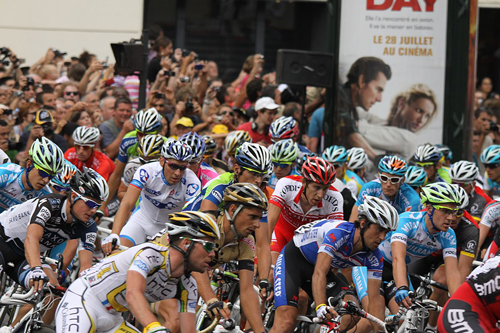
Stage 21 of the Tour de France 2022 is the traditional finish on the Champs-Elysées, with a sprint to round off the race.
It will be preceded by the first stage of the Women's Tour de France, on a circuit in the heart of Paris.
This is the Stage 21 TDF 2022 Blog.
| Date | Sunday 24th July 2022 |
|---|---|
| Stage classification | Flat |
| Distance | 115.6km |
| Intermediate sprint | Haut des Champs-Elysées |
| Climbs | Côte du Pavé des Gardes |
This is the official stage map:

This is the profile of Stage 21, Tour de France 2022:

| Caravan | Fast Schedule | Slow Schedule | |
|---|---|---|---|
| Start Time | 1430 | 1630 | 1630 |
| Entry onto the final circuit (59.5km) | 1616 | 1808 | 1816 |
| Finish Line (115.6km) | 1926 | 1943 |
Stage 21 starts at Paris La Défense Arena.
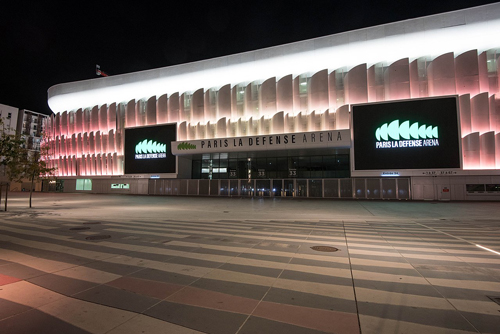
The Arena at La Défense is a multi-purpose stadium.
La Défense is a commercial and office area of Paris with tall buildings, outside the Péripherique. It's because it's outside the city that skyscrapers can be built there.
The area was developed from the late 1950s onwards. The centrepiece of the area is la Grande Arche de la Défense, one of the Grands Projets of Président François Mitterand in the 1980s.
La Grande Arche is the third of three triumphal arches, which are in a dead straight line. The line begins with the Arc de Triomphe du Carousel at the Louvre, and runs along the Champs Elysées and through the Arc de Triomphe. It then continues along Avenue Charles de Gaulle and across Pont de Neuilly to the triumphal arch at La Défense.
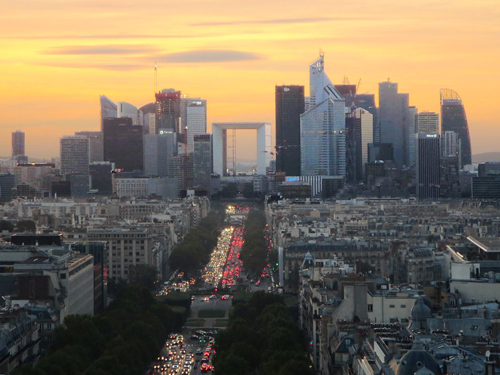
Stage 21 starts from the Arena at La Défense. Kilometre zero, where the flag goes down and the racing could start but doesn't on the final stage, is at Puteaux.
The riders pass Rueil-Malmaison. The Château de Malmaison is where Napoléon and Joséphine de Beauharnais lived.
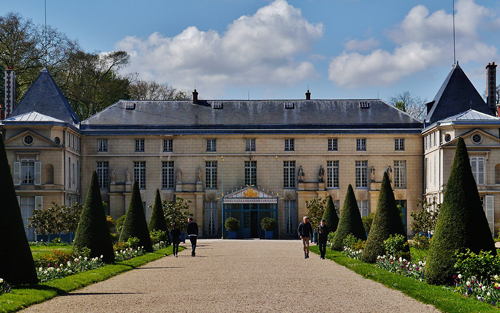
From Rueil-Malmaison, the peloton heads to Saint-Cloud, then west into the Yvelines département. It then returns to Paris via Versailles.
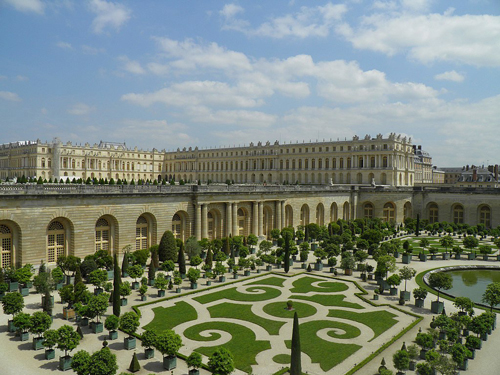
The Palais de Versailles is much too big. It was built by a king with an oversized ego. It is furnished and decorated in horrendous taste. It's far too busy, and if you visit you'll spend all your time either queuing up or jostling with thousands of other people on the way round part of the house. There is a distinct smell of stale pee in most of the rooms.
Don't let me put you off visiting the gardens though. You can hire a rowing boat or a bike, or you can bring your own bike and ride round. The sorbet ice creams are very nice too. Finally, on certain days the original fountains play.
Versailles started off as Louis XIII's hunting lodge.
Louis XIV was inspired by a visit to finance minister Nicolas Fouquet's residence at Vaux-le-Vicomte. The King had Fouquet arrested, then got to work building Versailles into a huge palace between 1661 and 1715. He used Fouquet's team of Le Vau (architect), Le Nôtre (landscape gardener) and Le Brun (painter).
Louis wanted his court and nobles to live at Versailles, so he could keep an eye on them and prevent any plotting. That's why it had to be so big.
Louis XVI was at Versailles when the French Revolution started. He was marched back to Paris and forced to live in the city, initially in the Tuileries palace, instead of out in the countryside.
Napoléon Bonaparte began the process of turning Versailles into a museum, and under the Louis-Philippe in the 1830s, it was designated as a Museum of the History of France.
The Treaty of Versailles that formally ended hostilities in World War I was signed in the Hall of Mirrors.
These days, other than being a giant tourist attraction, foreign heads of state are sometimes received at Versailles.
From Versailles, the route continues east on the D10 then D181 to Meudon, where a branch of the Paris Observatory was founded in the ruins of the old Château de Meudon.

The only King of the Mountains point is available at the Cote du Pavé des Gardes.
At the Quai d'Issy-les-Moulineaux (by the Seine), the riders pick up the boulevard that runs inside the Péripherique, and follow it until the Avenue Jean Moulin.
They then head for the Place Denfert-Rochereau, the Avenue of the same name, and the Boulevard Saint-Michel.
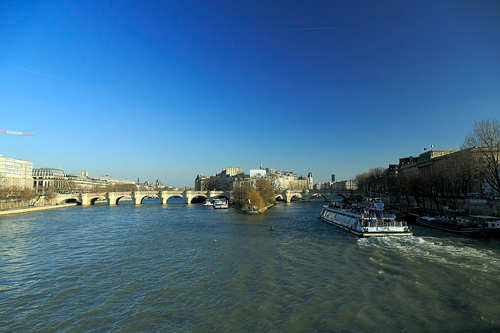
Next it's over the Pont Neuf, at the western end of the Ile de la Cité, and that brings them to the Palais du Louvre and the finishing circuit.
The intermediate sprint is just after passing the finish line for the third time. The finish comes when the peloton reaches the line for the ninth time.

The Champs-Elysées is the most famous street in Paris.
It runs for 1.2 miles from place de la Concorde to the Arc de Triomphe at Charles de Gaulle Etoile.
The lower part of the Champs-Elysées was originally laid out by André le Nôtre as an extension of Tuileries gardens in 1667.
The street was extended from Rond-Point up to Etoile under Napoléon Bonaparte. The Arc de Triomphe was commissioned by Bonaparte but not completed until after his fall from power in 1815. The Champs-Elysées was remodelled under Emporer Napoléon III from 1854.
The Bastille Day parade takes place here every year.
There are eight traffic lanes on the Champs-Elysées, and it is very polluted. In 2021 Mayor Anne Hidalgo announced plans to cut space for motor vehicles by 50%, create 'tree tunnels' to improve air quality, and to give more space to pedestrians.
Apparently work will only begin after the 2024 Olympic Games, and
won't be completed until 2030.
At the time of writing I don't know which sprinters will still be in the race, and who will be on form.
Fabio Jakobsen, Dylan Groenewegen, Wout van Aert, Jasper Philipsen and Caleb Ewan seem like good bets.
Who do you think will win Stage 21?

Rough Guide to France.
Price £14.39 from Amazon as at 3rd March 2022.
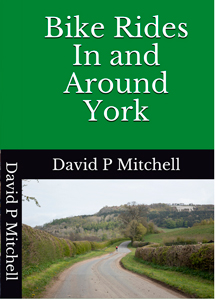
Bike Rides In and Around York features a historical city tour, plus family rides, road rides, and mountain bike rides.
"This book is simply a treasure trove not only of great rides but also as a travel guide to the area."
Read more about Bike Rides In and Around York.

Bike Rides in Harrogate and Nidderdale is a book of family, mountain and road bike rides.
"This guide is a wonderful companion whether you ride alone, with family or friends. Don't set out without it."
Read more about Bike Rides in Harrogate and Nidderdale.


