
N Yorkshire Still Putting Up Incorrect End of Route Signs

North Yorkshire County Council (NYCC) are still putting up incorrect, ill-advised or unnecessary END OF ROUTE signs.
The sign pictured above has appeared on the Otley Road Cycleway.
Cycle Infrastructure Design LTN 1/20 says that they are not mandatory and should be used sparingly.
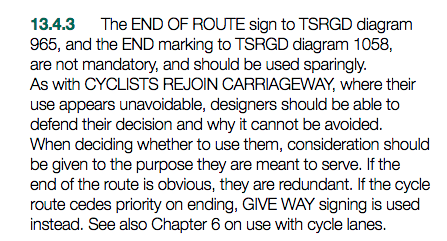
A positive instruction (such as CYCLISTS REJOIN MAIN CARRIAGEWAY) is preferred.
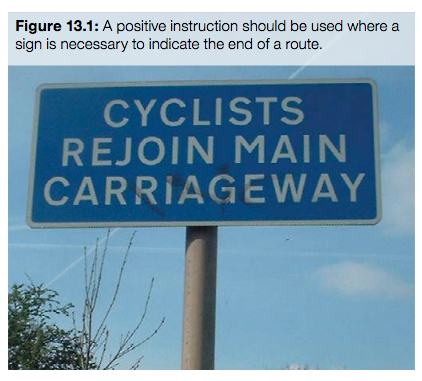
This is not the end of a route; cyclists are supposed to join a cycle lane leading to an Advanced Stop Zone at the Cold Bath Road junction.
CYCLISTS REJOIN MAIN CARRIAGEWAY is correct. END OF ROUTE is unnecessary and incorrect, but NYCC just can’t help themselves.
Quality of Provision after END OF ROUTE Sign
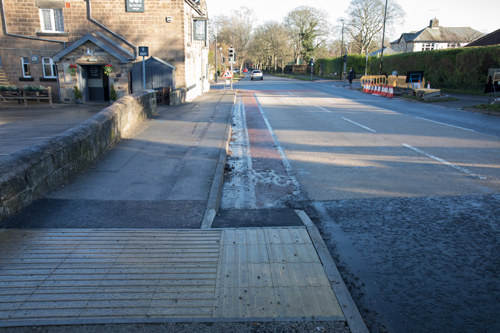
The quality of provision after these signs is abysmal. The ramp is just 93cm wide, so the cycle lane must be around 1m.
Cycle lanes with no physical protection are not appropriate on busy roads.
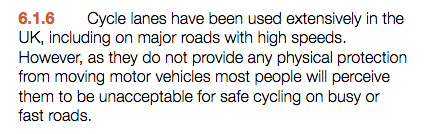
Where a cycle lane is appropriate, the Desirable Minimum width is 2m and the Absolute Minimum is 1m50.
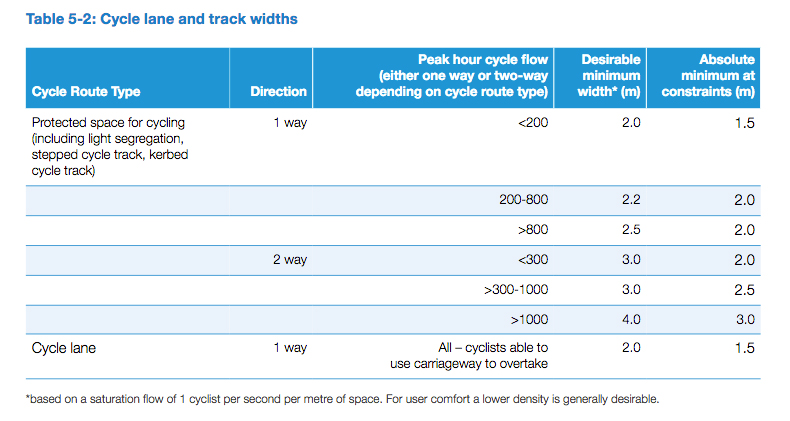
What’s needed instead of a cycle lane is a kerb-protected cycle track at least 1.5m wide.
It should lead to a convenient arrangement at the lights. At the lights, there should be an early release for cyclists, and a painted cycle lane across the junction to give priority over left-turning vehicles.
The facilities also need to continue the other side of the junction, further down Otley Road. NYCC promised to consult on Phase 2 of the Otley Road Cycleway this month (September 2022), but so far there has been no announcement.
Obstructing Cycle Facilities
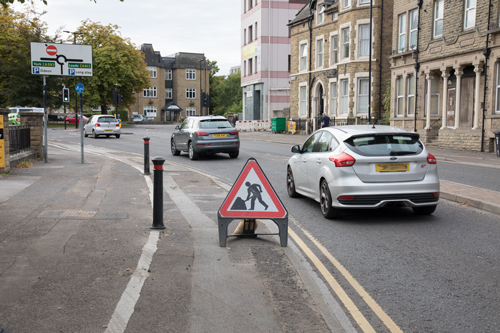
Elsewhere in Harrogate, there have been road works on Station Avenue. The contractors carrying out the work on behalf of NYCC have felt it necessary to obstruct the cycle lane on East Parade with a road works sign.
We have few enough cycle facilities in Harrogate, so it’s pretty disappointing that one of those few is obstructed.
The road works sign was placed just where there’s a bollard, to ensure maximum inconvenience.
I asked one of the workers why it had been put there. ‘This is a rural area, so it has to go in the cycle lane,’ was his dubious explanation.
They could have put it on the central reservation; they could have put it half-and-half in the road and on the cycle path.
But they see motorists as important and cycling and insignificant.