
Reversing the Decline in Active Travel Would Have Substantial Health Benefits – CMO
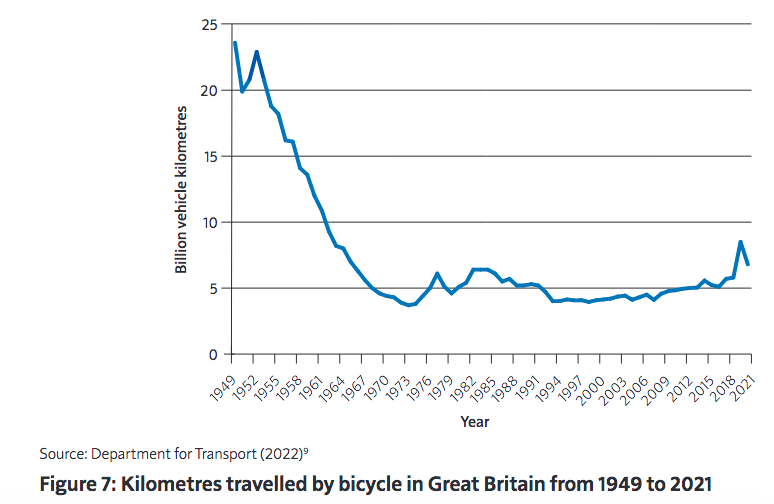
Reversing the decline in active travel would have substantial health benefits, according to the Chief Medical Officer Chris Whitty.
In his Annual Report 2022, he focused on the topic of air pollution. There is an Executive Summary, and a full report.
Air Pollution Affects Us All
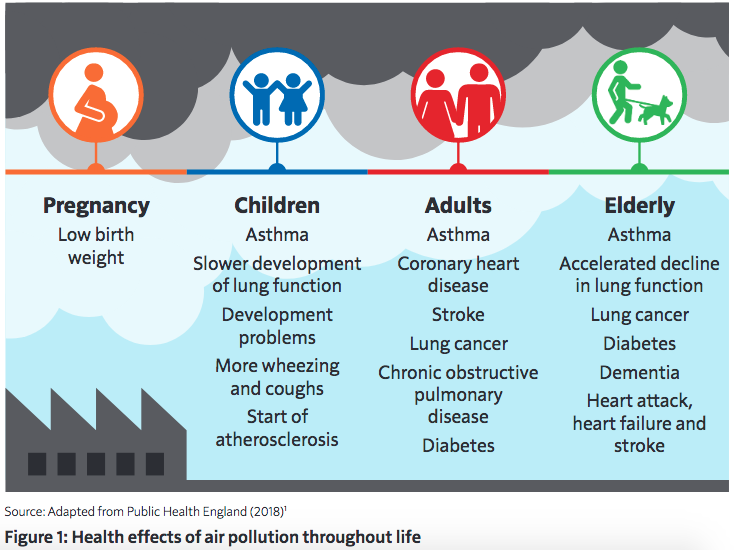
Air pollution affects us all, says the Introduction to the report. It impacts lung development, heart disease, stroke, cancer and asthma.
It is estimated that there are 26,000-38,000 premature deaths in England as a result of air pollution every year, plus non-fatal chronic ill health.
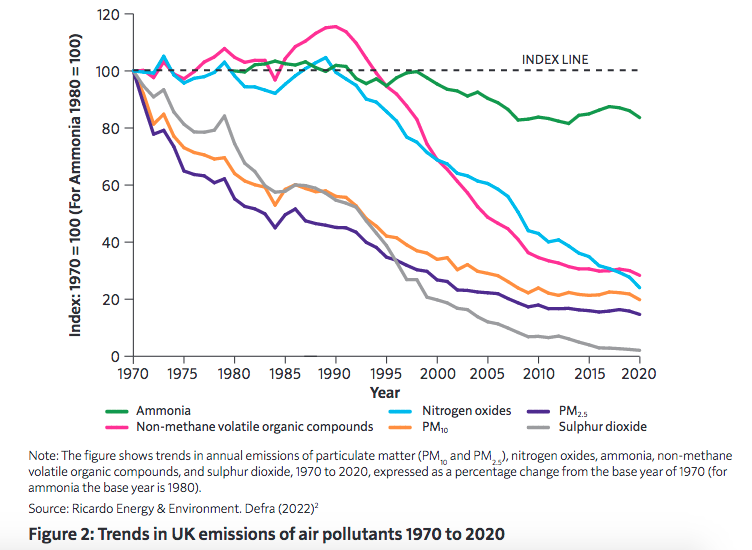
Outdoor air quality has improved since the 1980s, but we can and should go further, concentrating on places where people live, work and study.
Transport
Two of the most important pollutants from road vehicles are particulates and nitrogen oxides. They are falling, and should fall further as zero tailpipe emission vehicles take over.
Once petrol and diesel vehicles are phased out, emissions from tyre wear and resuspension of road dust will remain.
Active travel has fallen a long way since the 1950s. The graph at the top of the page shows this, in kilometres travelled by bicycle in Great Britain, 1949-2021.
‘Reversing this decline would have substantial additional health benefits due to physical activity being built into the normal day, in addition to reductions in air pollution. Improving the infrastructure for active travel is a necessary, although not sufficient, step towards more active trips taken safely by all ages.’
active travel in the executive summary
Urban Planning
The detailed section on urban planning is written by Chief Planner Joanna Averley.
She says that the planning system and health outcomes are intrinsically linked. The overarching objective of the modern planning system is to contribute to sustainable development.
‘Urban planning can help ensure that new neighbourhoods are designed in a way that reduces vehicle dependency, through the creation of compact, mixed-use neighbourhoods where people can access local services. It can also encourage active travel through the provision of infrastructure for cycling and walking and the design of streets and public spaces that people feel confident and comfortable using.’
urban planning section of cmo’s 2022 annual report
Averley refers to the National Model Design Code, which should be the basis for local authorities’ planning guidance. It emphasises that:
‘Turning the hierarchy of road and pavement users upside down, and enabling the health benefits of walking and cycling to be a first choice when making a journey, is a huge prize for health and wellbeing, as well as air quality. This is about designing for everyone in a community, irrespective of mobility.’
urban planning and active travel
Planning infrastructure for electric vehicles is important, ‘but this should not reduce the emphasis on a modal shift away from private cars to public transport, walking and cycling.’
As well as reducing air pollution, the co-benefits of increased walking and cycling include:
- health benefits of physical activity
- reduced carbon emissions
- economic benefits from reducing congestion and increasing footfall in retail areas
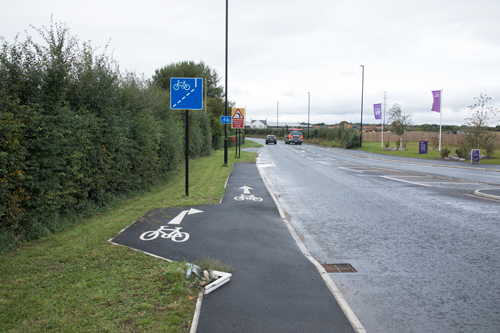
The logic is unanswerable, and it’s the Chief Planner making the argument. Unfortunately, it’s down to councils to implement all this, and when I look around locally, this is what I see.
Active Travel
The detailed active travel section is written by Trafford Director of Public Health Eleanor Roaf and Research Fellow at the University of Westminster Harrie Larrington-Spencer.
It says that in 2020, cycling’s modal share in Great Britain was 3%, compared with 26% in the Netherlands. The trend here has been upwards since 2011, though.
For children and young people, regular physical activity is associated with better mental health, cardiovascular fitness, healthy weight, and improved learning and attainment.
In adults, it protects against heart disease, type 2 diabetes, mental health problems, obesity and social isolation.
The most effective active travel interventions have an element of carrot and stick:
- make active travel safer and easier
- place some limits on motor vehicles
- recognise and address cultural and social factors
‘Changing people’s behaviour is easier when the environment changes to support it. When more people travel actively, this encourages others and makes it safer for everyone.’
quote from the active travel section of the cmo’s 2022 annual report
Low Traffic Neighbourhoods are effective because they simultaneously improve conditions for active travel and reduce the convenience of driving short journeys.
Other interventions include School Streets, physically-protected cycle tracks, 20mph limits, and bicycle trains to school.