
Bus Operators Propose £7 Congestion Charge Zones
Bus operators have asked the government to implement congestion charge zones in English towns and cities, urgently and widely.
The proposed charge for driving in urban areas is £7. It should only be applied once bus services have been increased, so there is a genuine alternative to driving.
The proposals were made in a report written by WPI Economics that the Confederation of Passenger Transport submitted to the the DfT and Department for Levelling Up earlier this month, according to an article in the Telegraph.
Congestion charges would be an important part of ‘carrot and stick’ measures to make bus travel more attractive. Without such measures the report says that net zero targets will be missed.
‘Without a significant step change to government policy, current decarbonisation targets will not be met.’
matthew oakley, research director at wpi economics
Carrot and Stick
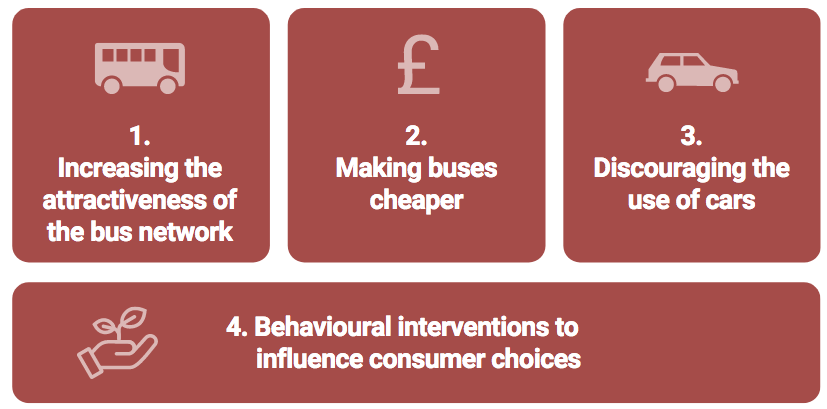
Buses need to be made more attractive at the same time as discouraging car use.
The key is to combine policies rather than relying on one or two.
An Ambitious Strategy
The WPI Economics report says that modal shift is ‘necessary, desirable and possible’, but piecemeal interventions will not deliver the scale of change required. Instead, an ambitious strategy will be needed.
There is a gap in the increase in bus passenger numbers forecast under current policy, and what’s needed to meet climate targets:
- bus passenger numbers will increase by 10% from 2019 to 2050 under current policy, but
- they must increase by 79% in order to meet the UK’s climate targets
Making buses free at the point of use would be expensive (£4bn a year) and only deliver 11% of the modal shift needed. The WPI Economics report therefore rejects that option, and recommends a three-pronged approach including congestion charges.
Recommended Approach
The three-pronged approach includes:
- widespread congestion charges
- employee incentives to use the bus
- a £2 cap on bus fares
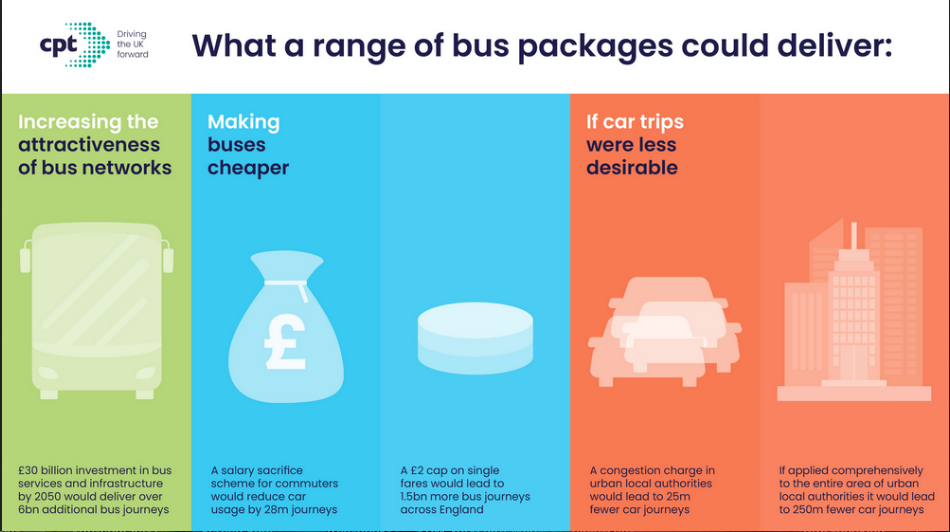
Funds raised by congestion charges would amount to around £17bn per year, and could be reinvested in the bus network. The total recommended investment in buses to 2050 is £30bn. This would deliver 6bn extra bus journeys per year, of which 1.8bn would replace car trips.
An employee incentive scheme has the potential to increase bus journeys by 55m per year, of which 28m would replace car trips.
A £2 fare cap would lead to 215m extra bus trips per year, of which 65m would replace car journeys.
The measures and benefits are set out in this graphic.
Cambridge has recently proposed a £5 congestion charge.
When Mr Johnson was Prime Minister, he launched a bus strategy with £3bn of funding. Slightly more than half of local transport authorities have benefited from this so far, but 31 of 79 have not.