
Only 20% Traffic Reduction by 2030 Consistent with UK Climate Goals
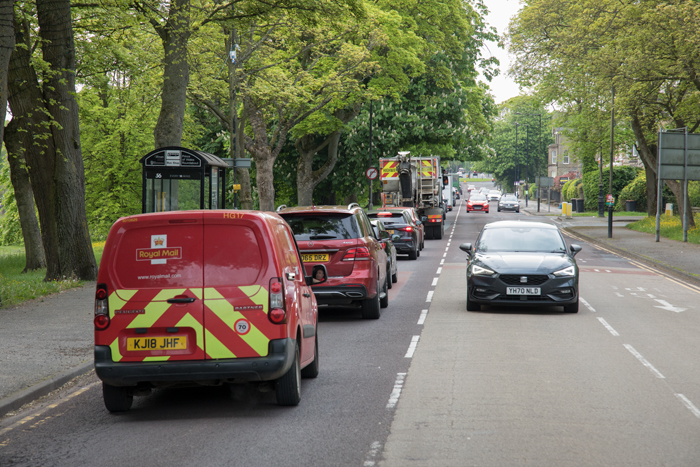
A 20% traffic reduction by 2030 would be consistent with the UK’s climate goals as set out in the Climate Change Committee’s (CCC) Balanced Pathway.
Unfortunately the UK government is planning for traffic growth instead. That’s according to Reverse Gear, a paper by Professor Greg Marsden of the Institute for Transport Studies in Leeds and the Centre for Research into Energy Demand Solutions.
TL;DR
The government should publish data to enable open carbon accounting.
The government’s plans now are 72% less ambitious than the high ambition pathway in the Transport Decarbonisation Plan.
The government appears to have given up on mode shift and travel demand management. Policies would be needed, and they are not there.
Both the National Road Traffic Projections and the National Policy Statement for National Networks anticipate traffic growth.
The government’s electrification plans are low ambition, and it has no plans to make ICE vehicles more efficient.
Given the technology pathway the government has chosen, traffic reduction of 20% by 2030 would be needed to stay in line with the CCC’s 6th carbon budget.
Background
Reverse Gear notes that the DfT published its Transport Decarbonisation Plan (TDP) in 2021. The government’s Net Zero Strategy, the Carbon Budget Delivery Plan (CBDP), was released in March 2023.
The assumptions and data behind the TDP were not made public, and Professor Marsden had to submit a Freedom of Information request in order to obtain them. Only after the Information Commissioner instructed the DfT to release the information did it do so – in January 2023.
Carbon Budgets
The TDP has a high ambition and a low ambition pathway. Only high ambition gets us close to the CCCs Balanced Pathway in the 6th Carbon Budget.
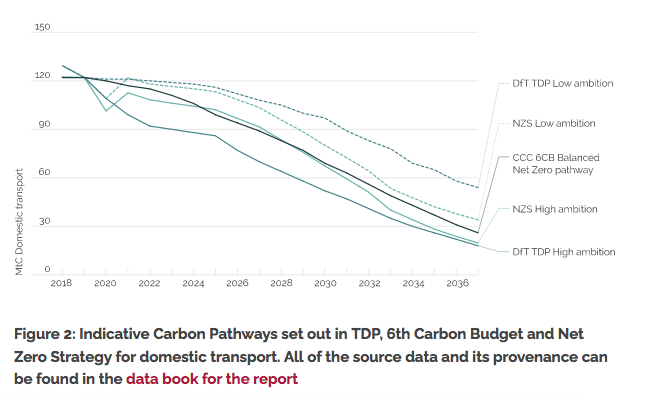
When the TDP high ambition pathway is compared with the CBDP from the government’s Net Zero Strategy, the CBDP shows a cumulative total of 411MtC extra emitted between 2023 and 2037.
This means the CBDP is 72% less ambitious than the most ambitious TDP pathway.
Travel Demand
The CBDP has little to say about influencing travel demand.
It mentions enhanced investment in walking and cycling. There is also a reference to Quantified Carbon Reductions that may be required of local authorities in their new Local Transport Plans. (Guidance for LTPs is awaited and long overdue).
Together, they represent a carbon reduction of just 8MtC for 2023-37, compared with the CCC’s estimate of 211MtC.
Prof Marsden’s conclusion is that demand management has disappeared from the decarbonisation agenda.
‘…[A]ny switch away from the private car cannot simply be desired, it has to be brought about. That would require a very different set of policies and funding commitments than is in play today.’
prof greg marsden, reverse gear
Road Traffic Levels

The National Road Traffic Projections (NRTP, December 2022) only have one scenario where traffic does not increase – the behaviour change scenario. Trips made per person reduce by 39% (commuting) and 55% (visiting family and friends).
This won’t happen without any supporting policies.
Both the NRTP core scenario and the draft National Policy Statement for National Networks anticipate traffic growth.
Electrification
The government began a final consultation on its Zero Emission Mandate, concerned with electrification of the vehicle fleet.
It is close to the TDP’s low ambition pathway.
Electrification is positive from a decarbonisation perspective, but also has negative implications. Cost per mile is about 17p for an ICE vehicle, and 8p for an electric car.
This makes driving an electric car cheaper once bought, so more attractive. In the absence of road pricing, this will increase congestion.
The CBDP contains no mention of road pricing in its policies to 2037.
The cost difference per mile between ICE and electric vehicles also means that driving becomes cheaper for richer people who can afford new cars, and more expensive for poorer people who can’t.
Carbon Pathways
The DfT is planning for the delivery of the lowest ambition pathway from the TDP. This is because it is:
- planning for road traffic growth
- legislating for low rates of electrification
- not intending to improve efficiency of ICE vehicles
Reverse Gear looks at various pathways based on those three factors.
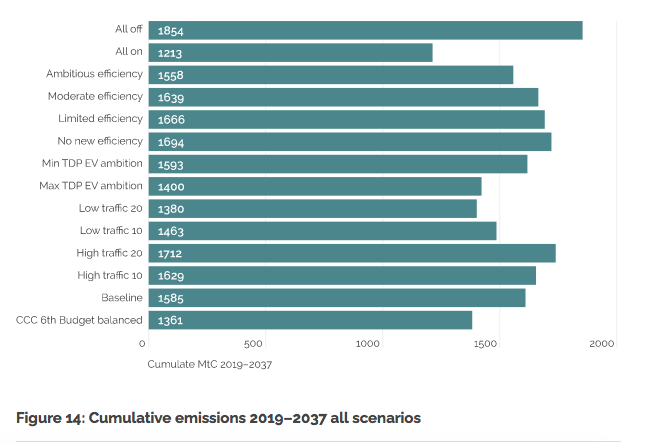
Notes about the graphic:
- Baseline reflects core government assumptions about traffic growth, electrification and efficiency
- High traffic 10 and high traffic 20 assume traffic growth 10% and 20% above the NRTP core
- Low traffic 10 and low traffic 20 assume traffic growth 10% and 20% below the NRTP core
- There are also pathways based on rate of electrification, and on efficiency of the ICE fleet
- All off means no policies to reduce emissions, and all on is applying all possible policies in the three areas (traffic growth, electrification and ICE vehicle efficiency)
Given the technology pathway the DfT has chosen, traffic reduction of 20% by 2030 relative to current plans is needed to stay in line with the 6th Carbon Budget pathway.
Traffic levels in 2037 would need to be lower than pre-pandemic, and electrification and ICE vehicle efficiency are also needed.
Implications
The government is planning to do nothing on mode shift or travel demand management. That is the main reason why 72% of the TDP ambition has been lost.
The only pathways that align with the CCC’s carbon budget involve a 20% traffic reduction by 2030.
‘England is currently in a false prospectus on transport and climate change. Many local authorities have set ambitious targets for carbon reduction which are way beyond the national ambition, particularly as the national ambition has been reduced. It is inevitable that there will be a delivery mismatch with, it seems, far less emphasis being placed on behaviour change nationally than has been deemed necessary and desirable locally.
The forthcoming round of Local Transport Plans is an opportunity to realign ambition scales. But in what direction? Will local authorities accept the downgrading of ambition or demand a different approach from national government?’
prof greg marsden in reverse gear
The CCC will have to assess the government’s backtracking on emissions reduction goals in its 2023 Progress Report to Parliament (July).
‘Pathways with reductions in car mileage will require a step change in funding and delivery of alternatives to the car which is not currently being planned for. Every year that passes with business as usual transport delivery reduces the potential shift to such pathways. If there is not a step change in our approach to behaviour change in the next five-year Local Transport Plan period then it feels as though it will be too late as there will be a firmer lock-in to a more car dependent electric future which itself will undermine the alternatives.’
prof greg marsden in reverse gear