
Disadvantage of the Term ‘Active Travel’
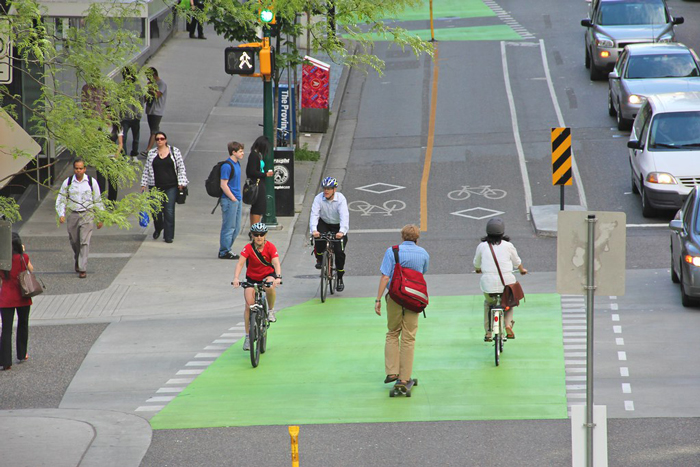

The term ‘active travel’ means getting about in a physically active way. It covers walking, wheeling and cycling, and usually refers to short trips such as those to school, work or the shops.
Scooting and skateboarding fall within active travel too, and it has been suggested that horse-riding and paddle-boarding should be part of the category as well.
‘Active travel’ was hardly used in article titles before the year 2000, and it has cropped more and more frequently since 2007.
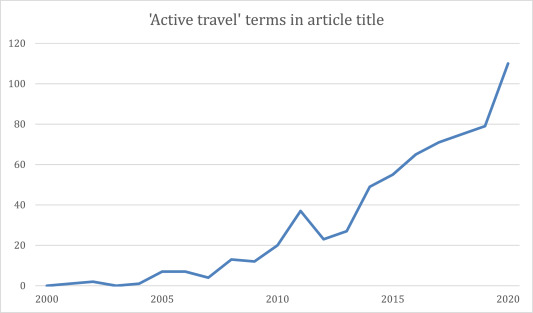
The term has become so much part of the mainstream that we now have an government agency which incorporates the term – Active Travel England.
Advantages of the Term ‘Active Travel’
There may well be advantages to talking about ‘active travel’. These could include:
- a broader coalition with more sway when asking for infrastructure funding
- using a more neutral term than ‘cycling’ or ‘cyclists’
On this latter point, Helen Pidd wrote an article last year about some people’s irrational hostility to cyclists. She recounts being told that all cyclists should be put up against a wall and shot; and being persistently called an ‘absolute prick’ by one Twitter user.
This hostility to cyclists is generated or amplified by some newspapers, like the Daily Mail.
To add a bit of nuance, Sustrans reports on one Australian study which showed that ‘cycling’ was more likely to be portrayed positively in the media than ‘cyclists’.
Still, it does seem that certain people are hostile to anything connected with bicycles. Thus ‘active travel’ infrastructure could be popular with more people than ‘cycling’ projects.
Disadvantage of the Term ‘Active Travel’
There is also be a potential disadvantage to using the term ‘active travel’.
If you live in an area with a local authority that isn’t committed to cycling, it can talk about ‘active travel’ in order to muddy the waters.
Such authorities focus on increasing capacity for motor vehicles. They don’t do cycle infrastructure, but if they throw in the odd pedestrian crossing they can call it an ‘active travel improvement’.
Thus the term ‘active travel’ is used as cover for prioritising motor vehicles and failing people on bikes.
This has happened in Harrogate on Otley Road, where North Yorkshire Council has dumped the cycleway that was central to its original funding bid, and is spending money on new traffic lights to increase capacity for motor vehicles instead.
The package also involves some tinkering with crossings and a 20mph zone, as well as a daft cycle scheme on a road that’s already very quiet – but essentially meaningful improvements to cycling have been excluded.
That’s the problem: a council doing nothing for cycling but still wanging on about ‘active travel’.
‘Sustainable Transport Measures’ and ‘All Users’
In the case of Otley Road, the package is labelled as ‘sustainable transport measures’ – the most expensive of which is explicitly designed to increase capacity for motor vehicles.
The council talks about spending the money on ‘all users’. If this were genuinely sustainable transport funding it would not be spent on drivers, who are by definition unsustainable transport users.
The lesson from this is that if a council is determined to communicate in Doublespeak it will do so, and it’s not really the fault of the specific terms which are being abused.
It all comes down to the good faith of the person or organisation using the language.
It pays, though, to be aware of the potential pitfalls of the term ‘active travel’.
Is it being employed in a helpful way to argue for improvements that enable walking, wheeling, cycling and other active modes? Or is it being used as a smokescreen to stop people noticing that cycling is being cut out of investment and infrastructure?