
All Party Cycling Road Justice Report
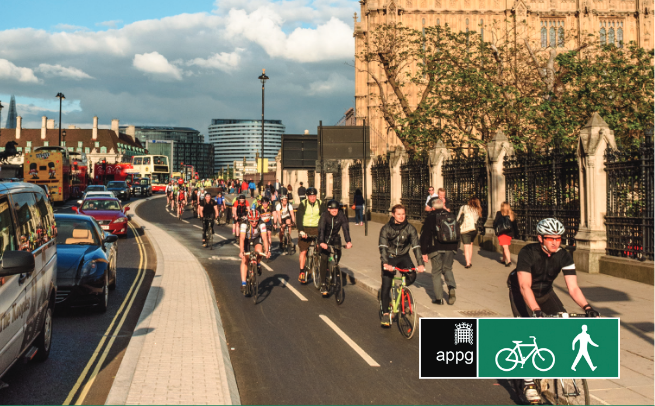
The All Party Parliamentary Group on Cycling and Walking (APPGCW) has published a new Road Justice report. It is a follow-up to the APPGCW’s inquiry into cycling and the justice system in 2017.
Introduction and State of Play
The Introduction contains some passages which provide reassurance that there people in Westminster who understand active travel and are well-disposed towards it.
This is vital at present, when the Transport Secretary and Prime Minister are clearly hostile to the active travel agenda, and doing their best to undermine progress over recent years.
The report says:
‘The UK is a car-driving nation. This is not to say that everyone drivers or even wishes to – far from it. But there is a strong tendency to see car ownership and use as normal and desirable; as right. And, by implication, walking, wheeling and cycling as unimportant or even eccentric.
Our built environment is full of signals that confirm this, such as the pelican crossing, where the walker/wheeler must request permission to interrupt the flow of vehicular traffic. This stands in contrast with rhetoric about these modes becoming “the natural first choice”.
introduction to appgcw road justice report
Under the heading State of Play, the report adds:
‘The perception of those who walk, wheel and cycle is shaped by what they see and hear. They see examples of bad driving…and they hear of a justice system that is, we argue, too forgiving of bad driving.
Those who drive impatiently, discourteously or, worse, maliciously, need more reason to believe they cannot do so with impunity. And those who are at greatest risk of injury need to have more confidence that bad driving will not be tolerated.’
state of play section of appgcw road justice report
The Inquiry
The 2017 Inquiry was extensive, with five oral evidence sessions. It resulted in 14 recommendations.
There has been progress on some of them, with a revised Highway Code that includes a hierarchy of road-user responsibility and a specific passing distance when overtaking cyclists.
The 2023 Inquiry was ‘light touch’. Evidence was taken from eight experts, who included Cycling UK Head of Campaigns Duncan Dollimore and Chief Superintendent Andy Cox.
The result is ten recommendations.
The Recommendations
The recommendations are split into Group A and Group B.
Group A contains more ambitious proposals, with large potential benefits. Group B consists of uncontroversial ideas which could in principle be implemented quickly.
A1) Escalating Penalties for Repeated Offences
Previous road traffic convictions can be an aggravating factor, but there is no increase in maximum penalty.
The report recommends escalating penalties for repeat traffic offences.
A2) Compulsory Re-Testing
Re-testing is compulsory for people convicted of dangerous driving, but not for lesser offences.
The recommendation is that anyone disqualified from driving should face a re-test.
A3) Increased Maximum Sentence for Dangerous Driving
The maximum sentence for dangerous driving should be increased to 4 years.
A4) Exceptional Hardship to be Truly Exceptional
23% of drivers who amass 12 penalty points successfully use the ground of ‘exceptional hardship’ to escape disqualification.
There should be automatic disqualification, with the possibility of appeal to the Crown Court.
A5) Removal of Tolerances in Speed Enforcement
Drivers who travel up to 35mph in 30mph zones will generally not be charged with speeding.
All Party Cycling recommends that tolerances be removed.
B1) Thorough Investigations of Serious Collisions
The problems here include inconsistent thresholds for the involvement of serious collisions investigation units, and inconsistency in the rigour and professionalism of investigations within and between police forces.
The report recommends the development of guidance based on best practice, and that it should be adopted widely by police forces.
B2) Standardising 3rd Party Reporting Systems (Op Snap)
Submitting dashcam or helmet cam footage is easy in London, and resulted in 12,000 NIPs in 2022. The system is not as good in some other areas, and there is no submission portal at all in Scotland
There should be a standardised system across police forces, with standard rules for assessing and acting on evidence. The Home Office should coordinate and fund this.
B3) UK Commissioner for Road Danger Reduction
A Commissioner would help join up the various parts of the justice system (police, CPS, courts) and hold all parties to account.
B4) Treating Crash Victims as Victims of Crime
According to the Victims’ Code, crash victims have certain standard rights, but crash victims are rarely granted the status of victim.
This should change.
B5) Widen Understanding of the Highway Code
The 2022 version of the Highway Code is great, but there has been limited publicity and therefore little change in practice.
The government should launch a very extensive and ongoing communications campaign, designed to increase understanding of and compliance with the changes.
Next Steps
Following the publication of the report, co-Chairs of the Group Ruth Cadbury and Selaine Saxby will be meeting with Ministers and lobbying for a Parliamentary debate.