
Birmingham Walking & Cycling Index 2023
Sustrans has published its bi-annual Walking & Cycling Index for 2023.
The Index was previously known as Bike Life, and was inspired by Copenhagen’s Bicycle Account. It looks at progress made towards making walking, wheeling and cycling more attractive in selected cities, and includes an independent survey of attitudes.
There are 23 cities in the UK and Ireland. Here I am focusing on the report for Birmingham.
Foreword
In the Foreword, Cabinet Member for Transport Liz Clements sets out the city’s vision for active travel.
‘As Birmingham’s Cabinet Member for Transport, my hope is that we can genuinely be a city where cycling, walking and wheeling are for everybody, everyone feels safe, and all citizens can experience the sheer fun and enjoyment of getting outside and incorporating active travel into their everyday lives.
We have a vision for our city which puts walking, wheeling and cycling first for shorter journeys and to link to public transport for longer trips. We want to move away from car dependency and embrace the benefits to health, emissions and the economy which a genuinely sustainable transport network affords’.
liz clements, cabinet member for transport
Headlines
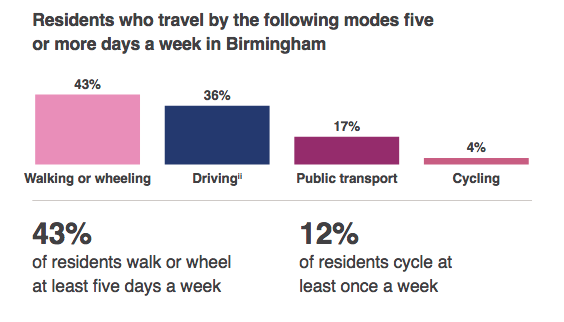
Walking and wheeling are the most common mode of travel (43% who travel that way 5 or more days a week). This is more than driving (36%) and public transport (17%).
Cycling is at 4% (5 days or more), but 12% cycle at least once a week.
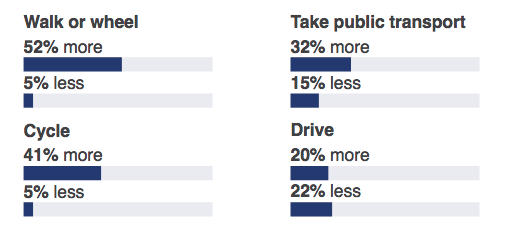
There is an appetite to walk, wheel and cycle more, as well as take public transport more. Those who would like to drive less outweigh those who want to drive more.
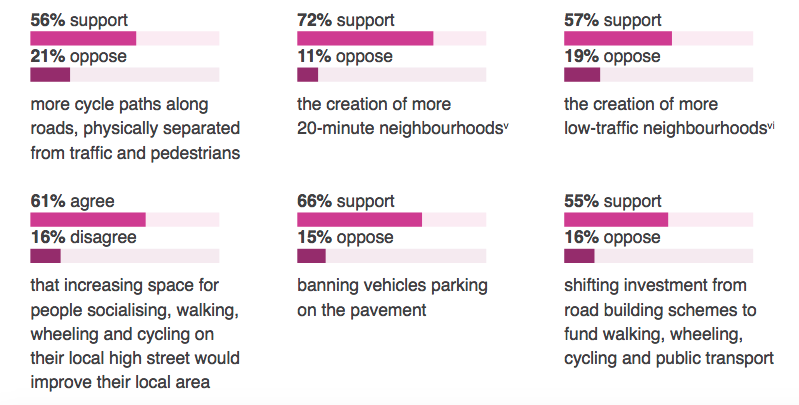
There is strong majority support for cycle tracks and LTNs. The majority also support banning pavement parking and moving investment from road-building to sustainable transport.
Cycling
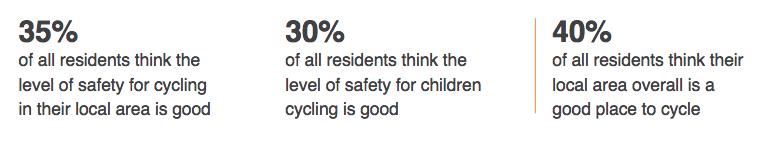
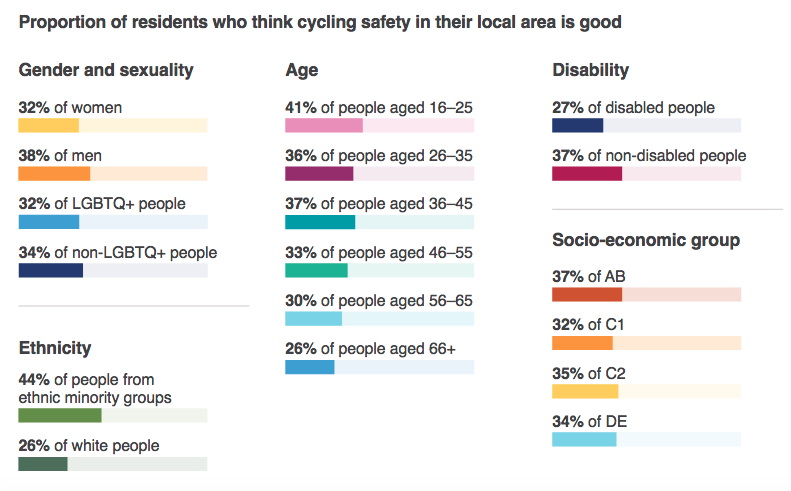
Only 35% of residents perceive cycling to be safe – so 65% do not.
Men are more likely to consider it safe to cycle than women.
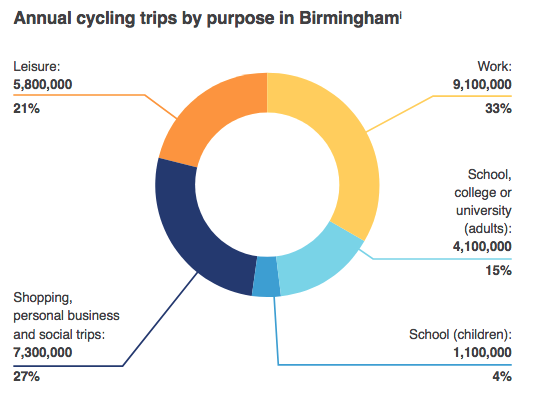
The report calculates that 27.4 million cycle trips were made in Birmingham in 2023. The health benefits of this save the NHS £2.9 million a year.
Cycling Solutions
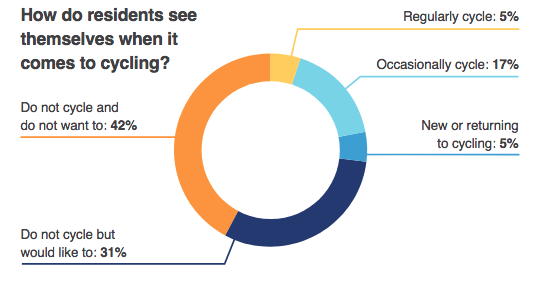
27% do some cycling, but there is huge potential for more cycling.
Although 42% are not interested, 31% do not cycle but would like to.
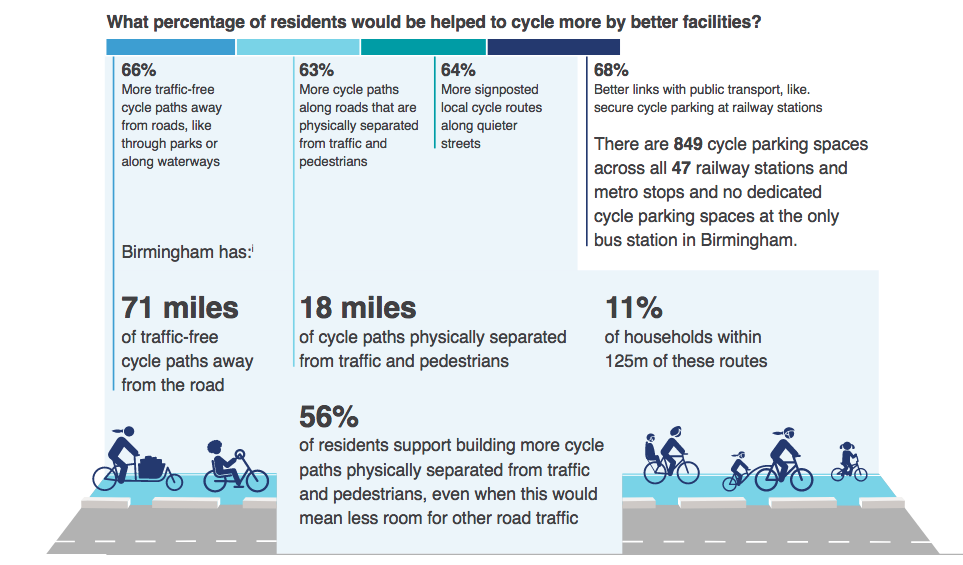
Support for cycle infrastructure (paths away from traffic, cycle tracks on main roads, and quietways) is well above 60%.
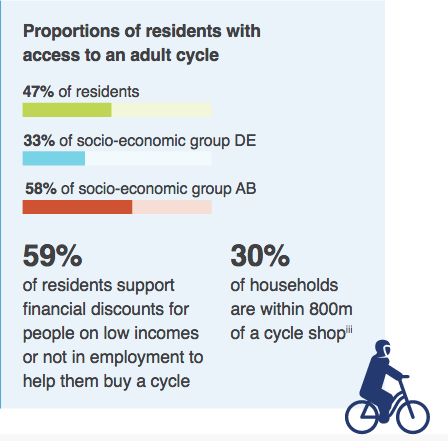
Access to an adult cycle is surprisingly low, so measures to increase access could be quite effective.
Developing Birmingham
Birmingham’s Transport Plan, adopted in October 2021, sets a target to reallocate a third of road space away from general traffic to more sustainable modes, and to have a third of neighbourhood streets under low-traffic conditions.
The city has 20 School Streets.
In terms of protected cycle tracks:
- the A34 cycle route has been extended through Perry Barr to the station
- a spur off the A38 cycle route links to Edgbaston Cricket Ground and Cannon Hill Park
- a major scheme is under way on Dudley Road, towards the City Hospital
- a scheme on the A45 Coventry Road is being developed
- a scheme on the A38 Selly Oak to Longbridge is also in development
Footways have been widened in Sutton Coldfield, and more will be widened this year in Kings Heath.
Birmingham wants Healthy Streets, where cars are guests and people are the primary users. This will enable cycling without dedicated infrastructure in residential neighbourhoods. Cycle tracks will be built on main roads.
Work is ongoing to remove circulating traffic from the city centre.