
CCC Seventh Carbon Budget and Active Travel
The Climate Change Committee (CCC has today published its Seventh Carbon Budget.
It contains advice to the government under the Climate Change Act 2008. The Seventh Carbon Budget is for the period 2038 to 2042, but to reach the emissions targets government action must begin now.
Executive Summary
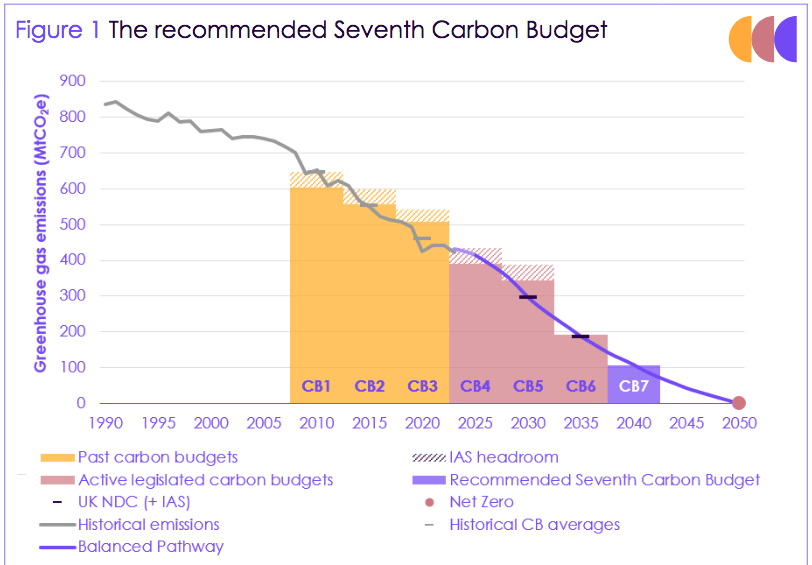
The CCC’s advice is based on its Balanced Pathway. Much of the pathway’s decarbonisation will come from electrification. Restoring peatlands and planting new woodland also have roles to play.
Direct air capture will be required to balance residual emissions, ‘principally from aviation’.
Demand reduction will play a part too.
The CCC estimates the costs of Net Zero at 0.2% of GDP per year. Investment up front will lead to net savings in the period of the Seventh Carbon Budget, because renewables and electric technologies are more efficient than combustion of fossil fuels. For example, heat pumps are 3 to 4 times more efficient than gas boilers.
The CCC says that the most impactful choices households can make are buying an electric car and a heat pump.
The next step is for the government to propose a level for the Seventh Carbon Budget, to be approved by Parliament by 30th June 2026. The government must also bring forward proposals and policies to enable the carbon budgets to be met.
The CCC’s next Progress Report is due in June this year.
Surface Transport, Including Cycling and Walking
The CCC’s comments on surface transport are in section 7.1 of the report.
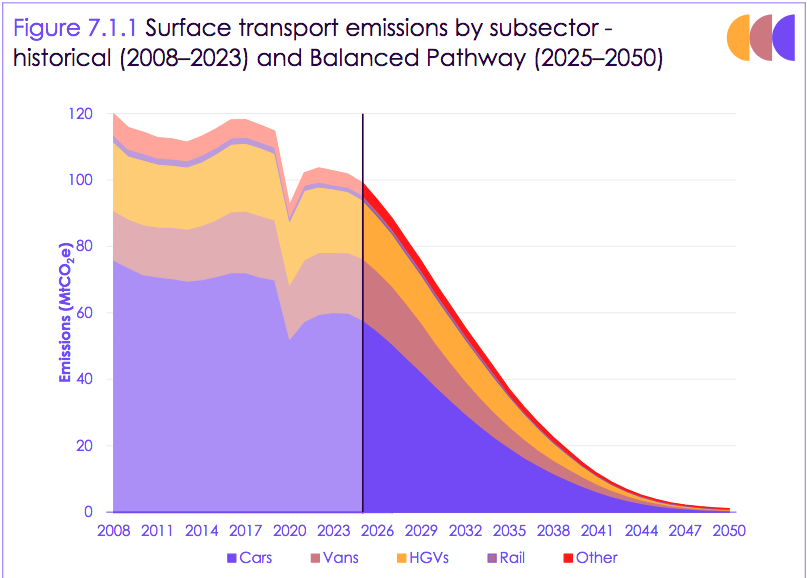
The Committee points out that surface transport represented 24% of UK emissions in 2023. It has been the highest-emitting sector since 2015.
Reductions in emissions from vehicle efficiency have been offset by a trend towards large cars and SUVs. Policy intervention may be needed to limit further vehicle size increases.
In the Balanced Pathway, surface transport emissions fall 86% from 2023 to 2040.
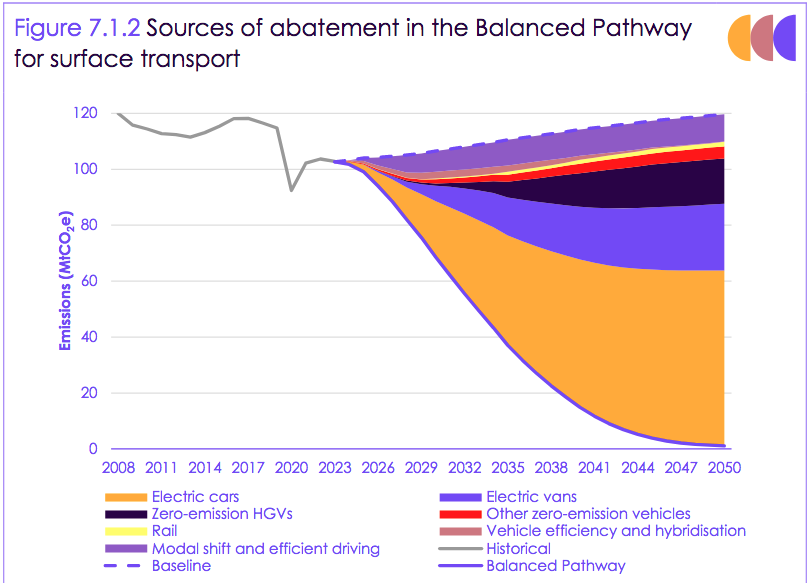
Modal shift is expected to contribute 9% to emissions reductions by 2040.
Modal shift away from cars in the Balanced Pathway is 4% by 2030 and 7% by 2035. Its effectiveness comes primarily early on, before the vehicle fleet has shifted away from fossil fuels.

The largest element of emissions reduction will be a move to electric vehicles, according to the CCC.
Electric Vehicles

The CCC says that:
- new electric vehicles will reach price parity with ICE vehicles between 2026 and 2028
- used electric vehicles have already reached price parity with ICE vehicles
- the lifetime cost of an electric vehicle is already lower than for an ICE vehicle
The CCC says this about the likely effect of cheaper motoring on total miles driven/volume of traffic:
‘The lower cost of motoring for electric cars is assumed to lead to an increase in car-kilometres in our analysis, which more than offsets the overall reduction due to modal shift.
Although there is uncertainty around the degree to which this will happen, this increases electricity demand from EVs in our analysis and could have a significant impact on congestion.
It will be important to monitor this rebound effect and consider whether policies to control any increases in driving brought about by EVs are needed’.
There is a risk that a large proportion of EVs will be Chinese-made imports rather than vehicles manufactured in the UK.
The CCC notes that at some point there will no longer be a complete network of petrol stations.
Modal Shift
The CCC says this about modal shift:
‘Enabling people to choose alternatives to driving can reduce emissions and deliver a range of co-benefits…More will need to be done to encourage a further shift away from cars towards alternative modes of travel.
Improvements to make buses and active travel more attractive, affordable and accessible allow 7% of car demand to be switched to public transport and active travel by 2035, compared to the baseline. This is an ambitious assumption on modal shift, underpinned by evidence on interventions in leading countries such as Germany and the Netherlands, and in towns and cities across the UK.
Modal shift in our pathway is primarily driven by a move to buses, cycling and walking.
Transformative rail projects are unlikely to be delivered before 2035, after which all new cars will be electric and the emissions-saving potential from modal shift declines substantially.
The government may wish to go further on modal shift for reasons beyond emissions reduction, such as reducing congestion and energy demand.
Switching to active forms of travel, such as walking and cycling, will offer health and wellbeing benefits’.
One of the key actions to deliver the Balanced Pathway is:
‘Provide local authorities with long-term funding and powers to deliver increases in public transport, walking and cycling.
Long-term clarity is also needed on what funding streams will be available to implement plans and additional powers for local areas to deliver an integrated public transport offer’.