
Headwinds Transport Decarbonisation Report

A report about transport decarbonisation, called Headwinds and written by Leeds academic Greg Marsden, was published by the Energy Demand Research Centre in June.
One of the report’s key findings is that the government’s current plans and funding are nowhere near enough to achieve the level of modal shift away from private cars and to active travel and buses that are required by its climate targets.
Seventh Carbon Budget (CB7)

Emissions from transport are bigger than from any other source, at 29% of the total in 2023. The reduction from 2022 to 2023 was just 1%.
Back in 2016, a reduction rate from 2022 to 2023 of 5% was anticipated, but expected reductions have not materialised.
The Seventh Carbon Budget (CB7) is for the period 2038-42. It is shown, along with previous carbon budgets, in this graphic.

The government has to say how it will deliver the budgets through a Net Zero Strategy or Carbon Budget Delivery Plan expected in September 2025. The last two were declared illegal in October 2021 and March 2023.
The Climate Change Committee’s ambition on transport has reduced by about 10% between CB5 and 6 and CB7. This still leaves a steep downwards trajectory.

Can the CB7 pathway be delivered?
Mitigation Pathways

The graphic above shows the contributions to be made by different behaviours and technologies to the emission reduction pathway.
Electric vehicle take-up is assumed to be higher than required by the government’s ZEV Mandate.
In the pathway, modal shift away from private cars to buses and active travel is expected to be (relative to business-as-usual growth in vehicle use):
- 1% by 2025
- 4% by 2030 and
- 7% by 2035
Are these reductions credible? A Political, Economic, Social and Technology (PEST) analysis can shed light on this.
PEST Analysis
Politics
In political terms, over two thirds of the UK population thinks that we need to tackle climate change, and it is a priority of the Labour government.
On the other hand, the Conservatives and Reform have broken the previous consensus about Net Zero.
Some councils have set aspirational climate targets, but failed to deliver. ‘We are now in a period where delivery is key and poorly aligned targets will be unhelpful’.
Economy
The report’s commentary on economic factors notes that the government could have raised fuel duty, but chose not to do so.
Capital spending on active travel is approximately £154 million per year – lower than the levels in 2022-23 and 2023-24. It is less than Active Travel England think is necessary to meet their target of 50% of all urban trips walked and cycled by 2030.
Social
In social terms, CB7 assumes a 7% reduction in vehicle miles travelled by 2035 relative to the DfT’s traffic growth predictions.
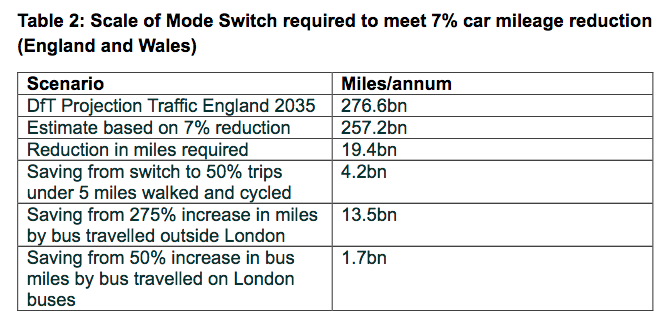
This would be a massive delivery and behaviour change challenge including – as the table above shows – a big increase in bus use.
‘There is evidence that, in other countries and, particularly with the advent of e-bikes, the potential for cycling to replace more short to medium length journeys exists’ but ‘there remains a large gap between the stated desired outcomes…and the pace and scale of change required to deliver that’.
Marsden says that there is potential for travel demand reduction, which has happened without any government policy. In 2023 people were driving 19% fewer miles than in 2002.

Technology
Electric vehicles are the key technology the CCC is relying on, but the CCC’s assumptions are more ambitious than current government policy.
Headwinds
The report identifies that progress to Net Zero is in a period of ‘headwinds’, or obstacles to progress.
The report’s author says:
‘Transport has failed to follow the ambition implied by the pathways set out in CB5 and CB6. As the largest sector of emissions in the economy, there is no scope for a further false dawn on decarbonisation ambition’.
He adds:
‘As we look to the Net Zero Strategy in September 2025, the government is tasked with determining how to square the circle of delivering a transport pathway outlined by the CCC that its spending plans are not resourced to achieve’.