Quantifying the Carbon Emissions of Local Transport
The DfT yesterday published Local Transport Quantifiable Carbon Guidance.
The guidance notes (1.1) that transport is the UK’s largest carbon-emitting sector and that ambitious action is needed.
The purpose of the guidance is to provide advice on carbon analysis for transport strategies and development of individual schemes. It also has suggestions for evaluating carbon impacts of schemes once they are complete.
Government Responsibility but Council Power
There is a conundrum which the guidance doesn’t resolve. The UK government is responsible for the country’s net zero target, but local authorities are in charge of local roads.
Giving optional guidance to councils and hoping that they will reduce transport emissions is not a certain or effective way of ensuring it happens.
This what the guidance itself says (2.1 onwards):
‘Reducing transport-related carbon emissions is vital for the UK to reach net zero [and] supporting people to choose public transport and active travel will have an important role to play.
While responsibility for achieving carbon budgets and Net Zero lies with national Government, local authorities are uniquely placed to influence transport decarbonisation through transport and place-based planning.
Transport strategies can have a significant influence on local transport emissions. They set a place-based vision for local transport and identify projects for investment that can help realise that vision through changes to the transport network’.
Whole-Life Carbon Impacts
The analysis that should be undertaken is Whole-Life Carbon assessment.
This means accounting for:
- capital carbon (construction, maintenance and end-of-life emissions of the infrastructure, plus habitat changes)
- operational carbon (impacts such as energy use for highway lighting, or resurfacing), and
- user carbon (e.g. exhaust pipe emissions, or modal shift to active travel)
Carbon assessments will compare ‘current’ emissions (a Business-as-Usual baseline) against Do Minimum and Do Something scenarios. They should go to at least 2050.
The baseline should include estimates of future emissions based on traffic growth forecasts. In most regions, ‘traffic modelling-based user carbon analysis’ has already been done (3.33).
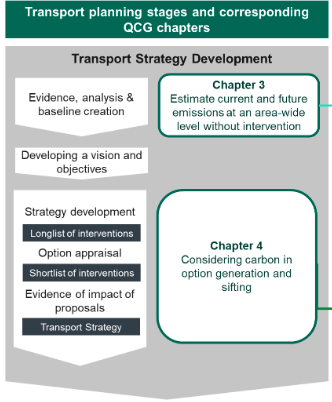
Carbon should be considered when developing a transport strategy and in generating and sifting options (4.2). Authorities should target the largest sources of carbon in their areas, and decide which interventions will decarbonise transport (4.10).
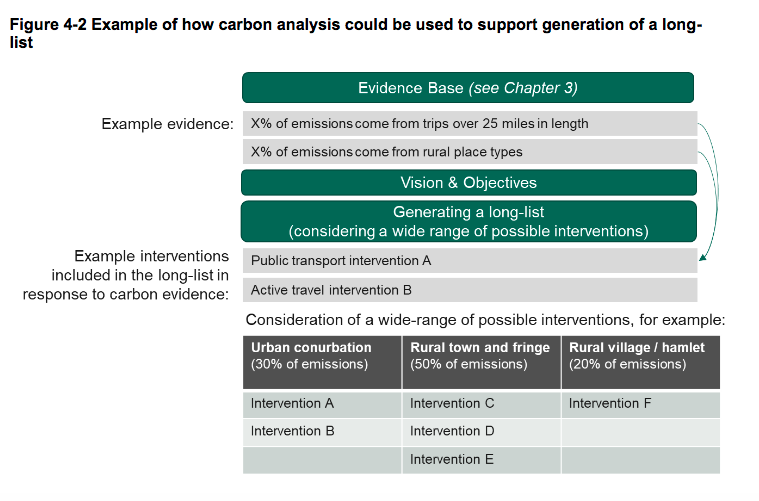
Carbon should be analysed when generating a longlist, and when sifting schemes to reach a shortlist.
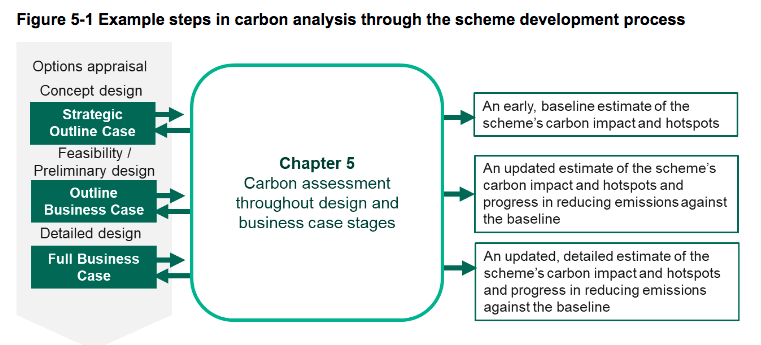
Further carbon assessment is needed through design and business case stages.