
Better Connected Integrated Transport Strategy
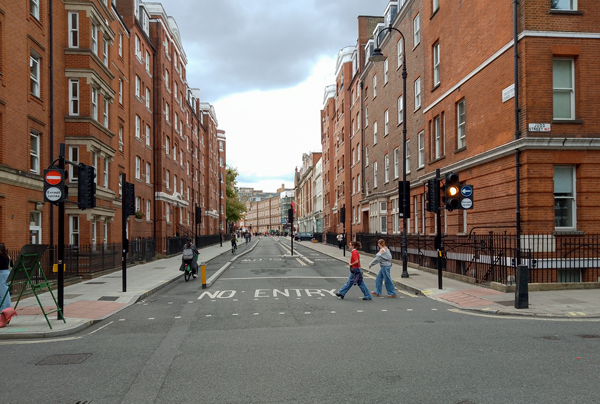
The government has published its strategy for integrated transport (‘the Strategy’) for England, which is called Better Connected.
Ministerial Foreword
The Foreword by Secretary of State for Transport Heidi Alexander contains little substance, and makes no mention of active travel.
She says that the Strategy is based on three core principles, people, place and partnership.
There’s a considerable element of passing the buck to local authorities.
‘Truly people-focussed transport is not something that can be delivered by government alone or overnight. We are empowering local leaders, who know their areas best, to take the reins’.
This failure by the national government to take responsibility has been a consistent theme from the government ever since Alexander took over from Louise Haigh.
A later section of the Strategy called Roles and Responsibilities says that national government sets policy and provides guidance such as the Local Transport Plan guidance, as well as providing funding.
It is then up to local transport authorities (usually Combined Authorities) to shape and integrate local transport.
Introduction
Cycling does get a mention in the Introduction, in the ‘what people told us they want’ section.
‘Greater choice in how they travel, whether that is people feeling safe to cycle to work or choosing to take the bus because the service runs frequently enough to fit around day-to-day life.
59% of trips in 2024 were by car; safety was reported as the top reason that people do not cycle (48% of respondents)…’
There is also a reference to many councils not feeling that they are up to the job of planning and delivering transport networks.
‘Only 54% of local authorities rated themselves as having good or fairly good capacity to plan and deliver transport, contributing to only 28% reporting bidding for funding at every occasion, potentially leading to lost opportunities’.
Strategic Framework

The Strategic Framework has a Vision: ‘transport will work well for people’. It is not exactly inspiring.
The Vision leads to the three P Principles.
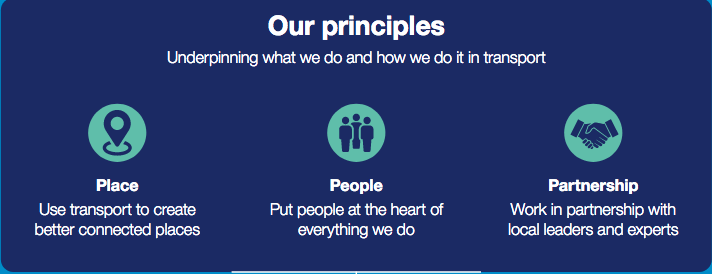
The Principles lead to eight Priorities.
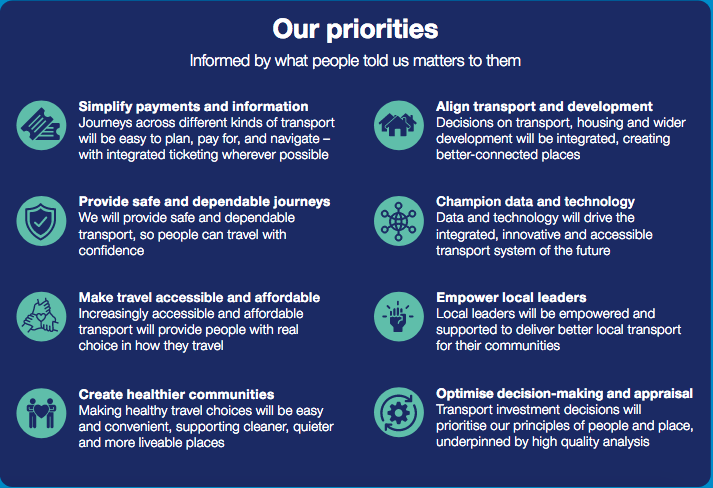
The document then goes into the Principles and Priorities in more detail.
Principles
The Principles are disappointing to say the least.
For example, under the Places heading, the Strategy says:
‘Most journeys begin or end at home, so it means ensuring homes are well connected to the places people want to go, that it is easy and practical to choose different options for travel, and it means taking care of our roads, cycle paths and pavements across the country so travelling around and between places is safe and easy’.
There are huge challenges related to transport, including road deaths and injuries, air pollution, greenhouse gas emissions and ill health due to inactivity and obesity.
The Principles section could have talked about reducing demand for travel, modal shift to sustainable modes, and reducing vehicle miles travelled – all of which are necessary to meet the government’s binding climate targets.
Instead, what does it say? Essentially, ‘let’s make travelling easy’.
To be fair there is a ‘spotlight on urban areas’ which mentions walking, wheeling and cycling, and aspires to make public transport cheaper and more convenient than driving.
In suburban areas, the Strategy says that walking, wheeling and cycling should enable first and last mile connectivity.
Priorities
I’ll pick out what’s relevant to cycling in the Priorities section; most of it is not relevant to cycling.
Provide Safe and Dependable Journeys
One paragraph under the Provide Safe and Dependable Journeys Priority refers to road safety. It says:
‘We want to reduce the numbers of people killed or seriously injured on British roads by 65% by 2035 using a 2022-2024 baseline, and see a 70% reduction in the number of children under 16 killed and seriously injured…’
This implies that a considerable proportion of the numbers killed (1,602 in 2024) or seriously injured (28,000 in 2024) on Britain’s roads will continue to be killed or seriously injured in 2035.
The government’s main tool for making cycling safer seems to be Bikeability training, which is useless without infrastructure.
The Strategy does also refer to ‘improving cycling routes’ as set out under the Create Healthier Communities Priority.
Make Travel Accessible and Affordable
There is to be some effort to make improvements for people with disabilities. The Strategy proposes an Accessible Travel Charter.
It also mentions blocked pavements. Its solution is devolved powers to enable local transport authorities to prohibit pavement parking.
This represents passing the buck once again, and is likely to result in pavement parking in some (probably most) areas but perhaps not in others.
The Strategy mentions floating bus stop guidance which has been published by Active Travel England.
On affordability of public transport, the Strategy says that the key is to get more people using it, increasing overall fare revenue.
For drivers, fuel duty is frozen until August 2026. The Strategy does not say how making driving cheaper will help reduce vehicle miles travelled or cut greenhouse gas emissions from transport.
Create Healthier Communities
Here the Strategy says that the government wants to improve ‘walking, wheeling and cycling infrastructure to enable everyday physical activity’.
It adds: ‘For cycling, a lack of safe routes remains a major barrier to uptake’.
‘[Walking, wheeling and cycling] are low and no cost ways to travel, and we want them to be easy, enjoyable and realistic choices for more people – both as ways of accessing public transport and as journeys in their own right – helping more people to incorporate activity into their daily lives’.
So far so good, but what is the government going to do about it?
The Strategy repeats the figure of £616 million in active travel funding from the June 2025 Spending Review. This amounts to £154 million a year for the whole of England, and is very much not the transformative investment that the government originally promised.
There is also transport funding to Mayors/Combined Authorities, some of which will be used for active travel projects.
The Strategy mentions a proposed national walking, wheeling and cycling network in collaboration with twelve Mayoral Strategic Authorities, cycle infrastructure design guidance for rural areas, LCWIPs for National Park Authorities, and possible repurposing of HS2 construction roads as traffic-free paths.
An updated Manual for Streets is to be published.
TSRGD will be updated to include simpler (and therefore cheaper) zebra crossings – without the need for Belisha Beacons, I believe.
Network Management Duty guidance is to be updated. The Strategy says:
‘This means treating all road users fairly by ensuring that footways (including pavements) and cycle paths are treated in the same way as the road infrastructure and recognising that every driver is also a pedestrian at some point – so places that work for pedestrians tend to work for everyone’.
There is an ambition to better integrate cycling and rail, including with better cycle parking.
In this respect, ‘Active Travel England will develop a framework for assessing the quality and connectivity of walking, wheeling and cycling routes to rail stations, as well as cycle parking provision, in line with best practice approaches for safety and accessibility’.
The Strategy adds:
‘Where cycle use is high, we will make more space available for cycles on trains whenever trains are bought or refurbished’.
The Strategy envisages working with local authorities and companies to scale up shared cycle and car club options, and establish more mobility hubs.
E-scooters are to be legalised after a trial ends in May 2028.
The Strategy says the government is investing £7.5 billion in the transition to electric vehicles. (Compare that to the paltry £616 million active travel funding).
The government is spending £2 billion giving car buyers £3,750 off new electric cars, and £600 million on charging infrastructure. It says it is reviewing the cost of public electric vehicle charging.
The Strategy has a section about reducing noise from transport. There are noise reduction measures in RIS3, so this will be mainly on strategic roads, but it also applies to railways and airports.
Align Transport and Development
There is mention here of vision-led transport planning at new developments, as set out in the National Planning Policy Framework.
‘We will be publishing updated Planning Practice Guidance for Transport outlining how we expect local authorities and developers to implement a vision-led approach.
This represents an important step in progressing our ambition for developments to be truly vision-led in practice’.
None of the provisions in NPPF about sustainable transport at new developments have had any effect in North Yorkshire, where council officers have continued with moto-centric, high-carbon business as usual.
The Strategy says:
‘Roads are essential growth corridors, but when planning transport for new developments, increasing road capacity alone is often the default choice which increases car dependence, leading to congestion and poor health outcomes.
Evidence in England shows that car dependency in new developments has risen or stayed the same largely due to homes being built without the provision of sustainable and affordable transport services.
Through proposed changes to national planning policy and a future update to the Planning Practice Guidance and associated Circular on the Strategic Road Network, we will consider how we set clear expectations that local authorities and developers should maximise sustainable transport interventions before considering any increase in road capacity’.
The Strategy mentions airport expansion at Luton, Gatwick and Heathrow, without explaining how the vast extra greenhouse gas emissions can be justified in the context of the government’s legally binding net zero obligations.
Empower Local Leaders
Local transport delivery is to be the responsibility of local transport authorities – usually Mayors/Combined Authorities.
They will have a Power of Direction over the Key Route Network in their region.
Strategic Mayoral Authorities are getting Integrated Settlements which include transport funding.
Key transport outcomes have been agreed with Established Mayoral Strategic Authorities; this means they do not need to get the DfT to approve transport business cases, except for the largest schemes.
Active Travel England’s capability ratings are used to offer local authorities targeted support, with the aim of increasing their capability.
Optimise Decision-Making and Appraisal
The Strategy says that the government will publish its new Appraisal, Modelling and Evaluation Strategy (AMES).
AMES will give more weight to factors including better health outcomes and improvements to quality of life from walking, wheeling and cycling.
It will guide future improvements to Transport Analysis Guidance, which is crucial in determining if transport projects can go ahead.
Monitoring and Evaluation
The delivery of the Strategy will be monitored and evaluated, with a progress update to Parliament.
This includes monitoring key metrics for each of the Priorities. For Create Healthier Communities, one of the metrics is the average number of walking, wheeling and cycling journey stages per year.