
Campaign for Safe Cycle Infrastructure on York’s Picadilly Continues

The campaign for safe cycle infrastructure on York’s Picadilly continues, following a council transport meeting on 17th May 2022.
Picadilly was one of the matters discussed at a decision session with the council’s Executive Member for Transport.
Background
The background is set out in a Director’s Report. It notes that:
- under the Castle Gateway Masterplan, Picadilly is to become a city living neighbourhood
- highways improvements associated with developments on Picadilly are being coordinated and dealt with as part of the Castle Gateway project
- Picadilly narrows at the northern end, near its junction with Pavement, making it hard to fit dedicated cycle infrastructure in there
- Picadilly could be made one way, but City of York officers are reluctant to do that
Officers’ preferred option is to reduce the carriageway to 6m50, which they say is the narrowest width for two-way bus traffic without buses having to slow to pass one another. As discussed in the comments below, that width could reduce further with a 20mph limit, or for short constrained sections. They also want to create wider pavements.
There would be no dedicated cycle infrastructure; cyclists would be expected to ride in primary position, mixing with traffic including buses. You’d have to be brave to do that.

Other options include a segregated bi-directional cycle track.

The report has an illustration of the council’s preferred option.

Objections to the Preferred Design
The fundamental objection to the design is that officers are continuing to prioritise motor vehicles over active travel. They have found it difficult to create dedicated space for cycling as well as widening pavements and maintaining two-way access for buses and private cars, so they haven’t bothered.
While most people would welcome wider pavements, a design that puts motor vehicles and lorry-loading ahead of active travel is not welcome. It looks like business as usual.
Decision
The decision was to accept Option B – which implements the preferred option, but with further engagement including on cycle facilities.
Executive Member for Transport Andy D’Agorne said, ‘There’s a lot of detail to look at, but the broad principle I completely agree with is the design of an attractive cycle route across a new bridge over the Foss needs to then link on to a clear network beyond it, notwithstanding the constraints that we have to work with.’
In effect, a decision on the exact design has not yet been taken. Officers would prefer it to include no cycle infrastructure, but Andy D’Agorne has told them that it should include cycle infrastructure.
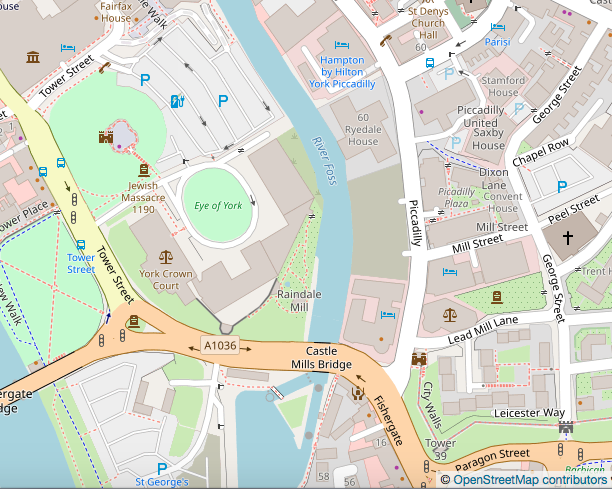
The new bridge over the Foss mentioned by the Councillor would link the Eye of York/Castle area to Picadilly.
York Cycle Campaign
York Cycle Campaign says there’s room on Picadilly, which is one of the widest roads in York.
They point out that:
- Picadilly is a key desire line into the city centre
- the preferred option does not comply with LTN 1/20 Cycle Infrastructure Design
- light segregation would be appropriate given the speed and volume of traffic
- an alternative back-road route would also not be LTN 1/20 compliant, because it is a Core Design Principle that cycle routes should be at least as direct as those for motor vehicles, and preferably more direct
On the requirements for buses, take a look at the detailed plans for Oxford’s Woodstock Rd (implementation of which is on hold pending funding) https://letstalk.oxfordshire.gov.uk/woodstock-road-improvements This has 6.4m for two-way buses, but that drops to 6.2m wherever there’s space constraints – and I’m told the bus companies were prepared to accept less if the speed limit were dropped to 20mph (which is the plan). So 6m is ok at 20mph, and for short pinches 5.5m can be accommodated.
That’s interesting, thanks.
In fact looking at the City of York report again, I see that 6m75 is the current effective width with on-street car parking, and they are recommending 6m50 as the min width that will avoid buses having to slow to pass one another.
So if buses having to slow to pass one another is not the end of the world, carriageway width could be less than 6m50, and it’s good to have the exact figures from Oxford.