
Local Transport Plan Guidance

New Local Transport Plan (LTP) guidance has finally been published.
It is for local authorities in England, outside London.
Introduction
The Introduction points out that 70% of all trips in England in 2024 were under 5 miles. It claims that local authorities know their areas well and are best-placed to tailor transport infrastructure to local needs.
Better active travel options get a mention.
An LTP should be a Local Transport Authority’s (LTA’s) vision for integrated transport in its area.
Moving Away from Predict and Provide
The guidance points out that Local Highways Authorities (LHAs) have a duty to ensure efficient movement of traffic, and reduce congestion on the network.
On the other hand, it specifically says that LTPs should be:
‘…moving away from the predict and provide model of transport planning, which aimed to forecast vehicle and transport need and then provide capacity to suit’.
‘LTAs should adopt a vision-led or outcomes-focused approach in their LTPs’.
One of the questions they should ask is ‘how are we prioritising and maximising sustainable transport options?’
Aligning LTPs with other Local Strategies
An LTP should provide the overarching transport strategy for the area, and the strategic vision and context for other strategies including the Local Cycling & Walking Infrastructure Plan.
Where the LTA is not the LHA, the two authorities should work closely together on the LTP.
An LTP should take a long-term view of the area’s transport needs. It will probably cover a period of 10 or 20 years.
The New Local Transport Funding Model
The DfT is simplifying funding for local authorities, giving multi-year, multi-modal transport settlements.
This is coupled with an outcomes-based assurance framework:
‘The government will set the local transport outcomes we want LTAs to achieve through the Integrated Settlement Outcomes Framework or the Local Transport Outcomes Framework…These should be built into LTPs when identifying priorities and assessing which projects to deliver’.
The new funding system involves:
- setting expectations through Outcomes Frameworks – the type of framework depends on whether the LTA is an Established Mayoral Strategic Authority or not
- setting what funding is available – an Integrated Settlement for Established Mayoral Strategic Authorities, a Mayoral Transport Fund for other Mayoral Strategic Authorities, and an Integrated Transport Fund for other LTAs
- setting out spending plans – Outcome Delivery Plans for mayoral authorities, and Local Transport Delivery Plans for other LTAs
- reporting to the government against the Outcomes Frameworks
- government support – where there are concerns about the LTA’s performance, they will get government support, for example from Active Travel England or the Bus Centre of Excellence
- evaluation – collect baseline data, track delivery (on time, to budget), and track progress against intended outputs and targets
Supporting National Priorities
LTAs have a statutory duty to ensure that their LTPs support national government priorities.
The DfT’s three strategic priority outcomes are:
- Enhancing growth and place
- Improving journeys for people
- Delivering green and healthy transport – reduce greenhouse gas emissions, improve air quality, and boost public health by supporting walking, wheeling and cycling
Also, the recently-published Better Connected integrated transport strategy contains eight priorities.
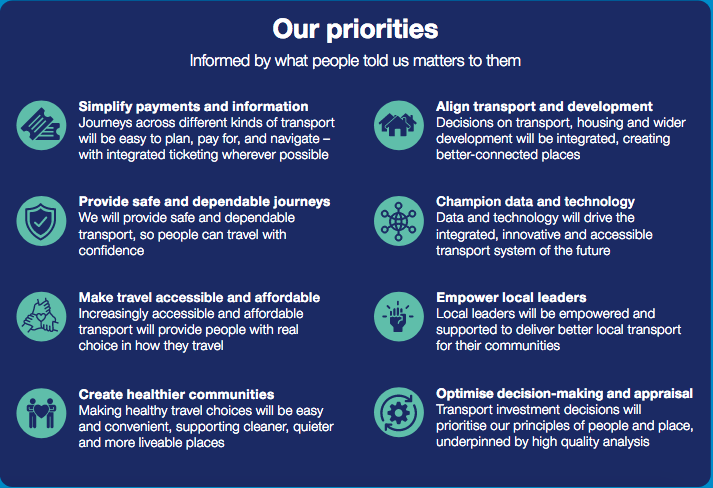
The guidance then deals with some but not all of the eight Better Connected priorities.
For example, road safety is included in the local transport outcomes frameworks, and new guidance will be published on setting local speed limits as well as a new Manual for Streets.
LTAs have statutory duties to ensure that transport services are accessible to disabled people. There will be an Accessible Travel Charter.
Accessibility should be a central theme of the LTP. LTAs should consider whether policies are needed to stop pavement parking.
Quantifying and Managing Carbon Emissions
The government published Quantifiable Carbon Guidance (QCG) in 2025; it must be used when developing LTPs.
LTAs also need to report on infrastructure emissions and user emissions of schemes included in their Local Transport Delivery Plans.
Large schemes which are ‘retained by the DfT for approval’ will need carbon management plans.
Going off at something of a tangent under the Quantifying and Managing Carbon Emissions heading, the guidance mentions active travel and public health:
‘Local transport systems have an important influence on both physical and mental health.
Transport policies and design affect everyday travel choices and can either encourage or discourage physical activity. Creating safe, convenient environments for walking, wheeling and cycling helps people build activity into daily routines such as commuting or travelling to school, improving physical health.
The importance of considering the health implications of transport will increase as we have an ageing population, some of whom may be living with reduced mobility and dementia’.
Aligning Transport and Development
The section on transport and development says that LTPs should be ‘vision-led and place-based’.
In support of this some of the things LTAs should do are:
- put people first and make sustainable transport considerations part of early engagement with local communities
- explore maximum local parking standards for new developments taking account of the connectivity of a development, levels of car ownership, opportunities for improvements to public transport as well as active travel and the needs of disabled motorists
- create well-designed streets to support development – streets should be safe, inclusive and attractive to all users, including through measures to minimise the scope for conflict between pedestrians, cyclists and vehicles
A government Connectivity Tool is available to professionals to help with this work.
LTAs should consider updating their LTPs when there are large new developments in their area, for example a new town.
Data and Technology
The guidance says it wants data and technology to be used better, to help improved decision-making.
There is a Transport Data Action Plan, and mention in this section of self-driving vehicles.
Designing and Maintaining the Local Road Network
Here, the guidance mentions the statutory duty of the LHA to secure expeditious movement of all traffic with a view to reducing congestion on the local highway network. (This is the source of a lot of car-centric local authority policies).
In fulfilling the statutory duty, LHAs must have regard to Network Management Duty guidance published by the DfT.
LHAs should work with National Highways where the local network operates alongside the Strategic Road Network.
There are some interesting passages on classification of roads here. In summary:
- LHAs should identify roads according to their location and the activities on them
- they should consider applying the concepts of place and movement set out in the Manual for Streets (MfS), and manage streets based on their function
- roads on the major road network, or interurban routes, are more likely to prioritise movement of through motor traffic
- for roads identified as streets, the MfS road user hierarchy should apply – walking & wheeling at the top of it, then cycling, public transport, with private motor traffic last
‘For example, in residential areas pedestrian needs may be considered paramount and footways, crossing points and street layouts designed accordingly, with a focus on clear, uncluttered environments which can be easily navigated’.
The LHA will have to produce a Highways Asset Management Policy and Strategy, setting out how they will manage their network in a sustainable, efficient and evidence-based way.
It should include clear objectives aligned with national priorities and the LTP goals, and performance monitoring.
Maintenance programmes should cover all parts of the highway network, including footways, cycle facilities, bridges and lighting columns.
Key Route Network
A Key Route Network (KRN) of the most important local roads is to be designated under the English Devolution Act.
Mayors have a power of direction over the KRN – to direct the LHA to undertake a specific action.
Active Travel
LTAs have to set out their active travel policies in the LTP, ‘setting out how walking, wheeling and cycling will be enabled, prioritised and integrated with other forms of local transport’.
The LTP policies should inform the LTA’s LCWIPs; the government will publish updated LCWIP guidance later this year.
The LTP should cover the following topics:
- A summary of local active travel policies and objectives
- A summary of measures required to deliver local active travel targets, including design assurance of schemes for example through a local Design Review panel, and a summary of measures to increase the capability of the LTA to improve delivery and quality of active travel measures
- A summary of overall approach to delivering appropriate infrastructure as part of LCWIPs
We’ve had plenty of warm words about active travel before, which haven’t led to delivery of on-the-ground improvements. Let’s see if it’s any different this time.
Electric Vehicle Infrastructure Charging Strategy
All LTAs must develop and publish an electric vehicle infrastructure charging strategy, including cross-pavement charging solutions.
Local Transport Outcome Frameworks
Local Transport Outcome Frameworks are a key part of the LTP guidance.
There are two types of Outcome Framework:
- Integrated Settlement Outcome Framework for Established Mayoral Strategic Authorities, with targets they are expected to achieve for each outcome and
- Local Transport Outcome Framework for other authorities: no specific targets, but performance assessed against a series of indicators
The performance indicators in the Local Transport Outcome Frameworks include:
- percentage mode share of trips by public transport
- public transport and walking & cycling connectivity score to key destinations using DfT Connectivity Tool
- bus patronage; bus punctuality, reliability and speed; bus passenger satisfaction; bus accessibility
- tram and light rail patronage
- miles of compliant new or improved active travel network delivered
- percentage of adults using active travel at least twice in the last 28 days
- active travel capability rating
- road casualties including, specifically, under 16 KSIs and pedestrian & cyclist KSIs
- NO2 monitoring/sites above legal limits
- annual transport carbon impacts to 2050
- public EV chargepoints; EV charging sockets and pavement channels on local authority land
There are also sections in the LTP guidance on buses and coaches, rail, light rail and taxis.