Cycling in Yorkshire

Cycling in Yorkshire
Stage
14 | Stage
15 | Stage
16

Stage 15 of the Tour de France 2023 is a 179km mountain stage from Les Gets-Portes du Soleil to Saint-Gervais-Mont-Blanc.
The climbs include the Col de la Forclaz Montmin and the Col de la Croix Fry. The stage ends with an ascent of the Côte des Amerands, swiftly followed by the climb to Saint-Gervais-Mont-Blanc Le Bettex and the finish line.
Stage 15 is likely to be important to the General Classification - an opportunity for the overall contenders to take time on their rivals. Vingegaard might try to crack Pogacar on the final climb.
These are video highlights of Stage 15 Tour de France 2023.
This is the Stage 15 TDF2023 Blog.
Race Details | Poll | Map & Profile | Timings | Videos | Food & Drink | Route Notes | Favourites
| Date | Sunday 16th July 2023 |
|---|---|
| Stage classification | Mountain |
| Distance | 179km |
| Intermediate sprint | Bluffy |
| Climbs | Col de la Forclaz Montmin (Cat. 1) Col de la Croix Fry (Cat. 1) Col des Aravis (Cat. 3) Côte des Amerands (Cat. 2) Saint-Gervais-Mont-Blanc Le Bettex (Cat. 1) |
This is a poll where you can vote for some of the main contenders to win Stage 15.
This is a map of the route of Stage 15, Tour de France 2023.

This is a zoom-able map of the route of Stage 15 of the 2023 Tour de France.
This is the profile of Stage 15 Tour de France 2023.

| Caravan | Fast Schedule | Slow Schedule | |
|---|---|---|---|
| Start Time (départ fictif) | 1105 |
1305 |
1305 |
| Start Time (départ réel) | 1120 |
1320 |
1302 |
| Col de la Forclaz | 1346 |
1519 |
1532 |
| Col de la Croix Fry | 1500 |
1631 |
1655 |
| Finish Line Le Bettex (180km) | 1636 |
1800 |
1836 |
This is a video overview of the route of Stage 15.
Stage 15 of the 2023 Tour de France has echoes of Stage 19 of the 2016 edition of the race.
In 2016, the race also climbed the Col de la Forclaz Montmin, and also finished at Saint-Gervais-Mont-Blanc Le Bettex. Romain Bardet won that day.

The Tour de France is still in the Alps today, so this is the land of Savoyarde specialities - fondue, raclette, pierrade and tartiflette.
Raclette involves a big wheel of cheese and an apparatus with a heating element. The element melts the top layer of cheese, and you scrape the melted cheese off (racler, to scrape) and eat it with potatoes, charcuterie and salad.
Vin de Savoie is often drunk with a traditional Savoyarde meal, but maybe you'd like to upgrade to a more refined wine. The Rhône valley is close by, so why not try a Côtes du Rhône?

Côte-Rôtie is from the northern Rhône region. It is made near Vienne, using red Syrah grapes and up to 20% white Viognier grapes.
Stage 15 starts in Les Gets (départ fictif), which is part of the Portes du Soleil ski area.

Les Gets is a ski resort on the col between Taninges and Morzine. The first (single person) chair lift was installed in 1938.
As well as skiing in Winter, Les Gets offers mountain biking in Summer. The downhill run on Mont Chéry has been used for lots of Mountain Bike World Cup events, and one World Championships.
There's also a golf course.
Les Gets has a Museum of Mechanical Music, and hosts a Festival of Mechanical Music every two years. If you go, make sure you deal with the organ-grinder not the monkey.
There's quite a long neutralised section leaving Les Gets and heading SW to Taninges on the D902. The flag goes down and the racing starts still on the D902 leaving Taninges (départ réel).
The riders pedal via Châtillon-sur-Cluses to Cluses.

Cluses is a town in the Arve valley. Cluse means narrow valley. A bridge was built here in the Roman era, and a village sprang up by it because of the trade that travellers brought.
Clock-making was introduced to Cluses in 1720, with a cottage industry supplying Geneva. In 1848 the Ecole Royale d'Horlogerie was founded, and clock manufacture became a mainstay of the Arve valley.
For many years Cluses was the HQ of the Mitchell Reel company, supplying reels for fishing rods.
Stage 15 continues in the Arve valley from Cluses via Bonneville to La Roche-sur-Foron.
La Roche-sur-Foron is part of the Grand Genève transborder agglomeration. The roche was one on which the Counts of Geneva built a castle, around 1120. The Genevois was sold to Savoie in 1401, and in 1860 Savoie became part of France.
From La Roche-sur-Foron, the climb of the Col des Fleuries (920m, uncategorised) begins. The riders descend to Thorens-Glières on the other side of the col.

Francois de Sales was born in the château at Thorens-Glières; he was later Bishop of Annecy. Cavour - Prime Minister of Piedmont and instrumental in unifying Italy in 1860 - holidayed here.
There's a short ascent from Thorens-Glières, then a descent brings the race to the edge of Annecy, just grazing the suburb of Annecy-le-Vieux.
There will certainly be helicopter shots of Lake Annecy.

Lake Annecy (le Lac d'Annecy, or 'le lac bleu') is 14.6km long, and has a circumference of around 38km. It's not the biggest lake in France, as it's smaller than the Lac du Bourget, but it's the most beautiful.
The lake formed about 30,000 years ago, at a time when great Alpine glaciers were melting.
The lake is supplied with water by seven streams, and by a powerful underwater spring called the Boubioz. Water runs out of the north end of the lake, into the Thiou, which becomes the Fier, which in turn flows into the Rhone. It takes 4 years for all the water in the lake to be replaced.
The average depth of Lake Annecy is 41.5m, and it's 81m down to the deepest point. The water temperature gets up to 22C in July.
The lake narrows to 800m between Talloires and Duingt. To the north of that point is what's known as the Grand Lac, which has shallower shores dotted with villages and vineyards; to the south is the Petit Lac, with steep, wooded slopes.
In the 1950s, Lake Annecy became quite polluted, particularly from sewage from the surrounding hotels. A decision was made to treat all sewage properly, and in 1957, a filtering plant was built at Cran. This helped the lake water to regain its purity, and over the space of 20 years, the depth of visibility increased from 4.6 to 8m. The level of nitrates in the lake water is particularly low.
Activities on and in the lake include boating, rowing, sailing, swimming, fishing, diving, windsurfing, and water skiing. The Fête du Lac, with fireworks, takes place on the first Saturday in August.
Mark Twain wrote of Lake Annecy:
'It is a revelation. It is a miracle. It brings the tears to a body's eyes it is so enchanting. That is to say, it affects you just as all things that you instantly recognize as perfect affect you - perfect music, perfect eloquence, perfect art, perfect joy, perfect grief. It stretches itself out there in the caressing sunlight, and away towards its border of majestic mountains, a crisped and radiant plain of water of the divinest blue that can be imagined. All the blues are there, from the faintest shoal water suggestion of the color, detectable only in the shadow of some overhanging object, all the way through, a little blue and a little bluer still, and again a shade bluer till you strike the deep, rich Mediterranean splendor which breaks the heart in your bosom, it is so beautiful.'
'And the mountains, as you skim along on the steamboat, how stately their forms, how noble their proportions, how green their velvet slopes, how soft the mottlings of sun and shadow that play about the rocky ramparts that crown them, how opaline the vast upheavals of snow banked against the sky in the remoteness beyond - Mont Blanc and others - how shall anybody describe? Why, not even a painter can quite do it, and the most the pen can do is to suggest.'
From Annecy-le-Vieux, Stage 15 takes the D16 through the Défilé de Dingy, then the D909 up and over the Col de Bluffy (638m).

How to Write a Kindle Ebook is a step by step guide to writing and publishing an ebook on Amazon.
It takes you through the process of writing and formatting it using Microsoft Word, then uploading it to Kindle Direct Publishing and selling it on Amazon.
There's advice and guidance at every stage, with examples including screenshots, and tips on how to overcome practical problems you're likely to encounter.
How to Write a Kindle Ebook will be your reliable and trusted companion as you write and publish your own book.
'I find this a really helpful and informative guide to e-book writing and recommend to others' - reviewer on Amazon.
Buy the ebook or the paperback on Amazon.
The Col de Bluffy is today's intermediate sprint point.
Instead of continuing past the Château to Menthon-Saint-Bernard on the lake shore, the riders fork off the D909 on the route de Bluffy.
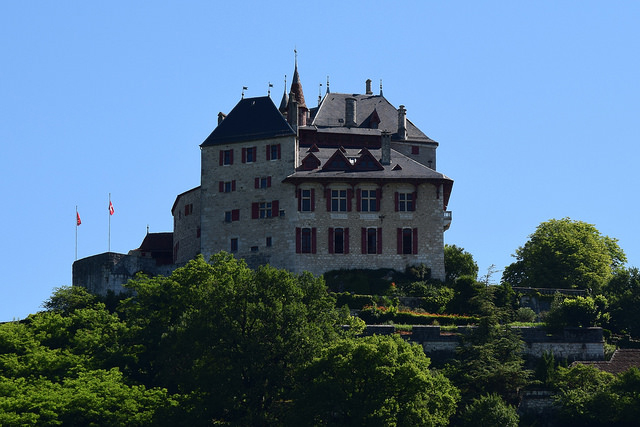
The road traverses the hillside, with the Lac d'Annecy/Talloires to the riders' right. On the D42 the race passes the Ermitage Saint-Germain.
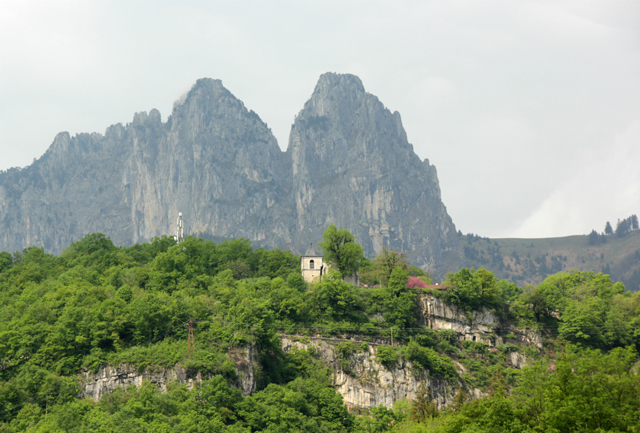
The Ermitage Saint-Germain is pictured above, with the Dents de Lanfon mountains behind. It is a church on the approximate site of the cave inhabited by Germain de Talloires, the first prior of the Abbey of Talloires, who lived as a hermit in the cave from 1033 to 1060.
Next away to the left after the Dents de Lanfon is La Tournette (2,351m).

The D42 continues steeply up to the Col de la Forclaz de Montmin.
Savoie Mont Blanc's website says of the Col de la Forclaz de Montmin:
'The Col de la Forclaz is as renowned for its difficulty as for the views overlooking Lake Annecy. What's more, its summit is often covered by a cloud of multi-coloured hang gliders and parapentes.'
The climbis 7.2km at an average gradient of 7.3%, and the route rises to 1,157m at the top of the Col de la Forclaz after82.8km raced.
The 2016 Tour de France went over three Cols de la Forclaz altogether - one on Stage 17 in Switzerland and two on Stage 19 in France.
According to Charles Marteaux in his 1918 essay on the etymology of the names of some Savoyard places, forclia or forclaz is a Savoyard dialect word which comes from the Latin furcula, meaning small fork. It signifies a passage which is quite wide to start with, and which then narrows, making a Y-shape. Forclaz can also mean two routes which join up in the mountains, forming a V.
At the top of the col there's a little ski resort called Montmin-Col de la Forclaz, with two draglifts and five pistes, which is open in winter. There's also a parapente take-off site at the Col de la Forclaz, which hosted parapente World Cup events in 2004, 2009, and 2012.

The descent of the Col de la Forclaz de Montmin is steep - a gradient of 13% in places. The road goes through the village of Montmin, and gets back down to the valley at the village of Vesonne.
From Vesonne the riders continue via La Balmette to Faverges. Next the D12 takes them through Saint-Ferréol and up to the Col du Marais (840m, uncategorised).

There's a slight descent from the Col du Marais to Thônes (601m).
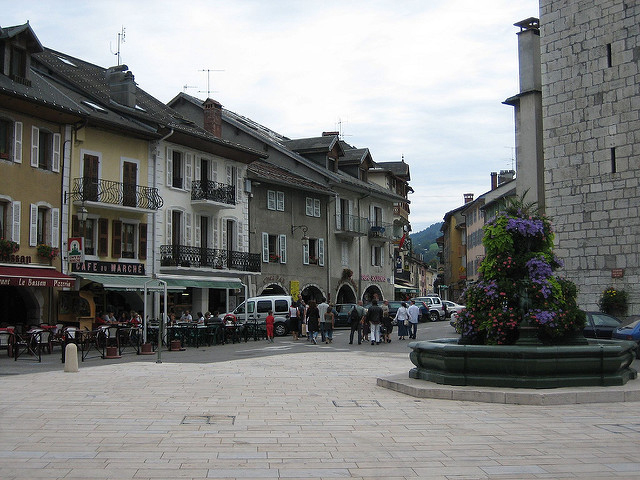
At Thônes the categorised climb of the Col de la Croix Fry (Category 1) starts.

The D16 heads up through Manigod to the Col de la Croix Fry. According to Alpine Cols, the second part of the climb is tougher than the first.
'After Manigod, you are treated to 2km at over 9%, before the road relents a little, varying between 6% and 8% all the way to the welcome café at the summit.'
Alpine Cols also have a 12-minute video of the climb.
The Tour de France organisers have this col as 11.3km at 7% average gradient. The height at the top is 1,477m, reached after 124.5km raced.
The Col de la Croix Fry is adjacent to the Massif de Manigod, part of the La Clusaz ski area - shown at the top right of the La Clusaz piste map.
The descent from the Col de la Croix Fry on the D16 is to the outskirts of La Clusaz.

Now Stage 15 takes the D909 up to the Col des Aravis.

The Col des Aravis is 4.4km at an average 5.8% to a height of 1,487m.
The top comes after 133.3km raced.
The descent from the Col des Aravis has a lot of hairpin bends. Then the road is straighter in the Gorges de l'Arondine to Flumet. Here, the race joins D1212 in the Val d'Arly.
The D1212 is fairly flat through Praz-sur-Arly.
Praz is a Savoyard variant of prés - meadows; the Arly is the river that flows here, and the root of the name is ar, running water, and ly, height.
The inhabitants of Praz-sur-Arly are called Pralins.
The first farms here appeared in the C14th. The church, of Sainte-Marie-Madeleine, dates from 1881.
Praz-sur-Arly has a ski resort, which is part of the Espace Diamant. It's also a well-known place for dog-sledding. (I think that's people on sleds being pulled along by dogs, not dogs going downhill on sledges).
There's an international hot air balloon event, les Montgolfiades de Praz-sur-Arly.
On the D1212 some of the shops have wooden carvings of bears outside.
It's about 5km from Praz-sur-Arly to Megève.

Read about Megève.
Beyond Megève is Demi-Quartier, then the road descends through Combloux.
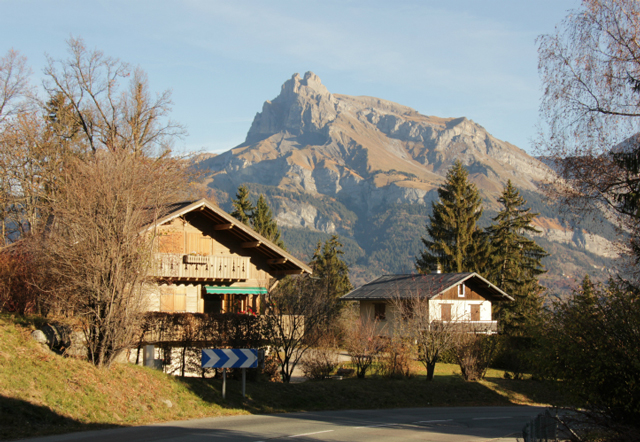
The riders will turn right down the Côte de Domancy (D199).
This was the scene of one of Bernard Hinault's triumphs, where he
dropped Baronchelli and went on to a solo victory in the 1980 World
Championships road race.
The Côte de Domancy also featured as a climb on the ITT on Stage 18 of the 2016 Tour de France; and it will be on the ITT on Stage 16 of the 2023 Tour de France.

From Domancy, the race takes the D1205 for a short distance along the Arve valley to Vervex, then it turns up to the right to begin the final climbs.

The final climbs are the Côte des Amerands and the Montée du Bettex.
From Vervex, the race goes up the route de Lardin, by the ruisseau de Vervex, to the hamlet of Les Amerands. The climb is 2.7km at an average 10.9% to the top at a height of 888m at the junction with the D909 after 170.6km raced.
Now the riders turn right on the D909 to Saint-Gervais, going over the Viaduc de Saint-Gervais.
Then it's right past the Tourist Office, right again over the Pont du Diable, and left up the rue de Mont Joly.
The riders turn left up the route d'Orsin/route du Bettex for the final 7.5km - the Montée du Bettex.
The climb is 7km at an average 7.7% gradient to the finish at 1,372m at Le Bettex, a ski village on the edge of St-Gervais Mont Blanc.
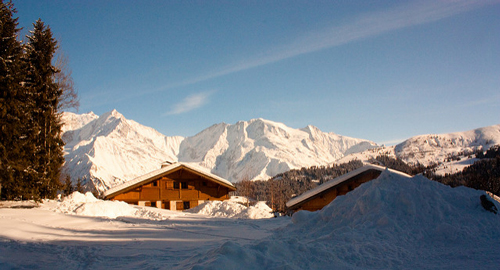
St-Gervais is the highest Commune in France and in Europe, since the summit of Mont Blanc is within its territory (although the Italians on the other side of the mountain dispute this).
The town is referred to as St-Gervais-les-Bains, or St-Gervais-Mont-Blanc. The stream or torrent running down le Val Montjoie and through St-Gervais is called le Bon Nant. The inhabitants are called St-Gervolains.
The St Gervais after whom the town is named was a Christian who was martyred together with his twin brother Protais in the reign of the Roman Emporer Nero.
Val Montjoie has been inhabited since Neolithic times. A Celtic people called the Ceutrons lived here immediately before the arrival of the Romans in the C1st AD. Val Montjoie became part of Savoie in 1355.
Hot springs were discovered at Le Fayet in 1806, and St-Gervais subsequently developed as a spa town. It is still popular with valetudinarians seeking a cure, and in 2011, a new spa area called 'les Bains du Mont Blanc' was opened.
The most popular route to the top of Mont Blanc (4810m) is from St-Gervais, on the Tramway du Mont Blanc to the Nid d'Aigle, then to the Dôme du Goûter and past the Vallot cabin and the Arête des Bosses. The route up Mont Blanc from St-Gervais is called the Voie des Cristalliers, or the Voie Royale.
Marie Paradis, the first woman to reach the summit of Mont Blanc (1808) was from St-Gervais.
St-Gervais is a ski resort, with skiing on the Mont d'Arbois, and le Prarion.
There's bungee jumping from the St-Gervais viaduct, with a 65m fall into the Gorges du Bonnant.

Stage 15 of the Tour de France 2023 is a race for climbers, but the descent of the Côte de Domancy could also provide an opportunity for a good descender to steal a march on his rivals before the two final climbs.
Romain Bardet won at Le Bettex in 2016. Now riding for DSM, could he roll back the years and do it again?
Who do you think will win Stage 15?

The Chimp Paradox was published by Dr Steve Peters in 2012 at the dawn of a golden era of British cycling.
Read a review of The Chimp Paradox.
Buy The Chimp Paradox on Amazon.

Beaujolais is a wine made with Gamay grapes in the Beaujolais region. The region gets its name from the town and Lords of Beaujeu.
Gamay grapes are thin-skinned and low in tannins. They make light wines with relatively high acidity.
The Romans were the first to plant vines here, along their trading route up the Saône valley. Later, Benedictine monks did much of the wine-making.
Beaujolais Nouveau became very popular in the 1980s, with easy-drinking, fruity wines. In the late 1990s that popularity faded, and Beaujolais producers are now concentrating on more complex wines that are aged longer in oak barrels.
Fleurie is called the Queen of Beaujolais. It has floral notes, and aromas of blueberries and red fruits.
It doesn't get its name from flowers, though, but from a Roman General, Floricum.
Fleurie vineyards are on the west side of the Saône valley, facing south or south east. The soil is on pink granite, and is sandy higher up, with more clay content lower down.
La Madone is one of the best-known Fleurie wines, taking its name from a chapel on top of the hill.
Buy a Fleurie La Madone gift set.

New in May 2023, Bike Rides in the Yorkshire Dales is available in colour paperback.
Find out more about Bike Rides in the Yorkshire Dales or buy a copy.

Bike Rides In and Around York features a historical city tour, plus family rides, road rides, and mountain bike rides.
Find out more about Bike Rides In and Around York or buy a copy.

Bike Rides in Harrogate and Nidderdale is a book of family, mountain and road bike rides.
Find out more about Bike Rides in Harrogate and Nidderdale or buy a copy.

Annecy is a historic town on the shore of Lake Annecy, in the Haute Savoie département of France. It has a population of about 52,000. It is sometimes called 'the Venice of the Alps', because two canals and the little river Thiou run through it.
There was a Roman settlement at what is now the adjacent town of Annecy-le-Vieux (not to be confused with the historic centre of Annecy, known as Vieil Annecy).
Annecy was one of the residences of the Counts of Geneva from the C10th. It passed to the counts of Savoy in 1401.
When the Protestant faith spread through the region, Annecy was a centre of the Catholic counter-Reformation. The old Bishopric of Geneva was transferred to Annecy in 1535. Francois de Sales was a celebrated bishop of Annecy from 1602 to 1622.
At the time of the French Revolution, Annecy was conquered and became part of France. It was returned to the House of Savoy after the defeat of Napoleon (1815), then became part of France for good under Napoleon III in 1860.

One of the historic buildings in the centre of Annecy is the Palais de l'Isle. It is a Medieval building which dates from around 1325, and has served as a fortress, a prison, a courthouse, and a mint. Today, it houses a local history museum.
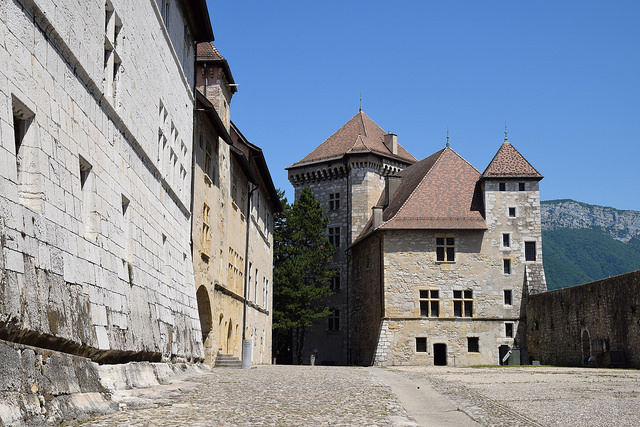
Parts of the Château d'Annecy (in particular la Tour de la Reine) date from the 1200s. The château was the home of the Counts of Geneva, and now houses l'Observatoire Régional des Lacs Alpins (Regional Observatory of Alpine Lakes).
In the 1800s, Annecy manufactured linen, glass, cutlery, and leather. Later, paper was also made here, there was a bell foundry at Annecy-le-Vieux, and Salomon skis had a factory near the lake.
Today, tourism and services are the largest part of the local economy.

Rough Guide to France.
Price £17.99 from Amazon at the time of writing.

Menthon-Saint-Bernard is a little town on the shore of Lake Annecy, just north of the Roc de Chère, and at the foot of the dents de Lanfon.
This area was in the territory of the Allobroges people, before the Romans arrived in the C2nd BC.
Saint Bernard of Menthon was born in the château here, around 923. He is famous for founding the hospices which served as refuges for travellers over the Grand and Petit Saint-Bernard passes. The dogs, which were used by the canons who ran the hospices to search for travellers lost in the snow, take their name from Bernard of Menthon. They are Saint-Bernard dogs.
The current Menthon family arrived here from Bourgogne around 1190. They are still owners of the château, which dates from the C13th. (It replaced an earlier castle).

Talloires is on the east side of Lake Annecy, below the rocky peaks of the Dents de Lanfon.
The origin of the name Talloires is unknown, but the settlement is first mentioned in documents in the 800s. In 1018, it was given by Rudolph III of Burgundy to the monks of Savigny. The first prior of the Abbey, Germain de Talloires, lived as a hermit from 1033 to 1060, in a cave above the town. The Ermitage de St Germain is built on the approximate site of the cave.
The Abbey buildings were burned by French Revolutionaries in 1792, and later rebuilt. L'Abbaye is now a hotel, which has hosted a number of well-known guests including Mark Twain, Winston Churchill, and Richard Nixon. Twain said of the two women who had the Abbey then, 'They fed us well, they slept us well, and I wish I could have staid there a few years and got a solid rest.'
The chemist Claude Louis Berthollet (1748-1822) was born in Talloires. He discovered the composition of bleach.
Paul Cézanne painted Le Lac Bleu at Talloires. The work is in the Cortauld Institute in London.


Faverges is between the Chaine des Aravis (to the north east) and the Massif des Bauges (to the south west). Immediately east of Faverges is the Dent de Cons (2064m). The Torrent de St Ruph runs down to Faverges. It becomes l'Eau Morte as it flows towards Doussard, Bout du Lac, and le Lac d'Annecy.
The name Faverges comes from the Latin fabrica. It dates from the C12th, and refers to a forge, factory, or workshop.
Before the Romans, the location belonged to the Celtic Allobroges tribe. The Romans appeared in the area in the C2nd BC, and Faverges was on the Roman route from Turin to Geneva. There was accommodation for travellers with baths (which have been excavated) at the mansio Casuaria, on the site of the present-day village of Viuz, on the edge of Faverges. Viuz comes from the Latin vicus, meaning a small town.
In the Middle Ages, Faverges belonged to Geneva, then from 1316, to the House of Savoie. Its chateau dates from the C13th. It was annexed by French Revolutionary troops in 1792. Faverges was returned to Savoie after Napoleon Bonaparte's defeat in 1814. It became part of France again in 1860, when Savoie was annexed by French Emporer Napoleon III.
Faverges has an industrial heritage dating back to the Middle Ages, with iron, copper, and cutlery manufacture in the C14th. Later, there were tanneries and paper mills, and cotton and silk production.
Industries in Faverges today include making prefabricated wooden chalets, mechanical engineering (Staubli), household appliances, and luxury goods (S T Dupont).
Thônes is a town at the junction between the Nom and Fier valleys.
It developed as an agricultural centre, with fairs and markets held from the 1300s. It was known for its resistance during World War II, especially from May 1942 onwards.
Today, the economy of Thônes is based on tourism, especially in the winter. It is still an agricultural centre too - associated with Reblochon cheese.
Reblochon originated in this area in the C13th, and it was produced in a clandestine way.
Farmers who rented fields from a landowner had to pay a sum proportionate to the amount of milk produced. On the day the landowner came to verify the quantity of milk produced, the farmer would only partly milk the cows, then finish milking after the owner had left. They made Reblochon cheese from the milk produced by the second milking.
'Reblocher' means to pinch a cow's udder again.
La Clusaz is a village and ski resort in the Aravis mountains. The name La Clusaz means 'narrow or closed valley between two mountains'. At one time, the village was called Clusa Locus Dei, or 'God's narrow place between two mountains', a name given to it by the Abbaye de Talloires, which owned La Clusaz.
The road to La Clusaz, from Annecy and Thônes, was opened in 1902, and this allowed it to become a summer and winter resort. The first cable car was built in 1956. Famous freestyle and freeride skier Candide Thovex is from La Clusaz. There's walking and mountain biking in the summer. La Clusaz hosted World Cup parapente events in 2001 and 2003.
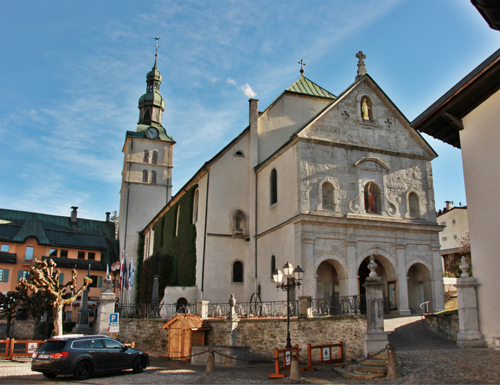
Megève is a fashionable ski resort - perhaps better known for celebrity clients and expensive restaurants than for extreme skiing. It is at an altitude of 1,113m, so not one of the higher resorts.
The name Megève comes from the Celtic Mageva, meaning village in the middle of waters. Before winter sports tourism, it was a peaceful agricultural village. The first tourists came in the C19th - pilgrims who came to visit the Stations of the Cross erected by Reverend Ambroise Martin from 1840, then tourists hoping to profit from the pure air.
The first ski competition took place in 1914. Local farmers created ski tows, and the arrival of the Rothschild family at Mont d'Arbois hastened the development of the town and ski resort. The first téléphérique was built in 1933.
Megève is known as the home town of famous skier Emile Allais, born here in 1912 (and who died in Sallanches in 2012). He learnt to ski when helping Baron Rothschild's Austrian ski instructor, as a porter. He broke a leg in 1933, while doing his military service with the chasseurs alpins, and it was then slightly shorter than the other; when he later broke the other leg, the doctor was able to make it the same length as the first.
He was the first Frenchman to win a medal in downhill skiing, and he won gold in downhill, slalom, and combined at the 1937 World Championships in Chamonix. He invented the 'French skiing method', published with Paul Gignoux at the end of 1937, and taught (in an updated version) at the French ski schools (Ecoles du Ski Francais) throughout ski resorts in France. In December 1937, he became the first French ski instructor, with medal number 1. After the Second World War, he became technical director at ENSA (Ecole Nationale de Ski et d'Alpinisme, which trains instructors). He was still skiing at the age of 100.
Amongst Megève's attractions other than skiing, there's a museum (Musée du Haut Val d'Arly); a replica of the Stations of the Cross in Jerusalem, with fifteen oratories and chapels; and plane trips from the altiport at Côte 2000.
There are also plenty of high-end shops, like A Allard. Armand Allard was a tailor in Megève from 1926, and Emile Allais asked him to create ski trousers which would be practical for competition. The result was the fuseau: tight-fitting trousers, which Allais wore when winning his gold medals in 1937.
Victor Hugo called Combloux 'the pearl of the Alps'.
It was a summer tourist destination from the 1920s, and attracted visitors for winter sports from the 1930s. Today, it has around 12,600 tourist beds. One of the summer attractions is an outdoor swimming pool which only uses aquatic plants and animals to filter and treat the water.
The ski resort is sometimes called 'Combloux 360°', because of the views in all directions to different mountain ranges. It has 100km of pistes, and is one of the cheapest resorts in Europe.
Combloux's C18th church, the Eglise Saint-Nicolas, is classed as a historic monument.
Demi-Quartier was originally a suburb of Megève, but is now a commune in its own right. Its Town Hall is in the Place de l'Eglise in Megève, though. It's unusual that the Town Hall of one commune should be in another commune.

Domancy is a village and a commune, with 1,904 people living in the commune. It has an attractive church, the Eglise Saint-André de Domancy, which dates from 1717, and has an older clock tower.
The Côte de Domancy was the scene of one of Bernard Hinault's triumphs. Here, he dropped Baronchelli, and went on to a solo victory in the road race, to become the 1980 World Champion.


