Cycling in Yorkshire

Cycling in Yorkshire
Stage
19 | Stage
20 | Stage
21

Stage 20 of the Tour de France 2023 is a 133.5km mountain stage from Belfort to Le Markstein Fellering.
This quite short day in the Vosges mountains of Alsace features 3,600m of climbing, including the Ballon d'Alsace, the Petit Ballon and the Platzerwasel.
If the GC had been very close, Stage 20 could have decided the outcome of the Tour de France 2023. As it is, Jonas Vingegaard looks to have it sewn up.
It should still be an exciting stage, with several dramas likely to play out.
Will a breakaway succeed? Can riders in the top 10 gain places? Will Pogacar record a redemptive win, or could he slip off the podium?
These are video highlights of Stage 20 Tour de France 2023.
This is the Stage 20 TDF 2023 Blog.
Race Details | Poll | Map & Profile | Timings | Videos | Food & Drink | Route Notes | Favourites
| Date | Saturday 22nd July 2023 |
|---|---|
| Stage classification | Mountain |
| Distance | 133.5km |
| Intermediate sprint | Fresse-sur-Moselle |
| Climbs | Ballon d'Alsace (Cat. 2) Col de la Croix des Moinats (Cat. 2) Col de Grosse Pierre (Cat. 2) Col de la Schlucht (Cat. 3) Petit Ballon (Cat. 1) Col du Platzerwasel (Cat. 1) |
This is a poll where you can vote for some of the main contenders to win Stage 20.
This is a map of the route of Stage 20, Tour de France 2023.

This is a zoom-able map of the route of Stage 20 Tour de France 2023.
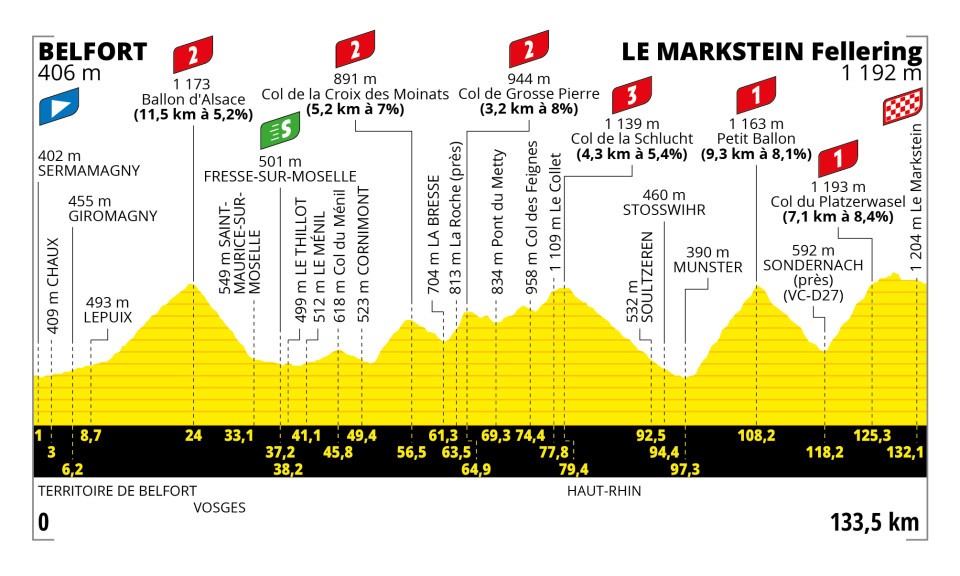
This is the profile of Stage 20 Tour de France 2023.
| Caravan | Fast Schedule | Slow Schedule | |
|---|---|---|---|
| Start Time (départ fictif) | 1130 |
1330 |
1330 |
| Start time (départ réel) |
1145 |
1345 |
1345 |
| Ballon d'Alsace Climb | 1223 |
1417 |
1420 |
| Petit Ballon Climb | 1436 |
1616 |
1632 |
| Finish Line Le Markstein Fellering (133km) | 1516 |
1654 |
1717 |
This video shows the route of Stage 20 of the 2023 Tour de France.

Stage 20 is in the Vosges, immediately west of the Rhine valley and the Haut-Rhin wine region. The grapes used to make Haut-Rhin wines are primarily Riesling, Pinot Gris, Muscat and Gewürztraminer.
Food to go with Haut-Rhin wines includes Tarte Flambée (a bit like pizza) and Pot-au-Feu (stew).
Farmhouses in the Vosges mountains will offer Alsatian sauerkraut, Roigabrageldi (potatoes with onion and bacon), Munster cheese, and blueberry pie.
Stage 20 starts in Belfort (départ fictif).

Belfort is a city of 47,000 people in north eastern France, about 25km from the Swiss border. It's on the Savoureuse river.
Belfort was part of the Austro-Hungarian Empire, but was transferred to France in 1648 at the end of the Thirty Years War.
Belfort was besieged during the Franco-Prussian War (1870-71), but remained French. It was bombarded by the Germans in World War I.
In World War II, Belfort was occupied by Nazi Germany, and liberated in November 1944.
Heavy engineering dominates the economy. Alstom, who built the first TGVs, are based in Belfort.
Belfort is twinned with Stafford (UK).
Stage 20 leaves Belfort heading north on the Avenue Jean Jaurès to the suburb of Valdoie. The départ réel is after the riders leave the built-up area, on the D5 Desserte du Pays Sous-Vosgien.
The route is then via Sermamagny, past the Aérodrome de Belfort-Chaux, and following the Savoureuse river north to Giromagny.
It continues to Lepuix and then to the first climb of the day, the Ballon d'Alsace.

The Ballon d'Alsace is 11.5km at an average 5.2%. The top is at a height of 1,173m after 24km raced.
The riders descend from le Ballon d'Alsace to Saint-Maurice-sur-Moselle, then continue down the Moselle river to Fresse-sur-Moselle and the intermediate sprint.

Skiing Made Easy is a practical guide to learning to ski based on many happy seasons of ski teaching.
It takes you through the beginner's progression from snowplough to parallel turns, starting at the very beginning and not assuming any prior knowledge.
The book suggests relevant exercises to develop and improve your skills. Common faults are identified, along with the best ways to correct them.
'By the way' sections contain information about many of the little things that people assume you just know, but you may not.
'This is the book I wish I'd had when I started skiing' - reviewer on Amazon.
How to buy:
The intermediate sprint at Fresse-sur-Moselle comes after 37.2km raced.
Fresse-sur-Moselle melds into Le Thillot.
Now the race leaves the Moselle valley and continues via le Ménil to the Col du Ménil (621m). Here they are doing the same roads as Stage 7 of the 2022 Tour de France, which was from Tomblaine to La Super Planche des Belles Filles; this time, the race goes in the opposite direction to 2022.
Top slalom skier Clément Noel is from Le Ménil, and learnt to ski at the small resort of Ventron.

The route descends to Cornimont. It gets its name from an auroch horn lost here by Charlemagne while hunting - or so the legend goes.
Now the riders climb the Col de la Croix des Moinats - 5.2km at 7%, reaching 891m after 56.5km raced.
The descent is to La Bresse, traditionally an isolated mountain village but where the local people are now involved in tourism and renewable energy. The Lac des Corbeaux is a glacial lake near La Bresse, which is used for hydro-electric power.

Climbing out of Bresse, the race heads up the Col de la Grosse Pierre.
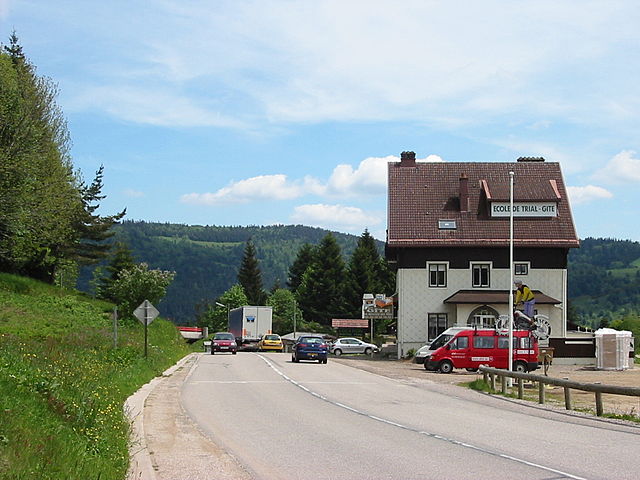
The Col de la Grosse Pierre is 3.2km at 8%, reaching a height of 944m after 64.9km raced.
From the col, there's a short descent back to the valley and the riders pass the Lac de la Ténine, followed by the larger Lac de Lispach.

Then the race continues on the D34 to the uncategorised Col des Feignes-sous-Volognes. Soon after, it picks up the D417 at Le Collet (1,109m), and heads on up to reach the Col de la Schlucht.
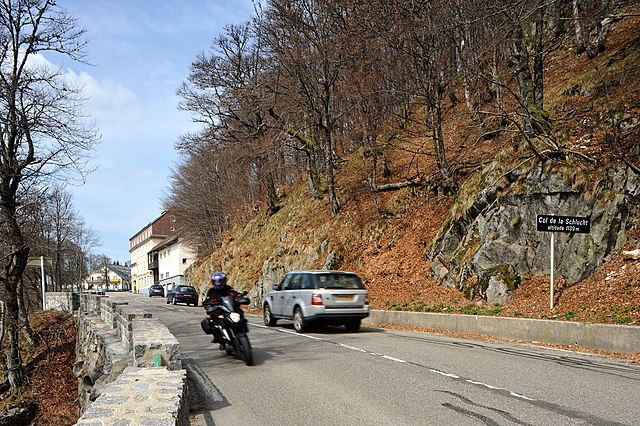
The Col de la Schlucht is 4.3km at an average 5.4%. The height at the top is 1,139m after 79.4km raced.
Now there's a long downhill to Soulzeren, and Munster (390m) in the valley of the river Fecht. Munster gets its name from a monastery that was established there in the 600s.
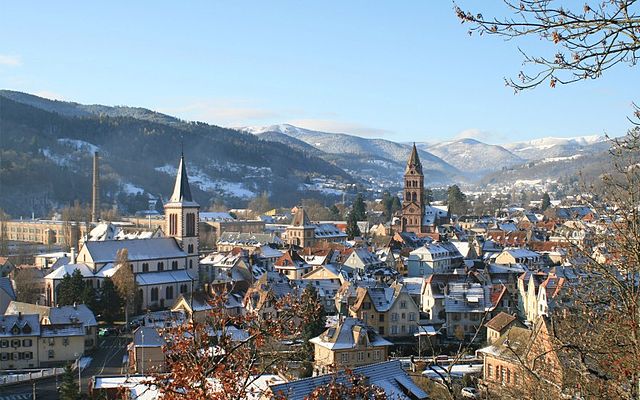
Munster is well-known for its cheese, made from unpasteurised cow's milk produced in the Vosges mountains. The cattle herders were called marcaires, and the cheese was conserved and matured in the monastery at Munster.
From Munster, the parcours is south, up the Petit Ballon.

The climb of the Petit Ballon is 9.3km at an average 8.1%, reaching 1,163m after 108.2km raced.

The descent is to Sondernach.
As soon as the downhill is finished Stage 20 heads uphill again, this time to the Col du Platzerwasel.
The climb of the Col du Platzerwasel goes past the little ski resort of Schnepfenreid. The climb details are 7.1km at 8.4%, reaching 1,193m after 125.3km raced.
There's just a little more uphill beyond the col, and a slight downhill to the finish at the ski resort of Le Markstein Fellering.

Le Markstein is a small ski resort in the Vosges mountains, on the Route des Crêtes.
It offers Alpine skiing, with 8 lifts and 10 pistes. There's a slalom stadium and the resort played host to World Cup races in the 1980s. The highest point is the Jungfraukopf.
There's cross-country skiing too, with 40km of tracked pistes. The highlight of the cross-country skiing is the Route Nordique, which links le Grand Ballon, le Markstein and le Schnepfenried.
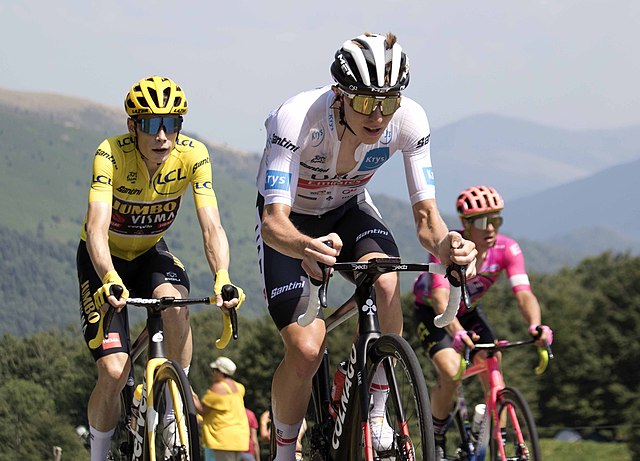
Stage 20 is the last chance for the overall contenders to move up the General Classification. That could mean cracking the top 10, getting a podium place, or grabbing the yellow jersey.
If Tadej Pogacar was on his best form, he could climb with the best then win a sprint to the line. Will be recover from his travails on Stage 17, or could he crumble again and slip off the podium?
Looking at it the other way round, Jonas Vingegaard (who isn't going to be winning any sprints) might drop his rivals on the Petit Ballon or the Col du Platzerwasel and solo to the finish.
Perhaps Felix Gall or Simon Yates will be in a break again. One of them might take the stage win and simultaneously move up on GC.
Who do you think will win Stage 20?

Tour de Force by Mark Cavendish available on Amazon.

Techalogic DC-1 dual lens helmet cam.
Price £198.95 from Amazon at the time of writing.

New in May 2023, Bike Rides in the Yorkshire Dales is available in colour paperback.
Find out more about Bike Rides in the Yorkshire Dales or buy a copy.

Bike Rides In and Around York features a historical city tour, plus family rides, road rides, and mountain bike rides.
Find out more about Bike Rides In and Around York or buy a copy.

Bike Rides in Harrogate and Nidderdale is a book of family, mountain and road bike rides.
Find out more about Bike Rides in Harrogate and Nidderdale or buy a copy.

Rough Guide to France.
Price £17.99 from Amazon at the time of writing.

Beaujolais is a wine made with Gamay grapes in the Beaujolais region. The region gets its name from the town and Lords of Beaujeu.
Gamay grapes are thin-skinned and low in tannins. They make light wines with relatively high acidity.
The Romans were the first to plant vines here, along their trading route up the Saône valley. Later, Benedictine monks did much of the wine-making.
Beaujolais Nouveau became very popular in the 1980s, with easy-drinking, fruity wines. In the late 1990s that popularity faded, and Beaujolais producers are now concentrating on more complex wines that are aged longer in oak barrels.
Fleurie is called the Queen of Beaujolais. It has floral notes, and aromas of blueberries and red fruits.
It doesn't get its name from flowers, though, but from a Roman General, Floricum.
Fleurie vineyards are on the west side of the Saône valley, facing south or south east. The soil is on pink granite, and is sandy higher up, with more clay content lower down.
La Madone is one of the best-known Fleurie wines, taking its name from a chapel on top of the hill.
Buy a Fleurie La Madone gift set.


