Cycling in Yorkshire

Cycling in Yorkshire
Stage 9 of the Tour de France 2023 is a 182.4km mountain stage from Saint-Léonard-de-Noblat to the Puy de Dôme. Christian Prudhomme says that the rugged Auvergne terrain will have taken a toll on the riders before they reach the mountain finish.
The final 13.3km is the ascent of the Puy de Dôme, with an average gradient of 7.7%. The final 4km are the steepest, at around 12%.
This could be a day for the breakaway, or the race might come back together so that the GC contenders also contest the stage win.
However it pans out, this is expected to be a highlight of the 2023 Tour. The race hasn't visited the Puy de Dôme since 1988, and after all this time we should be in for a spectacular stage finish.
These are video highlights of Stage 9 Tour de France 2023.
This is the Stage 9 TDF 2023 Blog.
Race Details | Poll | Map & Profile | Timings | Videos | Food & Drink | Route Notes | Favourites
| Date | Sunday 9th July 2023 |
|---|---|
| Stage classification | Mountain |
| Distance | 182.4km |
| Intermediate sprint | Lac de Vassivière |
| Climbs | Côte de Felletin (Cat. 4) Côte de Pontcharraud (Cat. 4) Côte de Pontaumur (Cat. 3) Puy de Dôme (HC) |
This is a map of the route of Stage 9, Tour de France 2023.
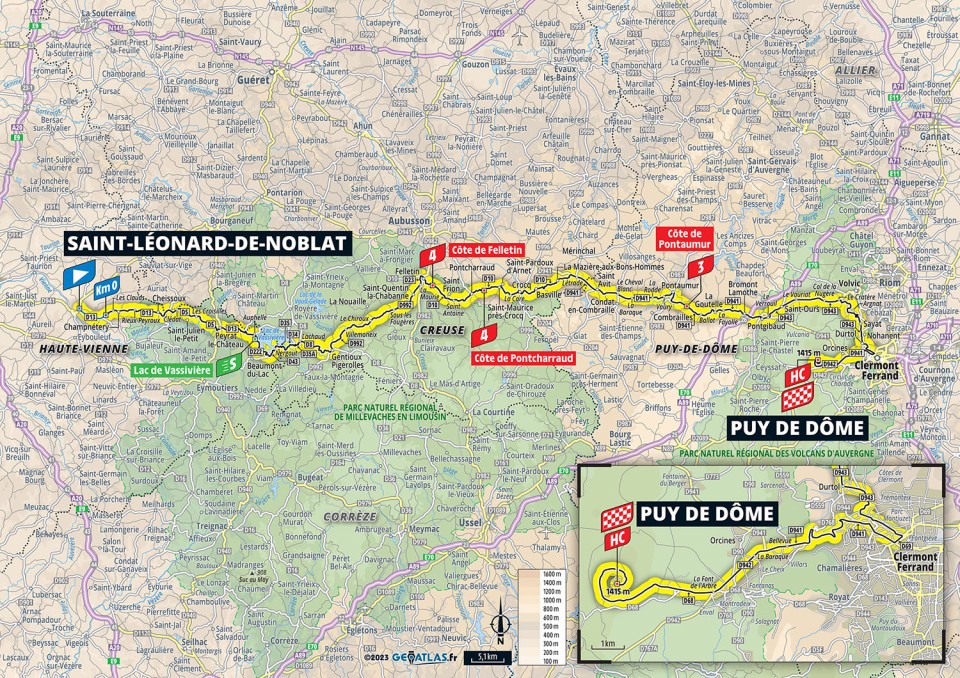
This is a zoom-able map of Stage 9 of the 2023 Tour de France.
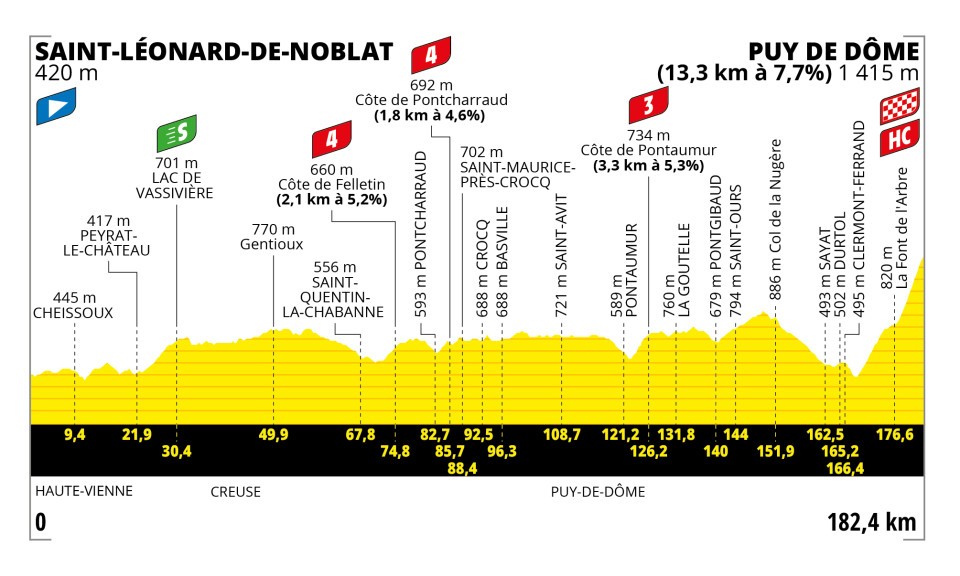
This is the profile of Stage 9 Tour de France 2023.
| Caravan | Fast Schedule | Slow Schedule | |
|---|---|---|---|
| Start Time (départ fictif) | 1130 |
1130 |
1130 |
| Start Time (départ réel) | 1145 |
1345 |
1345 |
| Lac de Vassivière | 1233 |
1428 |
1433 |
| Côte de Pontaumur Climb | 1504 |
1645 |
1704 |
| Finish Line (182.4km) | 1633 |
1805 |
1833 |
This is a video overview of the route of Stage 9 of the 2023 Tour de France.
Clermont Ferrand is hosting both the men's and the women's Tour de France in 2023. The city has made this video to mark the occasion. The video includes a clip of the battle between Anquetil and Poulidor on the Puy de Dôme in 1964.
These are video highlights of the 1986 finish at the Puy de Dome. Erich Maechler won, and the GC battle between Greg Lemonde and Bernard Hinault was finally decided in favour of the American.
This was the 1988 finish on the Puy de Dome when Johnny Weltz took the win.

The Auvergne region has produced wine since Roman times, and in the C11th had over 10,000 hectares of vineyards. It is not necessarily one of France's most celebrated wine-producing areas today, though.
Instead if you want to sample a local alcohol, why not try Gentiane? It is made with the root of the gentian plant. Génépi, made in the Alps, uses the plant itself to create a similar liqueur.
Buy a bottle of Gentiane liqueur.
The Auvergne is not renowned as one of the most famous regions of France for food and drink, but it does make some excellent cheeses. Perhaps the best-known are Cantal and Bleu d'Auvergne.
Other local blue cheeses include Rochebaron, Bleu de Chèvre (which is, as you would expect from the name, blue cheese made from goat's milk), Saint Agur, and Fourme d'Ambert.
Puy lentils, lentilles vertes du Puy, have been grown in the region for centuries. Truffade is a thick potato and cheese pancake
Stage 9 starts in Saint-Léonard-de-Noblat (départ fictif).

Saint-Léonard-de-Noblat is a town of 5,000 people, east of Limoges.
It gets its name from Saint Léonard, a hermit who may have lived in the area in the 500s, and around whose tomb the town grew. Léonard is the patron saint of prisoners.
The inhabitants of the town are called Miaulétous. This name is said to come from a red kite which nested in the bell tower of the collegiate church of St Léonard: red kites are called milans in French, and miaula in the local Limousin Occitan dialect. Another possibility is that the name comes from the Occitan diminuitive for Leonard, which would be liaunetou; it's common to invert the consonants in the local dialect, which could produce niauletou.
There was a ford here before the Roman conquest, on an important route between Bourges and Bordeaux.
St Léonard appears for the first time in a biography written in the 1000s. According to that book, he began his life at the court of King Clovis at the end of the 400s. He was granted the right to visit prisoners, and to release some of them.
He then left court, and came here to the forest of Pauvain to live as a hermit. He built a chapel, and on his death he was buried there. The chapel became a place of pilgrimmage, and amongst the pilgrims who visited it was Richard the Lionheart.
The story of St Léonard may not have a sound historical basis, but the town which bears his name grew here, and a bridge was built on the site of the earlier ford of the river. Around the year 1000, a first castle was built. The town became an important stop on the route of the pilgrimmage to Santiago de Compostela. Town walls were constructed in the 1100s.
In the 1500s and 1600s, convents were founded in Saint-Léonard-de-Noblat, as well as brotherhoods of 'penitents'.
As at Limoges, porcelain was made here. Other traditional trades and industries include making massepains (a type of macaroon), leather-work for shoes, and paper mills.

One of the main sights is the collegiate church of Saint-Léonard, which dates from the 1000s, and is in the Limousin Romanesque style. The pont Noblat, over the river Vienne, dates from the 1200s.

There's a museum dedicated to chemist Gay-Lussac, and a railway museum.
The reason the Tour de France visits Saint-Léonard-de-Noblat regularly is because it was the adopted home of Raymond Poulidor.
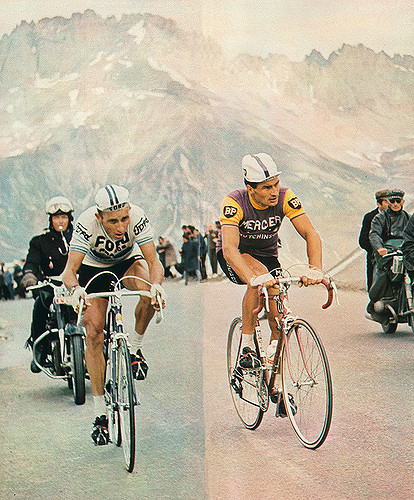
Raymond Poulidor (15th April 1936 to 13th November 2019) was born into a farming family in the Limousin. He wasn't born in Saint-Léonard, but it was his adopted home.
As a bike rider, he was nicknamed Pou-Pou. He was French national champion in 1961, and he made the podium of the Tour de France on eight occasions, although he never won it. He finished second three times and third five times.
His big rivalry was with Jacques Anquetil. Anquetil was a stronger individual time triallist than Poulidor. Although Poulidor didn't beat Anquetil in the Tour de France, he was more popular with the French public - he had greater Poupoularité.
In later life Poulidor was often to be found on the local mountain bike trails, or doing his shopping in town, and the Miaulétous generally didn't bother him.
Poulidor's daughter Corinne married Adri van der Poel, and their son Mathieu is quite good at cycling.
The neutralised section starts from Avenue du Champs de Mars and takes Rue de Strasbourg and the D13 Avenue Raymond Poulidor, heading south east out of town.
The D13 becomes the Route des Minerais then the Route de Lifarnais. The départ réel is on the Route de Lifarnais near Lartige Est.
As an overview of Stage 9, it goes east, first into the Parc Naturel Régional de Millevaches en Limousin, then to the Parc Naturel Régional des Volcans d'Auvergne.
Leaving Saint-Léonard-de-Noblat, the riders head via Champnétery to Peyrat-le-Château. The maquisards, or French Résistance, were active in this area, and there is a Musée de la Résistance in the castle.

Next the route of Stage 9 passes the Lac de Vassivière.

How to Write a Kindle Ebook is a step by step guide to writing and publishing an ebook on Amazon.
It takes you through the process of writing and formatting it using Microsoft Word, then uploading it to Kindle Direct Publishing and selling it on Amazon.
There's advice and guidance at every stage, with examples including screenshots, and tips on how to overcome practical problems you're likely to encounter.
How to Write a Kindle Ebook will be your reliable and trusted companion as you write and publish your own book.
'I find this a really helpful and informative guide to e-book writing and recommend to others' - reviewer on Amazon.
Buy the ebook or the paperback on Amazon.

The Lac de Vassivière is a man-made reservoir on the Plateau de Millevaches covering 10km2. That makes it the 16th biggest lake in France. It was built after World War II as part of a hydro-electric project by damming the Maulde river. It opened in 1950.
The Isle de Vassivière is connected to the shore by a causeway. It has a château.
The Plateau de Millevaches includes peat bog, wetland, heath and forest.
The intermediate sprint takes place at the Lac de Vassivière after 30.4km raced.
Leaving the lake behind, the race reaches Gentioux-Pigerolles, where there is cross-country skiing in Winter. Then it's on to Felletin.

Felletin is known for producing Aubusson tapestry (named after the nearby town of Aubusson). The craft dates back to the 1300s. The tradition is kept going in modern times by the Ateliers Pinton, which produce tapestries, rugs and carpets to order. They made the largest tapestry in the world, Christ in Glory, for Coventry Cathedral.
Leaving Felletin, the riders tackle the first categorised climb of the stage. It's the Côte de Felletin.
The climb is 2.1km at an average 5.2%, to a height of 660m at the top after 74.8km raced.
The race descends to Poncharraud, on the Rozeille river. Now the next categorised climb begins.
Leaving Pontcharaud, it's uphill. The Côte de Pontcharraud is 1.8km at an average 4.6% to a height of 692m at the top after 85.7km raced.
Now Stage 9 continues to Saint-Maurice-près-Crocq, and to Crocq where there's a castle from the 1100s and an impressive oil-press.

(I do appreciate that an oil press is not an A-list tourist attraction like the Sistine Chapel or the Eiffel Tower. On the other hand, if we didn't all crowd into just a few 'official' tourist attractions but instead spread ourselves out more evenly, we might all have a nicer time).
The riders head via Basville, La Mazière-aux-Bons-Hommes and Saint-Avit to Pontaumur. Now we get the next categorised climb, the Côte de Pontaumur.
The Côte de Pontaumur is 3.3km at an average 5.3%, to a height of 734m at the top after 126.2km raced.
The race continues via La Goutelle and Bromont-Lamothe to Pontgibaud.

The castle at Pontgibaud was built in the 1100s, modified in the 1400s, and restored in the 1800s.
It is called the Château-Dauphin because it was originally built by Robert I, Dauphin of the Auvergne. It is currently owned by Count and Countess Gabriel de Germiny.
Then it's uphill on the way to Saint-Ours (794m) as the race approaches the Puys of the volcanic region.
The Col de Nugère is uncategorised, but at a height of 886m (according to the Tour de France profile). This is the high-point of the race so far.

Now there's a long downhill. The race pasess close to Volvic, known for its mineral water. Mind you, we need to stop putting water into plastic bottles and shipping it around the world.
The race route edges around Argnat, Sayat and Nohanent, reaching Durtol on the edge of Clerment-Ferrand.
The riders take the Avenue de Clermont/Avenue du Limousin/Rue de Durtol to reach Boulevard Lavoisier on the edge of the city.
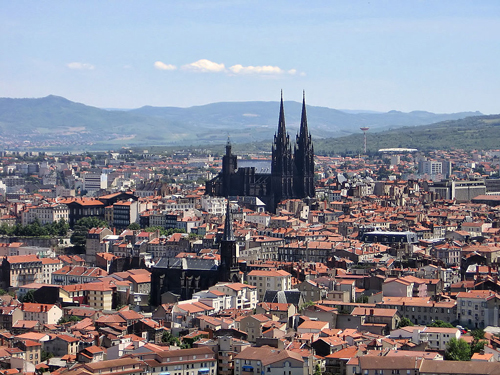
Clermont-Ferrand is a city of 147,000 people. It is the capital of the Puy-de-Dôme département.
It is surrounded by a chain of volcanoes, the Chaîne des Puys, including the Puy de Dôme.
It was known by the ancient Greeks as the capital of the Avernie tribe. In the C1st BC it developed as a Gallo-Roman settlement under the name Augustonemetum. The Roman forum was on Clermont mound, the site of the present-day black lava stone Cathedral.
Clermont suffered Barbarian attacks as the Roman Empire crumbled in the 300s and 400s AD. Later, there were Viking raids in the 800s as Charlemagne's Empire weakened.
Clermont was the starting-point of the First Crusade, in which Christendom sought to free Jerusalem from Muslim domination. Pope Urban II preached the Crusade in 1095 at the Second Council of Clermont.
The 'Ferrand' part of Clermont-Ferrand came out of disputes between the Counts of Auvergne and the Bishops of Clermont. The Counts founded a rival city to Clermont on a mound next to Clermont's walls; they called it Montferrand.
Clermont and Montferrand were joined as one city, Clermont-Ferrand, by edict in 1630.
Clermont-Ferrand is home to tyre company Michelin.
In 2023 Clermont-Ferrand hosts both the men's and the women's Tour de France.
Then they leave Clermont-Ferrand on Avenue Raymond Bergougnan/Avenue du Puy de Dome, heading for the Puy de Dôme.
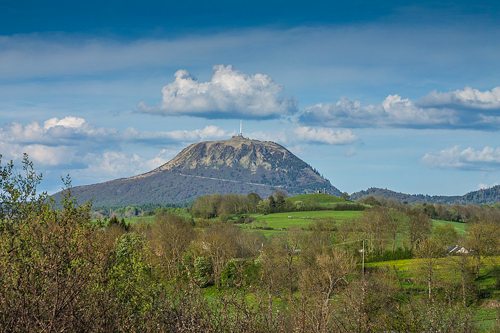
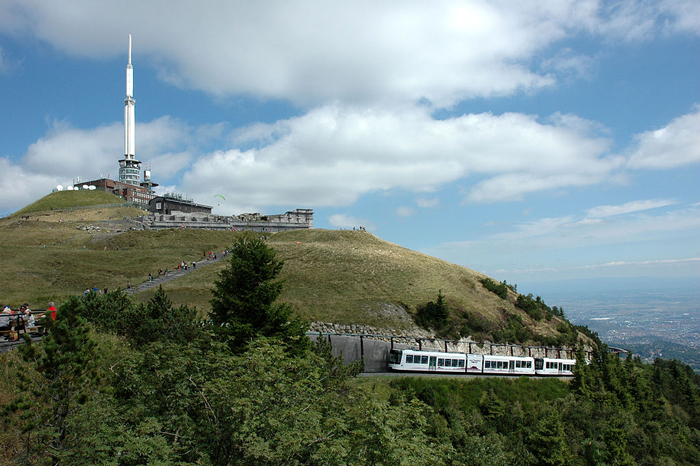
The Puy de Dôme is a lava dome. It is one of the younger volcanoes in the Chaîne des Puys, created by an eruption 10,700 years ago.
There was a Gallo-Roman temple of Mercury on the Puy de Dôme.
In 1648, Florin Périer measured the height of a column of mercury at three elevations on the Puy de Dôme, to help demonstrate the theory behind air pressure and barometers.
In 1875, a physics lab was built at the summit of the volcano, and in 1956 a TV antenna was added.
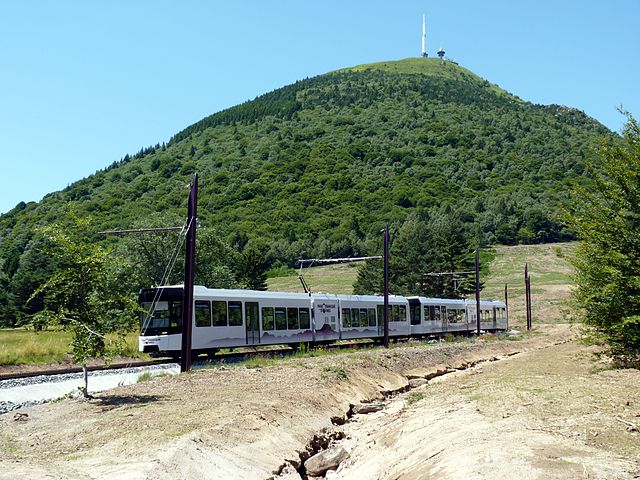
There are two paths up the Puy de Dôme, and since 2012 there is a rail option: the Panoramique des Dômes rack railway goes most of the way to the summit. The road next to the railway is closed to general traffic.
The first ascent of the Puy de Dôme on a bicycle was by Fernand Ladoux in 1892.
Fausto Coppi won on the Puy de Dôme in 1952.
Perhaps the most famous Tour de France ascent of the Puy de Dôme was the 1964 battle between Jacques Anquetil and Raymond Poulidor. Poulidor won, but didn't do enough to overtake Anquetil in the General Classification.
Luis Ocana won twice on the Puy de Dôme, in 1971 and 1973.
A well-known episode took place in 1975, when Eddy Merckx was punched in the kidney by a spectator.
In both 1976 and 1978, Dutchman Joop Zoetemelk won on the Puy de Dôme.
Before 2023, the last Tour de France ascent of the Puy de Dôme was in 1988, a stage won by Johnny Weltz. Pedro Delgado was in yellow.
This is the profile of the Puy de Dôme climb.

The climb is 13.3km at an average 7.7%. The last 4km are the steepest, with a gradient of around 12%, so it really will be a test of climbing ability.

Stage 9 of the Tour de France 2023 will be tough.
There are two scenarios - a breakaway group fights for the win, or the race comes back together and the GC favourites battle it out for the stage.
If the breakaway wins, that could mean Simon Geschke, Lilian Calmejane, Hugo Houle, or Michael Woods.
Perhaps the more likely scenario is that only the best climbers are left to battle it out.
They are likely to be Jonas Vingegaard and Tadej Pogacar, perhaps with Jai Hindley, Ben O'Connor, David Gaudu, Egan Bernal, Guillaume Martin, Mikel Landa, Romain Bardet, Felix Gall, Thibaut Pinot and Mattias Skjelmose hanging onto their coat tails.
If Simon Yates is on form, he could be a candidate for the win too.
Finally, Giulio Ciccone did very well in winning the final stage of the Dauphiné up to La Bastille in Grenoble. The Puy de Dome is a similar climb, but at another level of difficulty.
Who do you think will win Stage 9?
Mountains According to G. £8.59 in paperback on Amazon at the time of writing.

Techalogic DC-1 dual lens helmet cam.
Price £198.95 from Amazon at the time of writing.

Best Canoe Trips in the South of France.

New in May 2023, Bike Rides in the Yorkshire Dales is available in colour paperback.
Find out more about Bike Rides in the Yorkshire Dales or buy a copy.

Bike Rides In and Around York features a historical city tour, plus family rides, road rides, and mountain bike rides.
Find out more about Bike Rides In and Around York or buy a copy.

Bike Rides in Harrogate and Nidderdale is a book of family, mountain and road bike rides.
Find out more about Bike Rides in Harrogate and Nidderdale or buy a copy.
This page includes some affiliate links. If you click and buy a product, Hedgehog Cycling may receive a small commission.
This can help cover my costs; overall, running this cycling website is not a lucrative business.


