Cycling in Yorkshire & Beyond

Cycling in Yorkshire & Beyond

Stage 21 of the Tour de France 2026 is a 133km flat stage from Thoiry to Paris.
It finishes with two Paris circuits, one just on the Champs-Elysées, and the other including a climb at Montmartre and the Champs-Elysées.
The race organisers think they have found a balance between the interests of the puncheurs and climbers, and those of the sprinters.
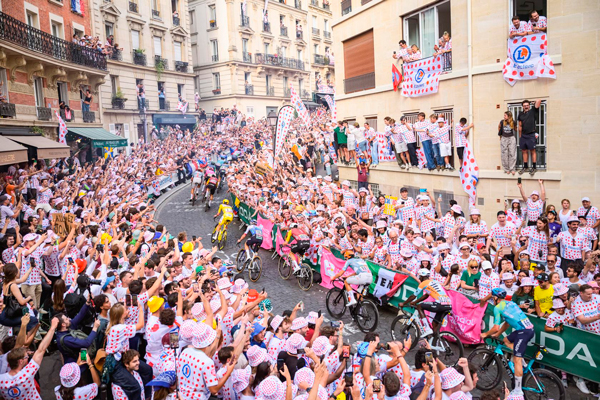
This is the race report for Stage 21 Tour de France 2026.
These are video highlights of Stage 21.
Race Details | Poll | Map & Profile | Timings | Videos | Food & Drink | Route Notes | Favourites
| Date | Sunday 26th July 2026 |
|---|---|
| Stage classification | Flat |
| Distance | 133km |
| Intermediate sprint | Paris Haut des Champs-Elysées |
| Climbs | Côte du Pavé des Gardes (Cat. 4) Côte de la Butte Montmartre (Cat. 4) x3 |
| Total climbing | 1,000m |
Vote for one of the main contenders to win Stage 21.
This is a map of the route of Stage 21 Tour de France 2026.
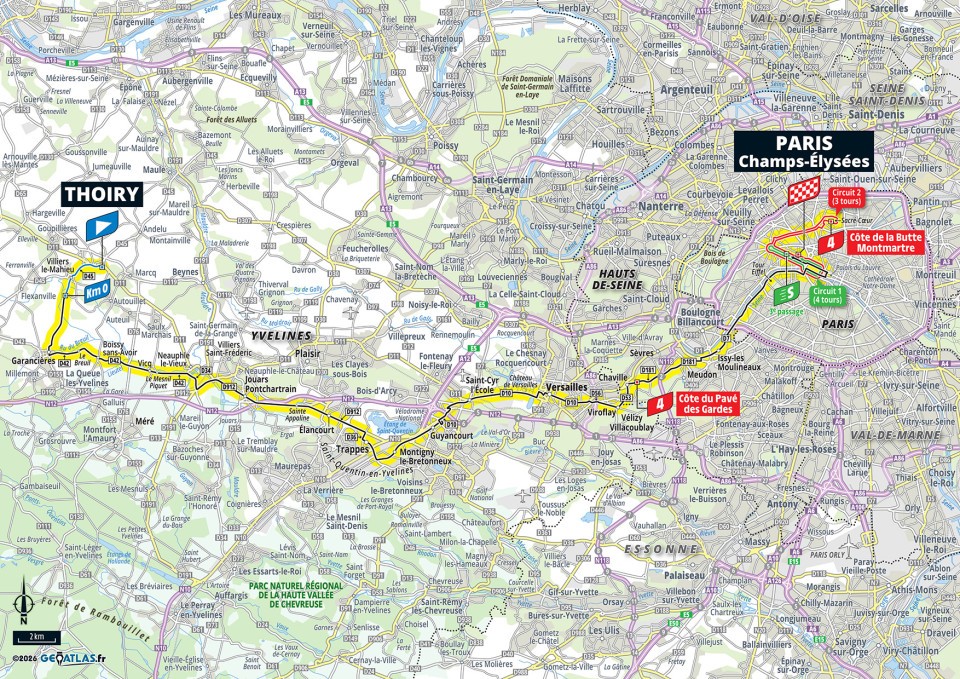
This is a zoom-able map of Stage 21 Tour de France 2026.
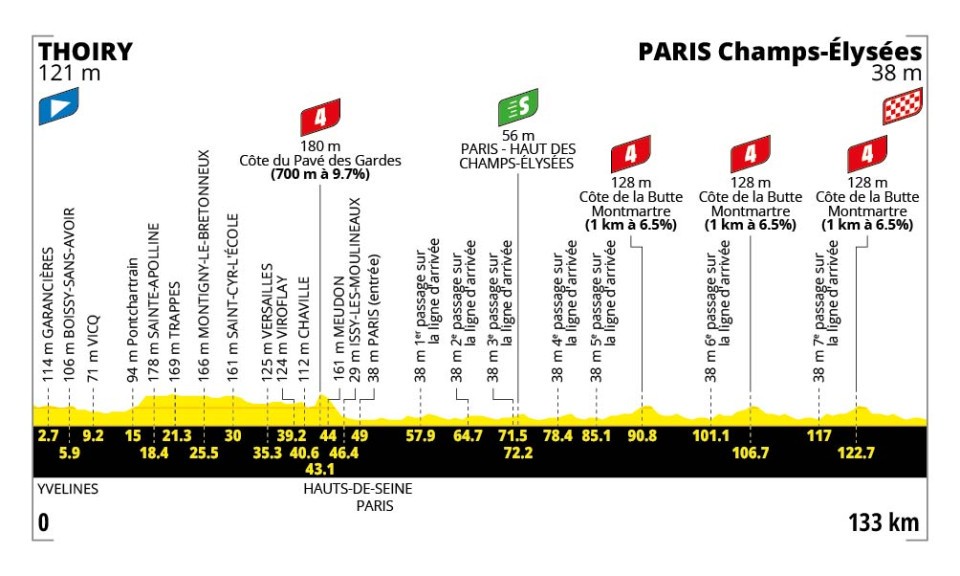
This is the profile of Stage 21 Tour de France 2026.
| Caravan | Fast Schedule | Slow Schedule | |
|---|---|---|---|
| Start Time (départ fictif) | 1350 |
1615 |
1615 |
| Start Time (départ réel) | 1400 |
1625 |
1625 |
| Côte du Pavé des Gardes Climb | 1518 |
1741 |
1751 |
| Intermediate Sprint | 1611 |
1820 |
1834 |
| Côte de la Butte Montmartre Climb | 1645 1712 1741 |
1845 1901 1919 |
1901 1919 1938 |
| Finish Line (133km) | 1800 |
1930 |
1950 |
Get the official Tour de France 2026 Race Guide.
The fully authorised guide includes detailed stage maps, team profiles, expert analysis and stunning photography.
Available in Standard and Premium Editions.

Get a bundle with the premium race guide, Cycling Plus Ride Like a Pro, plus socks, coasters and an allen key, for £26.38.

This is a video of the route of Stage 21 Tour de France 2026.
These are highlights of Stage 21 of the 2025 edition of the Tour.

In considering what food and drink should accompany Stage 21, let's
start with breakfast. The baguette is based on Viennese
bread, adopted in Paris in the 1800s. Similarly, the croissant
is a Viennese pastry made in Austrian bakeries that opened in Paris
in the 1830s.
Cheeses from the Parisian region are mainly bries, for example from Meaux or Melun.
The Opéra is a cake created by a Parisian pastry chef in 1955. It has layers of sponge and coffee-flavoured cream and ganache, and is topped with chocolate. The chef's wife thought it looked a bit like the stage of the Opéra Garnier in Paris, hence its name.
Macarons are also associated with Paris. Honey is made in Paris by bees in hives on roofs - for example on the roof of the Musée d'Orsay.
There's a thriving beer-making scene in Paris.
Since it's the last day of the 2026 Tour de France, champagne is in order - albeit the riders will probably settle for pizza and beer.
The stage starts in Thoiry (départ fictif).
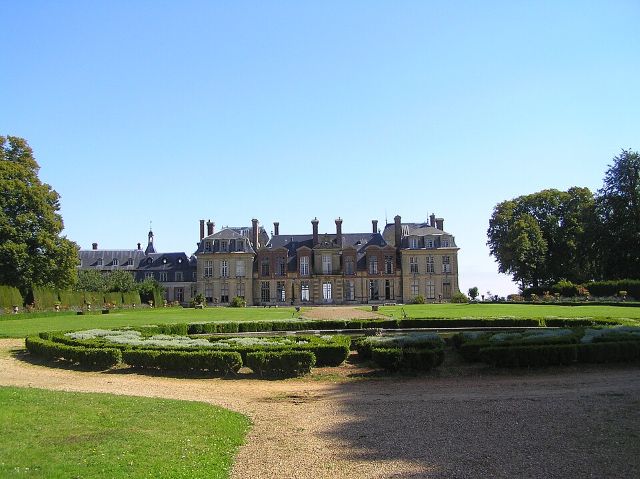
Stage 21 starts in Thoiry, where Stage 2 of Paris-Nice 2024 began.
It has the Château de Thoiry, which dates from the 1500s and features gardens with a maze and a safari park. The house is owned by the Counts of La Panouse.
The départ réel is south of Thoiry at Garancières.
The riders set off on the minor D42 to Boissy-sans-Avoir. They join the D912 at Jouars-Pontchartrain.
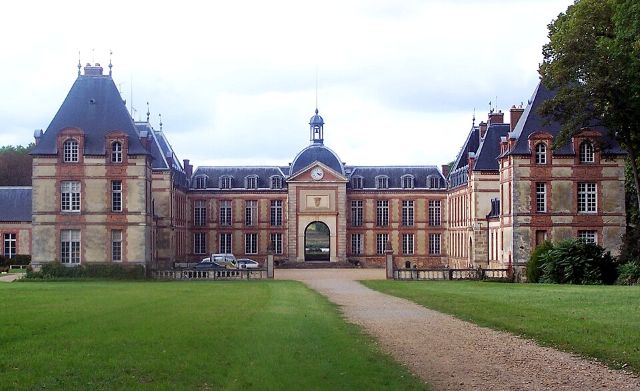
The race continues on the D134 through the Forêt de Sainte-Apolline and to Trappes.
Next the riders pick up the D10 to Saint-Cyr-l'Ecole and pass the Château or Palais de Versailles.

The Palais de Versailles is much too big. It was built by a king with an oversized ego and it is furnished and decorated in horrendous taste.
It's far too busy, and if you visit you'll spend all your time either queuing up or jostling with thousands of other people on the way round part of the house. There is a distinct smell of stale pee in most of the rooms.
Don't let me put you off visiting the gardens, though. You can hire a rowing boat or a bike, or you can bring your own bike and ride round. The sorbet ice creams are very nice too. Finally, on certain days the original fountains play - although that also generates an odour.
Versailles started off as Louis XIII's hunting lodge.
Louis XIV was inspired to create a palace at Versailles by a visit to finance minister Nicolas Fouquet's residence at Vaux-le-Vicomte. The King accused Fouquet of corruption and had him arrested, then got to work turning Versailles into a huge palace between 1661 and 1715. He used Fouquet's team of Le Vau (architect), Le Nôtre (landscape gardener) and Le Brun (painter).
Louis wanted his court and nobles to live at Versailles, so he could keep an eye on them and prevent any plotting. That's why it had to be so big.
Louis XVI was at Versailles when the French Revolution started. He was marched back to Paris and forced to live in the city, initially in the Tuileries palace, instead of out in the countryside.
Napoléon Bonaparte began the process of turning Versailles into a museum, and under Louis-Philippe in the 1830s it was designated as a Museum of the History of France.
The Treaty of Versailles that formally ended hostilities in World War I was signed in the Hall of Mirrors.
These days, other than being a giant tourist attraction, foreign heads of state are sometimes received at Versailles.
From the Palais de Versailles, Stage 21 is on the D10 Avenue de Paris, then makes its way to Chaville.
After Chaville, the D181 is called la Route du Pavé des Gardes and it heads up into Meudon Forest.
This is the Côte du Pavé des Gardes climb and it's 700m at an average gradient of 9.7%. The top is at 180m above sea level.
KOM competition: 1 point for 1st place.
Unless the King of the Mountains competition is unusually close after all the real climbs on the other stages, the Côte du Pavé des Gardes is unlikley to be significant.
Next on the race route is Meudon, where a branch of the Paris Observatory was founded in the ruins of the old Château de Meudon.

Reaching the river Seine, the race passes the Parc de l'Ile Saint-Germain and the Parc Omnisport Suzanne Lenglen.
It makes its way along the left bank of the river Seine on Quai André Citroën and Quai de Grenelle towards the Eiffel Tower. The road at the Eiffel Tower itself is now named after that old rogue Jacques Chirac.

The race continues along the Quai d'Orsay until it reaches the Pont de la Concorde. Here it crosses the river to Place de la Concorde.

Stage 21 continues between the Seine and the Jardin des Tuileries, going past the Louvre before turning left on the Rue de l'Amiral de Coligny. It goes left again, into the Cour Carrée of the Louvre, past the glass pyramid, and out onto Rue de Rivoli.
In recent years, even more than the rest of Paris, Rue du Rivoli has been transformed by Mayor Anne Hidalgo into a utility cycling paradise.
Here Stage 21 joins Circuit 1.
How to Write a Kindle Ebook is a step by step guide to writing and publishing an ebook on Amazon.
It takes you through the process of writing and formatting it using Microsoft Word, then uploading it to Kindle Direct Publishing and selling it on Amazon.
There's advice and guidance at every stage, with examples including screenshots, and tips on how to overcome practical problems you're likely to encounter.
How to Write a Kindle Ebook will be your reliable and trusted companion as you write and publish your own book.
'I find this a really helpful and informative guide to e-book writing and recommend to others' - reviewer on Amazon.
Buy the ebook or the paperback on Amazon (affiliate links).

Circuit 1 is three laps up and down the Champs-Elysées, turning around the Arc de Triomphe at the top - the normal route for a final stage of the Tour de France.
The intermediate sprint is on the Champs-Elysées by the junction with Rue Lincoln. It is just after the third time the peloton crosses the finish line and comes with 72.2km raced.
Green jersey competition: from 20 points for 1st place down to 1 point for 15th place.

The Champs-Elysées is the most famous street in Paris.
It runs for 1.2 miles from place de la Concorde to the Arc de Triomphe at Charles de Gaulle Etoile.
The lower part of the Champs-Elysées was originally laid out by André le Nôtre as an extension of Tuileries gardens in 1667.
The street was extended from Rond-Point up to Etoile under Napoléon Bonaparte. The Arc de Triomphe was commissioned by Bonaparte but not completed until after his fall from power in 1815. The Champs-Elysées was remodelled under Emporer Napoléon III from 1854.
The Bastille Day parade takes place here every year.
There are eight traffic lanes on the Champs-Elysées, and it is very polluted. In 2021 Mayor Anne Hidalgo announced plans to cut space for motor vehicles by 50%, create 'tree tunnels' to improve air quality, and to give more space to pedestrians.
The work was postponed until after the 2024 Olympic Games, and won't be completed until 2030.
The riders then take on Circuit 2.
Circuit 2 involves striking out from the Arc de Triomphe towards Montmartre, notably going up Rue Lepic to the Butte Montmartre, and past the Sacré Coeur Cathedral, then coming back and doing a lap of the Champs-Elysées.
The race does the Montmartre circuit three times.
Because it was a success in 2025, a decision has been made to include the climb at Montmartre to the Sacré-Coeur Cathedral in the Stage 21 parcours.
This route was originally inspired by the road races at the 2024 Paris Olympics, when enthusiastic crowds of half a million people lined that part of the route, cheering on the competitors.
In 2025 the race organisers said, 'To mark the 50th anniversary of the first finish on the Champs-Elysées, and one year after the excitement and cheers of the Paris 2024 Olympic road race, the peloton will return to the capital on a route that passes through the heights of Montmartre'.
The Category 4 Côte de la Butte Montmartre, which is 1km at 6.5%.
KOM competition: 1 point for 1st place each time.
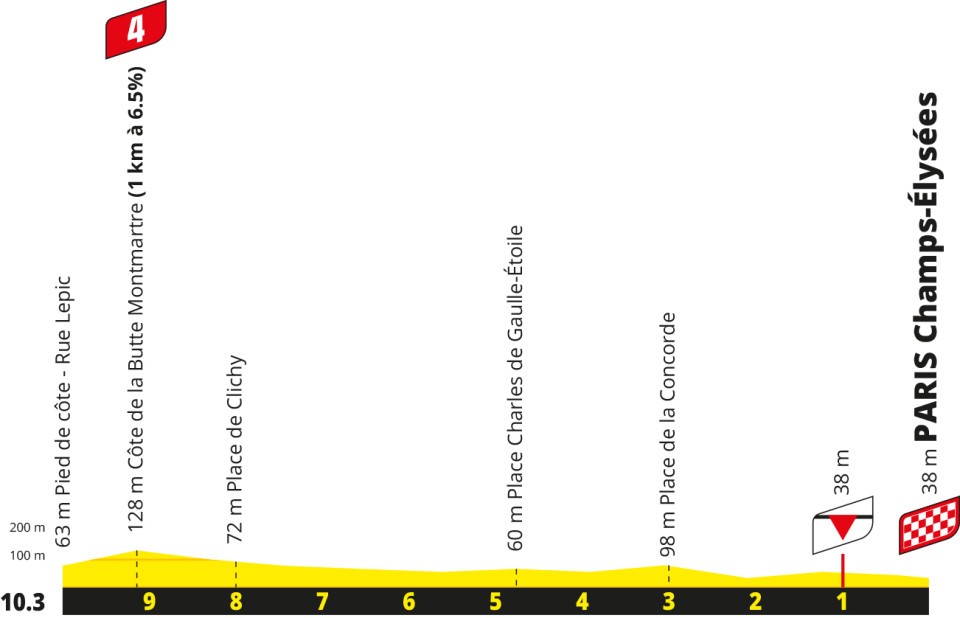
Stage 21 finishes on the Champs-Elysées in Paris.
After doing Circuit 2 three times, it's once more down and part-way up the Champs-Elysées to the finish line.
The graphic above shows the last 10.3km of the parcours.
In past years (other than 2024 in Nice and 2025 that included the Butte de Montmartre), Stage 21 has been one for pure sprinters. For example, two of them battled it out in 2023 - Jasper Philipsen and Jordi Meeus.
In 2025, Wout van Aert broke away in Montmartre and won the stage solo, but the Belgian is out of the 2026 Tour de France with an injury.
In 2026, the race organisers have tweaked the finishing circuits so as to balance the interests of puncheurs who could make a break at Montmartre, and sprinters who would like to win on the Champs-Elysées.#
Perhaps Olav Kooij (Decathlon) could get a prestigious Paris victory this time.
Who do you think will win Stage 21 of the 2026 Tour de France?

Coldplay 4 CD Catalogue Set, price £15.99 from Amazon at the time of writing (affiliate link).
As an Amazon Associate, I earn from qualifying purchases.

Bike Rides in the Yorkshire Dales is available in colour paperback.
Find out more about Bike Rides in the Yorkshire Dales or buy a copy.

Bike Rides In and Around York features a historical city tour, plus family rides, road rides, and mountain bike rides.
Find out more about Bike Rides In and Around York or buy a copy.

Bike Rides in Harrogate and Nidderdale is a book of family, mountain and road bike rides.
Find out more about Bike Rides in Harrogate and Nidderdale or buy a copy.

Find out more about Mountain Bike Rides in the Yorkshire Dales.
Buy Mountain Bike Rides in the Yorkshire Dales at £8 + P&P.

Garmin Edge Explore, £197.99 at the time of writing.
Garmin Edge Explore on Amazon (affiliate link).

Faster by Michael Hutchinson on Amazon (affiliate link).


